

Yes, Colorado investors can defer capital gains taxes with a properly executed 1031 exchange on qualifying investment real estate. You must hire a Colorado-savvy Qualified Intermediary before closing, identify replacement property within 45 days, and close within 180 days. Colorado also layers on its own reporting and bonding expectations, so start the conversation with a CPA or QI before you sign a listing agreement.
TL;DR:
- Colorado requires using a qualified intermediary and strict adherence to 45-day identification and 180-day closing deadlines for a valid 1031 exchange.
- Properly filing Colorado forms, such as DR 1305 and DR 1083, and understanding bonding rules are essential to avoid delays and complications.
- Identifying replacement properties with backup options and tracking your documentation reduces the risk of disqualification due to missed deadlines or procedural errors.
- The exchange's value and debt must match to avoid taxable boot, and any recognized gain is taxed at the Colorado flat state rate upon sale.
- Out-of-state investors benefit from local real estate professionals to coordinate timelines, paperwork, and replacement property searches within the tight Colorado mountain market schedule.
Table of Contents
- What Is a 1031 Exchange in Colorado?
- Step-by-Step: How a Delayed 1031 Exchange Works
- Colorado-Specific Rules, Forms, and Reporting
- How to Choose and Vet a Qualified Intermediary in Colorado
- Identification Rules and the Deadlines That Trip People Up
- Mistakes That Disqualify an Exchange
- Reporting the Exchange and Understanding Boot
- When a 1031 Exchange Isn't the Right Move
- Local Help for Summit County Investors Planning a 1031 Exchange
- Sources
- FAQ
What Is a 1031 Exchange in Colorado?
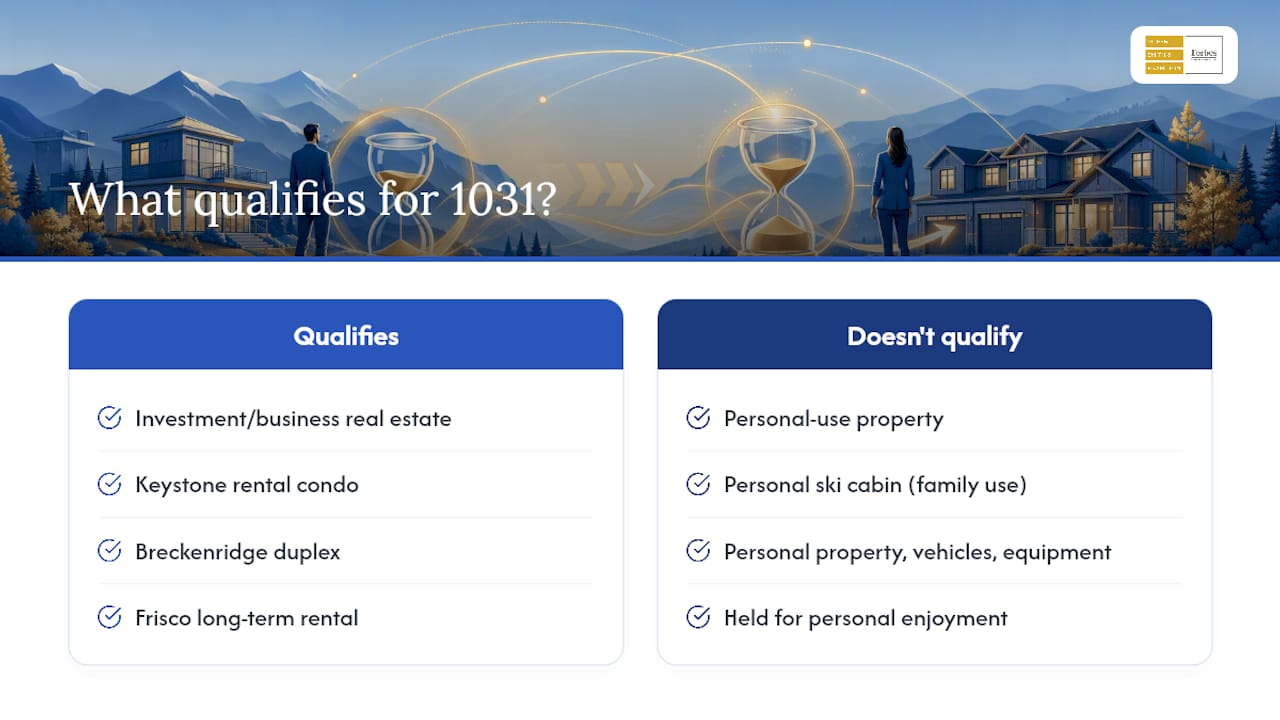
A 1031 exchange lets you sell investment or business real estate and roll the proceeds into a new property without paying capital gains tax at the time of sale. The mechanism comes directly from 26 U.S.C. §1031, which allows no gain or loss to be recognized on qualifying real property exchanges, provided you meet strict identification and completion timelines. Since 2018, only real property qualifies. Personal property, vehicles, and equipment no longer count, a change confirmed in the IRS's guidance on like-kind exchanges.
For a Summit County owner, that means a Keystone rental condo can trade into a Breckenridge duplex or a Frisco long-term rental, but a personal ski cabin you and your family use every winter generally will not qualify unless it's held for investment purposes. The property has to be held for productive use in a trade, business, or investment, not personal enjoyment.
Step-by-Step: How a Delayed 1031 Exchange Works
Most Colorado investors use a delayed, or "forward," exchange. The property sells first, then the replacement gets purchased within the deadline window. Here's the sequence:
- Hire your Qualified Intermediary before you close. The QI holds your sale proceeds and prepares the exchange agreement. Waiting until after closing disqualifies the entire exchange.
- Close on the relinquished property. Proceeds go directly to the QI, never to you. This closing date is day zero for both the 45-day and 180-day clocks.
- Submit written identification of replacement properties to your QI by day 45. Verbal mentions or casual emails to your agent don't count.
- Close on at least one identified property by day 180. The QI releases funds directly to the closing.
- Match value and debt to avoid boot. If your new property has less value or less debt than what you sold, the difference is often taxable.
Pro Tip: Always identify at least one backup property, even if your top choice looks like a sure thing. A Breckenridge condo deal falling through in escrow shouldn't cost you the entire exchange.
Colorado-Specific Rules, Forms, and Reporting
Colorado adds a few state-level layers on top of the federal framework, and skipping them causes real closing delays.
- Form DR 1305 tracks exchange transactions at the state level. Closing attorneys and title companies typically coordinate this filing with your QI, so confirm early who's responsible.
- Form DR 1083 covers non-resident withholding on Colorado real estate sales. If you live out of state, you'll need this form to claim a 1031 exemption from withholding, otherwise the state may hold back a percentage of your sale proceeds at closing.
- C.R.S. §6-1-721 requires exchange facilitators operating in Colorado to maintain bonding and follow escrow controls, including additional deposit safeguards once held funds exceed $250,000. The full statute text spells out fiduciary duties your QI is legally bound to follow.
- Colorado taxes income at a flat state rate, and any gain you eventually recognize (say, when you sell the replacement property outright years later without exchanging again) gets taxed at that rate on top of federal capital gains.
How to Choose and Vet a Qualified Intermediary in Colorado
Your QI holds your sale proceeds, sometimes for months, so vetting matters as much as vetting a lender.
- Confirm the QI isn't a disqualified person. Anyone who has acted as your attorney, accountant, employee, or real estate agent within the two years before your exchange cannot serve as your intermediary, a rule the IRS Chief Counsel has reinforced in guidance on qualified intermediary eligibility.
- Ask for proof of fidelity bond and errors and omissions coverage, and get specifics on how your funds are segregated from the QI's operating accounts.
- Request a sample exchange agreement showing explicit limits on your right to withdraw or access funds mid-exchange. Those limits are what protect you from constructive receipt.
- Ask about Colorado-specific experience, particularly whether the QI regularly handles DR 1305 and DR 1083 paperwork with local title companies.
Pro Tip: A QI who can't explain Colorado's escrow bonding rule under C.R.S. §6-1-721 off the top of their head probably hasn't closed many exchanges here. Keep looking.
Identification Rules and the Deadlines That Trip People Up
The IRS gives you three ways to identify replacement property, and understanding all three protects you from a technical disqualification.
- The three-property rule: identify up to three properties regardless of their combined value.
- The 200% rule: identify more than three properties as long as their combined fair market value doesn't exceed 200% of what you sold.
- The 95% rule: identify unlimited properties, but you must actually acquire at least 95% of their total identified value.
Both the 45-day and 180-day clocks run on calendar days, not business days, and weekends and holidays count against you, according to IRS guidance on Section 1031 timelines. There are no extensions except in presidentially declared disaster areas. The clock starts the moment your relinquished property closes, and touching the sale proceeds yourself, even briefly, kills the exchange instantly. Protect yourself with backup identifications, written confirmations sent to your QI, and contingency language in every purchase contract.
Mistakes That Disqualify an Exchange
Practitioners who handle exchanges regularly point to the same handful of fatal errors again and again: touching the money and using the wrong intermediary. A few concrete safeguards prevent both.
- Never let sale proceeds pass through your hands, even for a day. Route everything through the QI to avoid constructive receipt.
- Double-check the two-year disqualified person rule before hiring anyone connected to your finances or transactions.
- Match title exactly. The name on the relinquished property's deed must match the name acquiring the replacement property.
- File Colorado forms on time. Missing DR 1083 paperwork can trigger unnecessary withholding at closing, even when your exchange is otherwise valid.
Reporting the Exchange and Understanding Boot
You report a completed 1031 exchange on Form 8824, filed with your federal tax return for the year the exchange occurred. The instructions for Form 8824 walk through how to calculate deferred gain and any recognized boot.
"Boot" is the taxable portion of an exchange. It shows up as cash you keep back, or as a reduction in debt between the property you sold and the one you bought. If you sell a Silverthorne rental with a $200,000 mortgage and buy a replacement with only $150,000 of debt, that $50,000 gap is typically boot, and it's taxable in the year of the exchange.
Colorado follows the federal deferral until you eventually sell without exchanging again, at which point the gain hits your state return too. Keep a clean file: sale closing statement, QI exchange agreement, written identification letters, and the replacement closing statement. Your CPA will need all of it.
When a 1031 Exchange Isn't the Right Move
Exchanges don't fit every situation, and forcing one can cost more than it saves.
- Primary residences and property held as inventory (like a house you renovated to flip) generally don't qualify.
- Tight timelines or title mismatches in a fast-moving mountain market can make the 180-day window unrealistic.
- Alternatives exist: selling and paying the tax outright, an installment sale spreading gain over years, or rolling proceeds into a Delaware Statutory Trust as replacement property, though DSTs shift you into passive ownership.
- Reverse or improvement exchanges solve tight-inventory problems but add real cost and coordination, usually only worth it in a competitive market squeeze.
Local Help for Summit County Investors Planning a 1031 Exchange
Executing an exchange on a tight 45 and 180 day calendar gets a lot easier when someone local is coordinating the closing logistics alongside your QI and CPA. Local real estate professionals work with Summit County investors across Keystone, Breckenridge, Frisco, Dillon, and Silverthorne to line up replacement property searches with your exchange deadlines, and can point you toward Colorado-savvy qualified intermediaries and CPAs who already know DR 1305 and DR 1083 paperwork cold.
Every mountain-market exchange runs on a calendar, and finding the right replacement property before day 45 hits is the hardest part for most out-of-state owners. Whether you're eyeing a Keystone condo, a Breckenridge property, or something in Frisco or Silverthorne, start by gathering your current property documents and reaching out for a consultation. A local real estate expert can help walk through your timeline, flag the right local partners, and assist in narrowing down replacement options that fit your deadline. Contact Jayden Vermeer Realtor to get the process started.
Sources
Before executing an exchange, review the primary rule text yourself and loop in a tax professional: 26 U.S.C. §1031, the Form 8824 instructions, C.R.S. §6-1-721, and the Colorado DR 1083 guidance on non-resident withholding.
FAQ
What Is the Two-Year Rule for a 1031 Exchange?
The two-year rule generally requires that replacement property acquired in an exchange be held for at least two years to support investment intent, and it separately disqualifies anyone who acted as your agent, attorney, or accountant in the prior two years from serving as your intermediary.
What Is the Downside of a 1031 Exchange?
The main downsides are the rigid, non-extendable 45-day and 180-day deadlines, the cost of hiring a Qualified Intermediary, and the fact that your tax liability is deferred, not eliminated, so it eventually comes due unless you exchange again or hold until death.
When Should You Not Do a 1031 Exchange?
Skip the exchange if the property is your primary residence, if it was purchased and renovated purely to flip as inventory, or if your closing timeline is too tight to realistically identify and close on replacement property within 180 days.
What Is a Poor Man's 1031 Exchange?
This informal term usually refers to an installment sale, where you spread out gain recognition over several years' worth of payments instead of deferring it entirely through a true 1031 exchange, trading full deferral for simpler logistics.