

A vacation or second home can qualify for a 1031 exchange, but only if you use and document it as investment property rather than a personal getaway. The IRS's clearest path is the safe harbor in Revenue Procedure 2008-16: 24 months of ownership, at least 14 fair-market rental days in each 12-month period, and personal use capped at the greater of 14 days or 10% of rental days. You'll also need a Qualified Intermediary and must hit the 45-day identification and 180-day closing deadlines.
TL;DR:
- Owners must document at least 14 fair-market rental days per year and limit personal use to 14 days or 10% of rental days to qualify under the safe harbor.
- The replacement property must be identified within 45 days and purchased within 180 days of the initial sale, with the entire process handled through a Qualified Intermediary.
- Adequate records, including Schedule E income, depreciation, rental agreements, and comparable rental rate analyses, are essential to prove the property’s investment purpose.
- Failing to meet these rental and timing requirements can trigger immediate tax liabilities on gains and recapture, making early planning crucial.
- Local market seasonality and permits significantly impact the ability to meet rental thresholds, especially in resort areas like Summit County.
Table of Contents
- Meeting The 1031 Exchange Vacation Home Safe Harbor
- The 45-Day Clock, The 180-Day Clock, And Why You Need a Middleman
- What Records Prove You're Running an Investment, Not a Getaway
- Turning a Vacation Home Into a Qualifying Rental: A Step-By-Step Checklist
- What Happens If Your Exchange Gets Disqualified
- What Mountain-Market Owners in Summit County Need to Watch
- Two Owners, Two Outcomes: How This Plays Out in Real Life
- Why the Safe Harbor Gets Treated as a Formality When It Shouldn't
- How Jayden Vermeer Realtor Helps You Prepare for an Exchange
- Sources
Meeting The 1031 Exchange Vacation Home Safe Harbor
Rev. Proc. 2008-16 doesn't ask you to prove your state of mind when you bought the place. It gives you a bright-line test, and if you clear it, the IRS won't second-guess your intent. Clear it on both ends of the trade, too. Every threshold below applies to the property you're selling and the one you're buying.
The 24-month clock runs in two consecutive 12-month blocks, measured backward from closing on the relinquished property and forward from closing on the replacement. You need both blocks clean, not just an average across two years.
Within each 12-month window, the property must be rented at fair market value for 14 days or more. A "rental day" means someone paid you a market rate, not a discounted family stay or a favor to a friend. Comping your own rate against similar local listings is how you prove it was market rate.
Personal use is capped at whichever is larger:
- 14 days per 12-month period, or
- 10% of the days the property was actually rented at fair value
Loan your place to your brother-in-law for two weeks at half price, and those days typically count as personal use, not rental use. That math can quietly blow the test for owners who think a few generous rates to family won't matter.
The 45-Day Clock, The 180-Day Clock, And Why You Need a Middleman
Meeting the safe harbor's use tests doesn't finish the job. A 1031 exchange also runs on strict federal deadlines that have nothing to do with rental days, and missing either one kills the deferral entirely, according to the IRS's own guidance on asset dispositions.
- Identify replacement property within 45 days of closing. You can name up to three properties regardless of value, more than three if their combined value stays under 200% of what you sold, or any number if you end up acquiring 95% of what you identified.
- Close on the replacement within 180 days of the original sale, with no extension for weekends, holidays, or a slow lender, aside from limited federally declared disaster relief.
- Route the entire transaction through a Qualified Intermediary. You cannot touch the sale proceeds at any point. A QI holds the funds and handles the paperwork, and touching the money yourself, even briefly, disqualifies the exchange.
- File Form 8824 with your tax return for the year of the exchange, as the IRS outlines for like-kind exchanges. Because the replacement property's own 24-month test isn't finished by filing time, you may need to amend later if your post-exchange rental pattern ends up falling short.
What Records Prove You're Running an Investment, Not a Getaway
The IRS doesn't take your word for how you used the property. It wants a paper trail, and the trail needs to start well before you list the property for sale.
Report rental income and expenses on Schedule E every year you hold the property, and claim depreciation consistently. A return that shows years of near-zero rental income next to a big deferred gain is exactly the mismatch that draws scrutiny.
Keep these on file:
- Platform booking confirmations and guest communication showing arm's-length transactions
- A day-by-day calendar separating rental days from personal days
- Signed rental agreements at market rates
- Comparable listings and rate analyses proving your rent reflects fair market value, not a discount
Pro Tip: Pull your comparable rate analysis the same month you start renting, not the month before you sell. A comp report dated years before the exchange is far more convincing than one assembled the week you list the property.
Consistency beats intensity here. Two full years of modest, well-documented rental activity outweighs a frantic six months of heavy bookings right before closing.
Turning a Vacation Home Into a Qualifying Rental: A Step-By-Step Checklist
Converting a second home into exchange-eligible investment property is a sequencing problem as much as a paperwork one. Get the order wrong and you'll still be short of the 24-month clock when you want to sell.
- List at market rates through a reputable booking platform and save every confirmation.
- Buy short-term rental insurance built for transient guests, not a standard homeowner's policy.
- Confirm your HOA and municipality actually allow rentals, in writing, before you count on rental income.
- Hire a property manager, or document your own operations just as thoroughly if you self-manage.
- Track operating costs and claim depreciation on Schedule E every year, not just at tax time before a sale.
- Start the clock at least 24 months before your intended sale, and begin renting the replacement property immediately after you close on it.
Budget for real operating costs while you plan this. Management fees on a short-term rental commonly run 20 to 30% of gross rental income, and annual operating costs on a mid-range rental can land between $15,000 and $28,000. Those numbers matter for your investment case and your cash flow.
What Happens If Your Exchange Gets Disqualified
A failed exchange doesn't just cost you the deferral. It typically triggers immediate tax on the entire recognized gain plus depreciation recapture, and can add interest and penalties on top if the IRS deems the original filing understated.
Auditors tend to flag the same patterns every time:
- Schedule E rental income that's suspiciously low next to a large deferred gain
- Rental day counts that shift between what you told your insurer, your HOA, and the IRS
- Discounted stays for family dressed up as market-rate rentals
- No comparable listings to support the claimed rental rate
Courts have rejected the "I'll just start renting now" fix. In Moore v. Commissioner, the taxpayer's hope of future appreciation and thin rental history weren't enough to prove investment intent. If you suspect your exchange won't hold up, talk to a CPA or real estate attorney before you file, not after an audit letter arrives. Sometimes the right move is amending the return and paying the tax rather than gambling on an examination you're likely to lose. One modeled example puts the stakes in concrete terms: missing the safe harbor on an $819,000 gain generated a $199,372 federal tax bill that a compliant exchange would have deferred entirely.
What Mountain-Market Owners in Summit County Need to Watch
Resort real estate runs on seasons, not a steady year-round curve. A condo in Keystone or Breckenridge might book solid in January and sit empty in May, which makes hitting 14 rental days look easy some months and genuinely tight in others. Plan your rental calendar around the actual season, not a hopeful average.
Check short-term rental permit status and HOA restrictions before you buy, not after. Several towns in Summit County cap the number of active STR permits, and once that window closes, a property without one may simply be unable to generate the rental days a safe-harbor case needs. Comparable local listings and a professional property manager can build credible fair-rent evidence quickly, which matters when your file needs to hold up on paper, not just in memory.
Two Owners, Two Outcomes: How This Plays Out in Real Life
Picture an owner who bought a Frisco townhome six years ago, used it two or three weekends a year, and let it sit dark the rest of the time. No rental listing, no Schedule E entries, no property manager. If that owner sells and tries to roll the proceeds into a new property through a 1031 exchange, the file has nothing to point to. Personal enjoyment, not investment, is what the record shows, and that's the profile the IRS and the courts have consistently rejected.
Now picture an owner who converted a Dillon condo to a managed short-term rental more than two years before selling. The unit was listed at market rates, booked more than 14 days in each 12-month window, and personal stays stayed under the cap. Schedule E shows income and depreciation every year. Comparable listings back up the rental rate. That owner clears Rev. Proc. 2008-16 cleanly, identifies a replacement property within 45 days, closes within 180, and rolls the entire gain forward through a Qualified Intermediary.
Some owners go a step further and exchange out of a hands-on vacation rental into a more passive asset, like a net-lease property, once they've had enough of guest turnover and maintenance calls. The tax deferral carries forward either way. What separates the two outcomes above isn't luck. It's whether the paper trail existed before the sale, not after.
Why the Safe Harbor Gets Treated as a Formality When It Shouldn't
Most advice on this topic treats Rev. Proc. 2008-16 like a box to check the year before you sell. That's backwards, and it's the single biggest reason exchanges involving vacation homes get unwound in audit. The safe harbor rewards two full years of unglamorous, consistent behavior, not a strong final quarter.
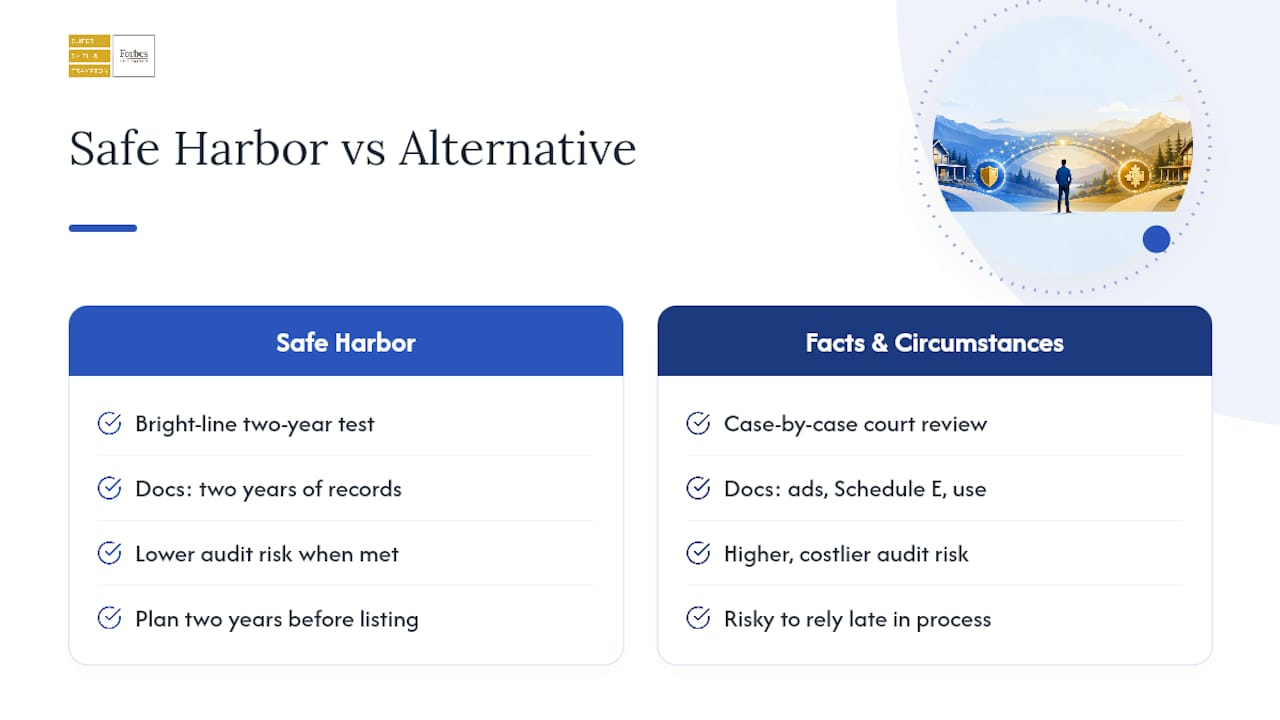
The facts-and-circumstances alternative gets oversold, too. Yes, a property that misses the bright-line test can still qualify, but that route asks a tax court to weigh your advertising, your Schedule E history, your depreciation schedule, and your personal-use pattern against each other. That's a harder, costlier case to win than simply meeting the safe harbor in the first place.
If you own a second home in Summit County and you're even considering this move, prioritize the calendar before the closing date. Confirm your permit status, start renting at market rates now, and build two years of documentation before you list. The tax code rewards the owners who planned early, not the ones who scrambled.
— Jayden Vermeer: Summit County Realtor
How Jayden Vermeer Realtor Helps You Prepare for an Exchange
Getting a vacation home exchange-ready takes more than good intentions. It takes a property that actually performs as a short-term rental in Summit County's market, and Jayden Vermeer Realtor starts there with a straightforward evaluation of your condo or home's rental viability in Keystone, Breckenridge, Frisco, Dillon, or Silverthorne.

That evaluation includes pulling comparable local listings and rate data to help document fair-market rent, exactly the kind of evidence your file needs if the IRS ever asks. Jayden also connects owners with CPAs familiar with vacation-home exchanges and can point you toward qualified intermediaries experienced with this specific safe-harbor scenario, so your rental history and your paperwork are working together instead of against each other. If you're weighing whether your Summit County property is ready to convert to investment use, schedule a consultation and get a clear read on where your property and your timeline stand before you list.