

Cap rate equals net operating income divided by purchase price, expressed as a percentage that tells you the property's unlevered annual return. Use it to compare rental yields across markets and property types before you get attached to a listing, then follow up with cash-flow modeling and financing math before making an offer. What counts as "good" swings widely by location and asset type, so treat cap rate as a filter, not a final verdict.
TL;DR:
- A cap rate is a useful filter for comparing rental properties across markets but does not reflect financing or personal tax benefits.
- Accurately calculating NOI requires deducting operating expenses and vacancy allowances while excluding mortgage payments and capital expenditures.
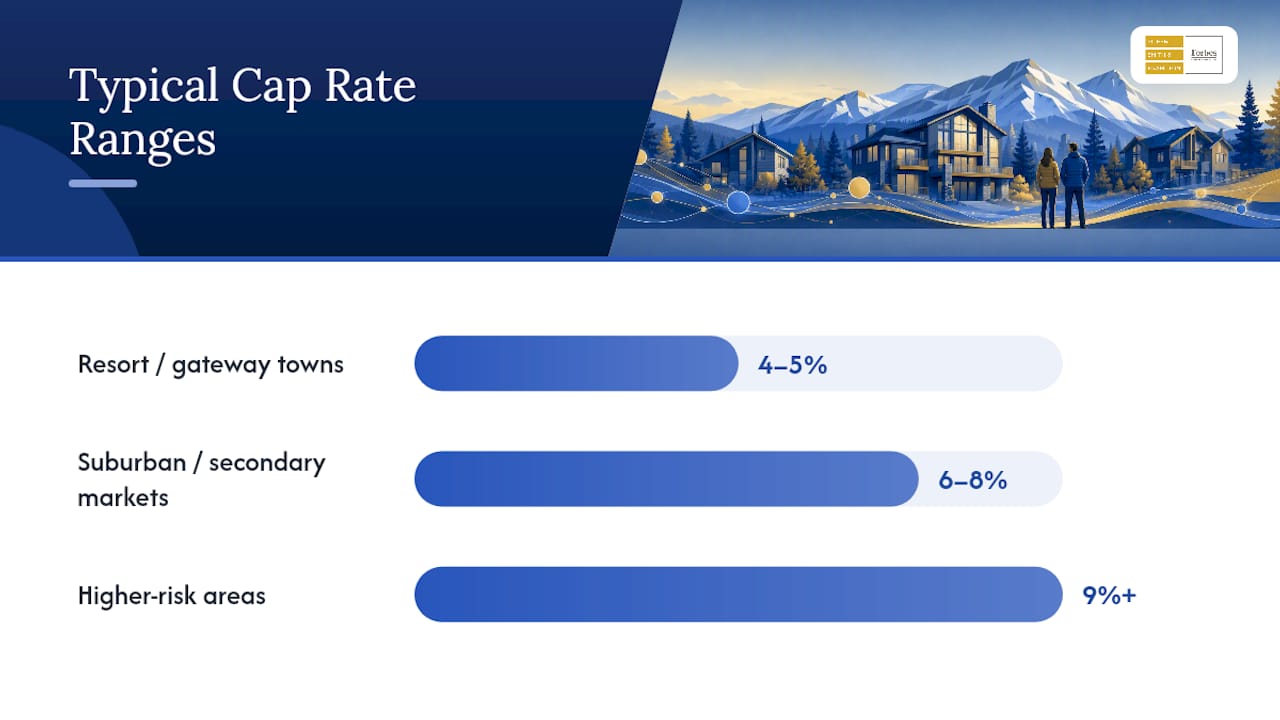
- Typical cap rate ranges vary by location: 4-5% in high-demand resort areas, 6-8% in stable suburban markets, and above 9% indicates higher risk.
- A property's cap rate can be significantly distorted by high HOA fees, market-specific risks, or overly optimistic income projections.
- Always supplement cap rate analysis with cash-on-cash return estimates and local expert advice before making an investment decision.
Table of Contents
- What Does Cap Rate Mean for Rentals?
- How Do You Calculate NOI for a Rental Property?
- A Worked Example: Cap Rate Formula in Action
- What Is a Good Cap Rate for Rentals?
- What Doesn't Cap Rate Tell You?
- Cap Rate vs Cash-on-Cash: How Financing Changes Your Return
- What Should You Know About Vacation Rental Cap Rates?
- How Do You Use a Cap Rate Calculator Correctly?
- How Does a Local Advisor Apply Cap Rate to Real Listings?
- What's the Smartest Way to Use Cap Rate Before You Buy?
- Get a Custom Cap Rate and Cash-Flow Analysis for Summit County
- Where Can You Verify These Numbers?
- Sources
What Does Cap Rate Mean for Rentals?
Cap rate is a snapshot of what a property earns relative to what it costs, stripped of financing entirely. That's the part investors most often misunderstand: it assumes an all cash purchase, so it never touches your mortgage, your interest rate, or how much you put down. The formula, as Investopedia defines it, is simple:
- Cap Rate = Net Operating Income (NOI) ÷ Current Market Value or Purchase Price
NOI is the income a property generates after operating expenses but before debt service. Purchase price is straightforward, though appraised or current market value works too when you're evaluating a property you already own.
Because cap rate ignores how the deal is financed, it's the right tool when you want an apples to apples comparison. A $500,000 duplex and a $2 million fourplex can be measured on the same scale, regardless of who's putting 20% down versus paying cash. That's the whole point of cap rate analysis: it levels the field so you can judge the asset, not the buyer's balance sheet.
How Do You Calculate NOI for a Rental Property?
Getting cap rate right starts with getting NOI right, and that means knowing exactly what belongs in the calculation and what doesn't. A step-by-step breakdown from Anderson Advisors walks through the inputs, but here's the practical checklist:
- Start with gross scheduled rent. This is the total rent you'd collect if every unit were occupied all year at market rate.
- Subtract a vacancy allowance. Most rentals run a modest vacancy rate in stable markets; resort and seasonal properties often need a wider buffer.
- Add other income. Parking fees, storage, laundry machines, and pet fees all count toward effective gross income.
- Subtract operating expenses. Property taxes, insurance, HOA dues, property management fees, repairs, utilities you cover, and landscaping all belong here.
- Exclude anything related to financing or ownership structure. Mortgage payments, loan interest, capital expenditures (roof replacement, new appliances), and your personal income taxes never enter the NOI calculation.
The formula in short: NOI = Effective Gross Income − Operating Expenses. When you're estimating vacancy or reserves for a property you haven't owned yet, pull comparable rent rolls from a property manager or check recent listings in the same building rather than guessing.
A Worked Example: Cap Rate Formula in Action
Numbers make this concrete. Say you're looking at a long-term rental listed at $450,000, generating $3,200 a month in gross rent.
- Gross annual rent: $3,200 × 12 = $38,400
- Vacancy allowance applied: $38,400 × estimated occupancy rate = effective gross income.
- Operating expenses (taxes, insurance, management, maintenance, HOA): $11,200
- NOI = $36,480 − $11,200 = $25,280
Divide NOI by purchase price: $25,280 ÷ $450,000 = 5.6% cap rate.
Pro Tip: Run the math both with and without HOA dues if you're comparing a condo to a single-family home. HOA fees can shave a full percentage point off cap rate on a mountain-town condo, and skipping that line item is one of the most common ways investors overestimate returns.
For a short-term rental variant, swap the gross rent line for seasonal average daily rate multiplied by projected occupancy. A Breckenridge cabin might pull $450 a night at 60% winter occupancy and $280 a night at 35% summer occupancy. Blend those into an annual revenue figure, then subtract platform fees and higher cleaning and turnover costs before you land on NOI. Short-term numbers swing harder year to year than long-term leases, so the same formula needs a more conservative revenue assumption going in.
What Is a Good Cap Rate for Rentals?
There's no single number that works everywhere, and that's the honest answer most calculators won't give you. A cap rate reflects both the income a property produces and the risk the market assigns to that income, so the same percentage means different things in different places.
- 4% to 5%: common in high-demand resort towns and gateway cities, where buyers accept lower yield in exchange for stronger appreciation and lower vacancy risk.
- 6% to 8%: typical for solid suburban rentals and stable secondary markets with steady tenant demand.
- 9% and above: often signals higher risk, whether that's a rougher neighborhood, older building, management headaches, or a market with slower appreciation.
A lower cap rate in a place like Summit County usually isn't a red flag. It often means buyers are pricing in equity growth and low vacancy, not settling for weak returns. Compare any property against recent sales of similar rentals in the same submarket rather than a national average, since local comps tell you far more than a blanket rule of thumb.
Pro Tip: If a listing's cap rate looks unusually high compared to everything else in the neighborhood, dig into why before you get excited. Deferred maintenance, an unstable rental history, or an unrealistic income projection from the seller are the usual culprits.
What Doesn't Cap Rate Tell You?
Cap rate is useful precisely because it's simple, but that simplicity is also its blind spot. It excludes debt service entirely, so it says nothing about your actual monthly cash flow once a mortgage payment enters the picture. It also excludes capital expenditures like a new roof or HVAC system, and it ignores your personal tax situation, including depreciation benefits that can meaningfully change your real return.
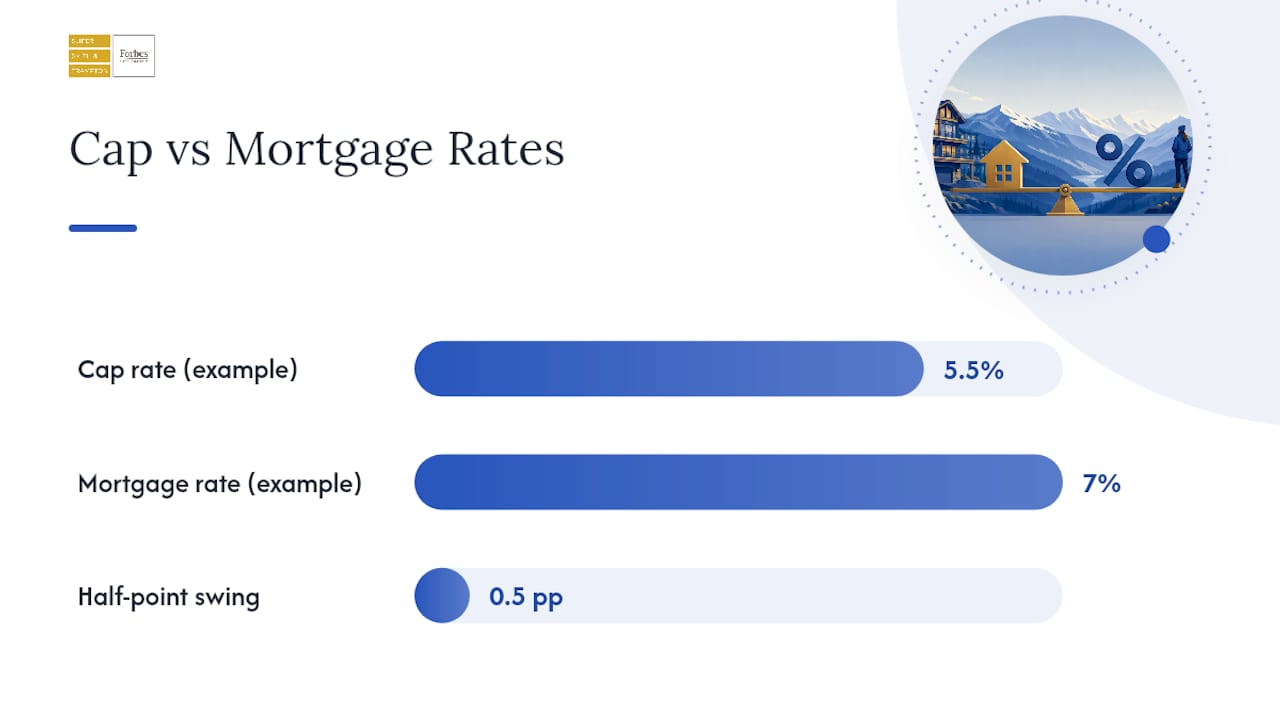
The biggest risk hiding behind a clean cap rate number is negative leverage: when your borrowing cost exceeds the cap rate, financing the deal actually reduces your return rather than boosting it. This became a real concern as mortgage rates climbed in recent years, because a property with a 5.5% cap rate financed at a 7% interest rate works against you, not for you.
Before committing to any deal, run these checks:
- Calculate cash-on-cash return using your actual down payment and financing terms.
- Estimate a capital expenditure reserve for major systems nearing the end of their life.
- Check debt service coverage ratio if you're using investment property financing.
Pro Tip: Ask your lender for a firm rate quote before you finalize any offer based on cap rate alone. A half-point difference in interest can flip a deal from cash-flow positive to negative.
Cap Rate vs Cash-on-Cash: How Financing Changes Your Return
Cap rate and cash-on-cash return answer two different questions, and mixing them up is one of the most common mistakes new investors make.
- Cap rate measures return on the full purchase price, assuming no financing. It answers: "How does this property perform on its own?"
- Cash-on-cash return measures return on your actual cash invested, factoring in your mortgage payment. The formula is Annual Pre-Tax Cash Flow ÷ Total Cash Invested.
- Compare the two scenarios. On that $450,000 property earning $25,280 NOI, an all-cash buyer earns the full 5.6% cap rate as their return. A buyer who puts 25% down ($112,500) and finances the rest at 7% interest might see annual debt service around $22,700, leaving only $2,580 in cash flow. That's a cash-on-cash return of just 2.3%, well below the cap rate.
That gap is negative leverage showing up in real numbers. Whenever your loan's interest rate sits above the property's cap rate, borrowing money shrinks your percentage return even though it lets you control a larger asset with less cash.
What Should You Know About Vacation Rental Cap Rates?
Short-term and vacation rentals need a different lens because revenue swings far more than a standard 12-month lease. Seasonality, average daily rate, and occupancy forecasting all drive the top-line number, and a mountain town like Breckenridge or Keystone sees dramatic differences between ski season and shoulder season.
- Pull realistic ADR and occupancy estimates from data platforms rather than the seller's optimistic projection.
- Subtract booking platform fees, higher cleaning costs, and increased turnover from your revenue before calculating NOI.
- Build in a conservative buffer for slow years, since a single soft winter can swing annual revenue by a wide margin.
Specialized data tools like AirDNA help ground vacation rental revenue projections in actual market performance instead of guesswork. Because short-term income is more volatile, a vacation rental's cap rate deserves a wider margin of safety than a comparable long-term lease showing the same number on paper.
How Do You Use a Cap Rate Calculator Correctly?
A cap rate calculator is only as good as what you feed it, and common input mistakes are the main reason two people can run the same property and get wildly different answers.
- Purchase price or current market value — use actual comps, not a hopeful asking price.
- Gross rental income — pull from a rent roll or verified market rent, not a landlord's best-case estimate.
- Vacancy rate — check local averages rather than assuming zero vacancy.
- Operating expenses — include every recurring cost; underestimating expenses is the single most common error.
Once you have a number, run a quick sensitivity check: recalculate with vacancy and expenses each shifted by 10% to 20%. If the cap rate swings dramatically, the deal is more fragile than it first appeared.
How Does a Local Advisor Apply Cap Rate to Real Listings?
Cap rate on its own is a starting filter, not a decision. Local advisors layer it with actual Summit County comps, seasonal rental history for towns like Frisco and Silverthorne, and cash-flow modeling that accounts for local property tax rates and HOA structures specific to mountain condos and ski chalets.
That local context changes the read on a number. If you're evaluating a specific property and want a model built around its actual numbers rather than a national rule of thumb, that's the point to bring in a local expert rather than relying on a generic calculator alone.
What's the Smartest Way to Use Cap Rate Before You Buy?
Cap rate earns its place as the first filter in any rental analysis, but it should never be the last check you run. Two moves worth making right now: pull cap rates on three comparable listings in your target area, and run a cash-on-cash estimate using real financing terms before you write an offer. From there, a tailored local analysis is the natural next step.
— Jayden Vermeer: Summit County Realtor
Get a Custom Cap Rate and Cash-Flow Analysis for Summit County
Local real estate professionals can offer investors data built around actual Summit County listings instead of national averages. Working with local market data on Keystone condos, Breckenridge cabins, and Frisco single-family homes means every cap rate estimate reflects real comps, not guesswork imported from a different market.

Useful services for rental buyers include local market analysis pulled from current listings, rental income forecasting for both long-term and short-term properties, cap rate and cash-flow modeling that accounts for HOA rules and seasonal occupancy, and property marketing support if selling. If you're weighing a specific listing and want the real numbers behind it rather than a rough estimate, browse current investment properties and reach out to start a custom analysis built around your target property and your financing plan.
Where Can You Verify These Numbers?
- Investopedia covers the formal cap rate formula and definition.
- Anderson Advisors breaks down NOI calculation step by step.
- AirDNA provides short-term rental revenue data for cap rate estimates.
- Newfi explains calculator inputs and common pitfalls.
- Vacation Homes for Sale Colorado lists Summit County investment properties for further research.