

Summit County, Colorado runs expensive by almost any measure, and housing is the reason. HUD sets the 2026 fair market rent for a one-bedroom at $1,880 a month, which takes roughly $75,200 a year just to keep rent under 30% of income. The county's average annual wage is considerably less than the income needed to afford rent at the HUD FMR, making affordability difficult for renters, service-sector employees, and accommodation-and-food-services workers.
TL;DR:
- The rent for deed-restricted two-bedroom units remains high at around $2,000, requiring household incomes well above the local average wage for affordability.
- Wages in the county are not keeping pace with rising rent and home prices, especially in the tourism-heavy service sectors which pay less than construction or professional jobs.
- Outside income from remote workers and retirees has driven up the county's income thresholds, making workforce housing less accessible for local workers.
- Utility and transportation costs, along with healthcare and childcare expenses, further strain local households' budgets, often pushing total essential costs to nearly 75% of income.
Table of Contents
- What Is the Cost of Living in Summit County Right Now?
- Why Do Rents Stay High Even With Deed Restrictions?
- How Does the Local Job Mix Affect Wages?
- What Do AMI and FMR Actually Measure?
- Where Can Renters and Buyers Find Local Housing Help?
- Which Local Real Estate Agent Covers Summit County?
- Why Local Market Knowledge Matters for Buyers and Sellers
- Is Summit County Getting More or Less Affordable?
- What Do Utilities and Monthly Bills Cost Here?
- What Does Getting Around Summit County Cost?
- How Much Do Groceries and Dining Cost in Summit County?
- What Should Residents Know About Healthcare Costs and Access?
- What Do Childcare and Schooling Cost in Summit County?
- Ready to Talk Through Your Own Numbers?
- Where This Data Comes From
- Sources
- FAQ
What Is the Cost of Living in Summit County Right Now?
The short answer: high, and driven almost entirely by housing rather than everyday goods. Groceries, gas, and utilities in Breckenridge, Keystone, Frisco, Dillon, and Silverthorne run somewhat above the Colorado average, but nothing close to the gap between local wages and local rent.
Three figures anchor the picture:
- Median household income and average wage: The NWCCOG regional update reports Summit County's average annual wage is significantly below Colorado's statewide average.
- HUD Fair Market Rent: The one-bedroom FMR for FY2026 is $1,880 a month, up from the prior year, requiring an annual income well above average to stay within the 30%-of-income benchmark.
- MIT Living Wage: The MIT Living Wage calculator shows required hourly rates for single adults and family households running noticeably higher than what the average local job pays.
Quick comparison:
| Metric | Approximate figure |
|---|---|
| County average annual wage | $53,612 |
| Income needed for 1BR at HUD FMR (30% rule) | ~$75,200 |
| Median owner-occupied home value | See Census QuickFacts |
The math is blunt: a single full-time job paying the county average wage does not clear the HUD affordability threshold for a one-bedroom apartment. That single fact explains most of the housing conversation in Summit County right now.
Why Do Rents Stay High Even With Deed Restrictions?
Rent is where the affordability gap actually lands on people. The Summit County Housing Needs Assessment estimates median market-rate rents for two-bedroom units are well above the HUD benchmark, with blended medians reflecting a mix of market and subsidized units. Deed-restricted and subsidized two-bedroom units rent for less than market rates but can still be unaffordable for many working in service industries.
A few points worth understanding before you budget:
- Deed-restricted housing lowers rent, but it does not eliminate the burden. A rent near $2,000 still requires a household income considerably higher than many local wages to meet the 30% affordability standard.
- The Housing Needs Assessment finds many households paying closer to 75% of income once housing, transportation, and healthcare are combined, not the 30% textbook figure.
- Market-rate rents at about $2,600 for two-bedroom units require household incomes significantly above the county average wage to avoid cost burden under the 30% rule.
Pro Tip: If you're weighing a move to Summit County, run your own numbers against the deed-restricted rent, not the market rent. The gap between the two is often the real difference between staying and leaving.
How Does the Local Job Mix Affect Wages?
The county's wage problem isn't a lack of jobs. It's the type of jobs available. Accommodation and food services make up an outsized share of local employment, and that sector consistently pays less than construction, professional services, or government work.
- The NWCCOG regional update puts the county average annual wage at $53,612, a figure pulled down by the heavy tourism and hospitality footprint.
- BLS county wage data for Colorado shows mountain resort counties like Summit consistently trailing the state average, largely for the same reason.
- Wages have grown over the past decade, but not at the pace of rent or home prices, which widens the affordability gap year over year rather than closing it.
A ski town economy runs on seasonal, tip-adjacent, hourly work. That's the trade-off behind the low unemployment rate: plenty of jobs, but a wage ceiling that rent increases blow past every year.
What Do AMI and FMR Actually Measure?
These terms get thrown around constantly in Summit County housing debates, and they're worth understanding in plain terms.
- Area Median Income (AMI) is the midpoint income for the county, used to set eligibility for workforce and deed-restricted housing. Remote workers and retirees who move to Summit County but earn income elsewhere have pushed local AMI up fast, according to SummitDaily reporting, even though wages for people actually working local jobs haven't kept pace.
- HUD Fair Market Rent (FMR) is a federally set benchmark rent used for housing assistance programs, currently $1,880 for a one-bedroom.
- MIT Living Wage estimates the hourly income a household actually needs to cover basic expenses, and it usually lands higher than either AMI-based or FMR-based figures suggest.
Here's the practical problem: the standard 30%-of-income housing rule ignores transportation and healthcare. The Housing Needs Assessment found total essential costs approaching 75% of income for many households once you add those two categories back in.
Where Can Renters and Buyers Find Local Housing Help?
Summit County and its towns run several programs aimed at closing this gap, and knowing which one fits your situation saves time.
- Summit County Housing Department / Housing Helps manages deed-restricted listings and eligibility screening for workforce housing across the county.
- Deed-restricted purchase and buy-down programs let qualifying buyers purchase homes below market value in exchange for occupancy and resale restrictions.
- Rental assistance and waitlists run through the county and individual towns; availability shifts, so checking early in your search matters more than it does in most markets.
- Each town, Breckenridge, Frisco, Dillon, Silverthorne, sets its own HOA and short-term rental rules separately from county-level housing programs, so verify locally before assuming a program applies countywide.
Which Local Real Estate Agent Covers Summit County?
If your next step is buying or selling rather than renting, working with an agent who actually knows the towns matters more here than in most markets, since Breckenridge, Keystone, and Frisco each run different price bands and different HOA and short-term rental rules.
Jayden Vermeer : Slifer Smith & Frampton holds a 5 star Google rating across 30 reviews and focuses specifically on luxury homes, resort condos, and second-home transactions across Keystone, Breckenridge, and the surrounding towns.
- Best for: luxury and resort-condo buyers or sellers, and anyone navigating the second-home or vacation-rental market.
- Core focus: Summit County coverage with specific depth in Keystone and Breckenridge inventory.
One practical note before you pick an agent: a vacation-rental purchase and a full-time residency purchase run on different criteria entirely, HOA rules, short-term rental permitting, and financing all diverge, so match your agent's specialization to your actual goal rather than picking on rating alone.
Why Local Market Knowledge Matters for Buyers and Sellers
Jayden Vermeer specializes specifically in Summit County real estate, with working knowledge of Keystone, Breckenridge, and the surrounding towns' distinct pricing and HOA landscapes. The site offers comprehensive property listings and market data tools covering resort condos, luxury homes, and full-time residences. Readers typically use these resources for home valuation requests, private showings, and listing comparisons, standard first steps whether you're buying a vacation condo or selling a full-time residence in a market that SummitDaily reports is cooling slightly without losing overall strength.
Is Summit County Getting More or Less Affordable?
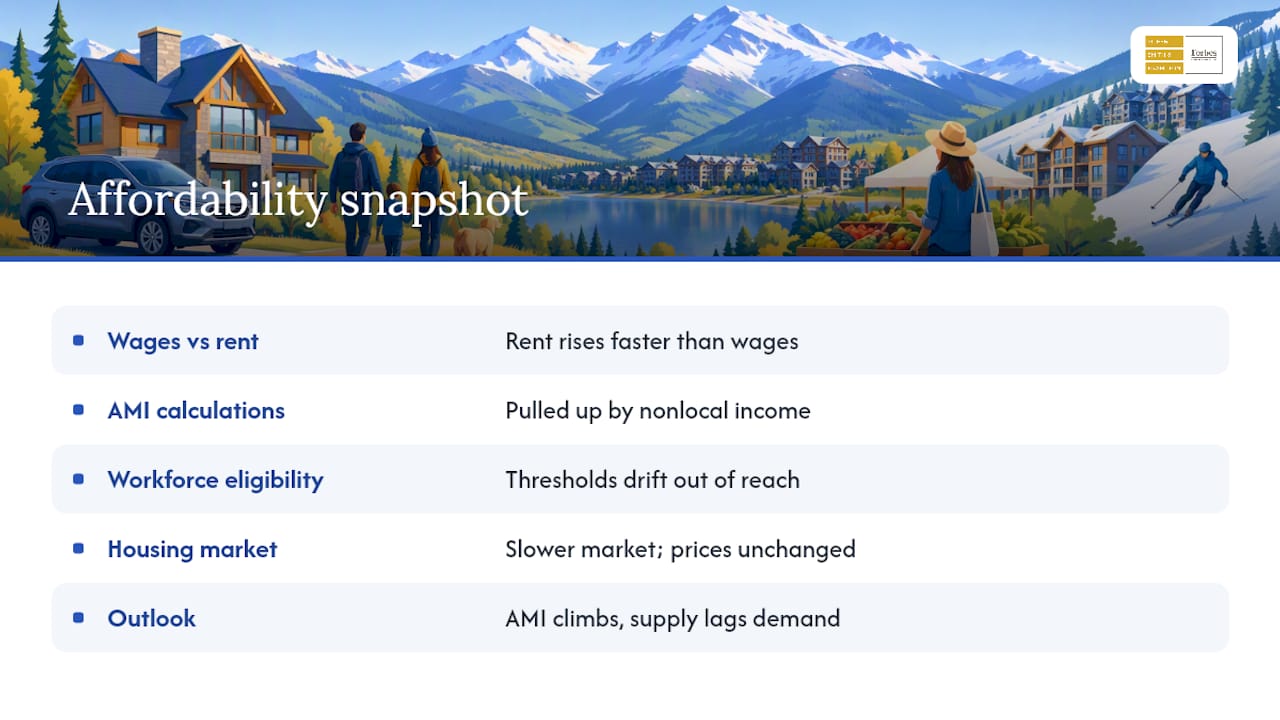
The gap between wages and housing costs has widened over the past several years, not narrowed. That's the core trend: rent climbs faster than paychecks, most years.
There's a second force pulling in the same direction. Remote workers and retirees moving into Summit County bring outside income that doesn't reflect local wages, but it still counts toward the county's AMI calculations. That pushes AMI up even when wages for people working local jobs stay flat, a dynamic SummitDaily has documented in detail. The practical effect: workforce housing eligibility thresholds tied to AMI can drift out of reach for the very workers those programs were built to serve.
On the buying side, the picture is a little more balanced. Local reporting notes the market has slowed slightly compared to the intensity of recent years, longer time on market, a bit more room to negotiate, though prices themselves haven't dropped in any meaningful way. For prospective buyers, that shift can translate into more leverage during negotiations, even in a county where the underlying cost structure remains high.
Looking forward, expect continued pressure on deed-restricted housing supply as demand for workforce units outpaces new construction, and expect AMI figures to keep climbing faster than wages tied to actual local jobs. Neither trend points toward Summit County getting cheaper in the near term.
What Do Utilities and Monthly Bills Cost Here?
Mountain elevation and long winters shape utility bills in Summit County more than almost any other cost category. Heating season runs long, often October through May at elevations near Breckenridge and Keystone, and that stretches propane, natural gas, or electric heat bills well beyond what a similar-sized home would run at lower elevation.
Electricity comes through Xcel Energy or, in some areas, local rural electric cooperatives, with typical residential bills fluctuating seasonally based on heating demand. Water and sewer service is billed separately by each town, Breckenridge, Frisco, Dillon, and Silverthorne all run their own municipal utility departments, so rates vary block to block depending on which town's system serves your address.
A few practical points for anyone budgeting a move:
- Heating costs typically peak in the coldest winter months and taper significantly by late spring, so budget for a wide seasonal swing rather than a flat monthly number.
- Homes with older insulation or larger square footage, common in some Keystone and Breckenridge properties, run notably higher heating bills than newer, tighter-built construction.
- Trash and recycling service is often billed separately from water and sewer, and rules on service frequency vary by town.
If you're comparing a condo to a single-family home, condos often bundle some utilities into HOA dues, which can make monthly budgeting more predictable even if the total cost isn't necessarily lower.
What Does Getting Around Summit County Cost?
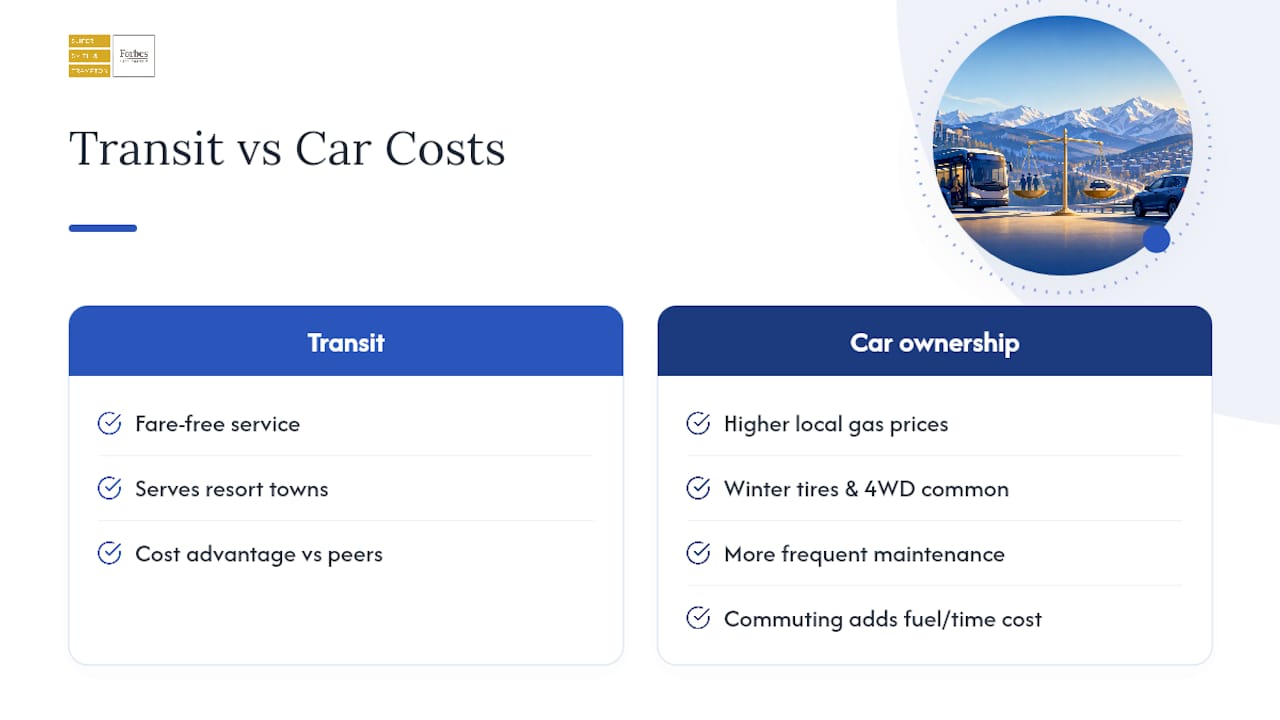
Transportation in Summit County splits into two very different experiences: free local transit and expensive car ownership. The Summit Stage, the county's public bus system, runs fare-free between Breckenridge, Frisco, Dillon, Silverthorne, Keystone, and Copper Mountain, a genuine cost advantage compared to most US counties of similar size.
Car ownership is a different story. Winter tires, four-wheel drive or all-wheel drive capability, and more frequent maintenance from mountain driving conditions all add real cost on top of standard vehicle ownership. Gas prices in Summit County typically run above the Colorado state average, partly due to elevation and partly due to the logistics of getting fuel to a mountain community.
Commuting adds another layer. Many service-industry and hospitality workers commute from more affordable housing in Silverthorne or Dillon into higher-cost job centers in Breckenridge or Keystone, and some commute from outside the county entirely, from Leadville or even the Front Range, on I70, particularly during ski season when traffic and weather delays stretch travel times significantly. That commute cost, in gas, vehicle wear, and time, is a real but often overlooked piece of the local cost-of-living picture, and it's part of why the Housing Needs Assessment folds transportation into its broader affordability analysis rather than treating housing cost in isolation.
How Much Do Groceries and Dining Cost in Summit County?
Grocery prices in Summit County run above the Colorado average, largely a function of transportation logistics getting food to mountain towns and a limited number of large chain grocery stores serving the entire county. Breckenridge, Frisco, and Silverthorne each have grocery options, but selection and pricing don't match what you'd find in Denver or Colorado Springs.
Dining out is where the cost gap becomes most visible to visitors and new residents alike. Restaurant pricing in a resort economy reflects tourist demand as much as local costs, ski season pricing in Breckenridge or Keystone often runs noticeably higher than off-season rates in the same restaurants. A casual lunch that might cost $12 to $15 in a typical Colorado town can easily run $18 to $25 in peak season at a Summit County resort-area restaurant.
For residents, the practical workaround many locals use is buying in bulk during trips to Front Range stores, or timing bigger grocery runs around visits outside the county. It's a real strategy, not a complaint, and it reflects how tightly grocery costs here track the broader housing-and-transportation affordability squeeze covered elsewhere in this guide.
What Should Residents Know About Healthcare Costs and Access?
Healthcare access in Summit County comes with a rural mountain twist: fewer providers, longer drives for specialty care, and premium pricing tied to the same logistics that push up grocery and utility costs. St. Anthony Summit Hospital in Frisco serves as the county's main hospital, and it handles a broad range of care, but residents needing specialist treatment often drive to Denver, a trip that adds real time and transportation cost on top of the medical bill itself.
Health insurance costs in mountain resort counties have historically run higher than Front Range Colorado, partly reflecting the smaller local risk pool and the cost of maintaining rural healthcare infrastructure. That's worth factoring into any household budget, particularly for families or anyone without employer-sponsored coverage.
The Housing Needs Assessment's finding that essential costs, housing, transportation, and healthcare combined, can reach roughly 75% of income for many households isn't abstract. Healthcare is one of the three legs of that stool, and it's a cost category too many affordability discussions leave out entirely when they focus only on rent.
What Do Childcare and Schooling Cost in Summit County?
Childcare in a resort economy runs into the same supply problem as housing: demand outpaces available slots, and pricing reflects that scarcity. Summit County families frequently report waitlists for infant and toddler care that stretch months, and the limited number of licensed providers countywide means pricing rarely comes down even when a family shops around.
Summit School District serves the county's public school students across Breckenridge, Frisco, Dillon, Silverthorne, and Keystone, and public K through 12 education carries no direct tuition cost, a real budget advantage compared to private schooling elsewhere. Families relying on before- and after-school care, or summer programs during the long ski-town school breaks, should budget for that as a separate and recurring cost.
For working parents in service-industry jobs, the math gets tight fast: a full-time childcare bill layered on top of Summit County rent and grocery costs can consume a disproportionate share of a single paycheck, another reason many households here run on two incomes even when the math might otherwise suggest one parent staying home.
Ready to Talk Through Your Own Numbers?
Cost-of-living data tells you the county-wide picture, but your own budget depends on which town, which property type, and which stage of homeownership fits your life. Jayden Vermeer Realtor works directly with buyers and sellers across Keystone, Breckenridge, and the surrounding Summit County towns, offering a free home valuation through the What's Your Home Worth? tool, private property comparisons for buyers weighing multiple listings, and private showings for serious buyers ready to see homes in person.
If you're comparing condo ownership against renting at current market rents, a private showing in Keystone or a look at current Breckenridge condos for sale can clarify the real numbers faster than a spreadsheet. Buyers looking for relatively more affordable entry points often start with Frisco or Dillon, both a shorter commute to Breckenridge and Keystone job centers than commuting from outside the county entirely. Sellers weighing whether now is the right time to list can start with a no-obligation home valuation.
Reach out through the Jayden Vermeer Realtor contact page to talk through your specific situation, whether that's a vacation condo, a second home, or a full-time move into Summit County.
Where This Data Comes From
- HUD Fair Market Rents: annual rent benchmarks by county and bedroom count, updated yearly.
- MIT Living Wage: county-level living-wage estimates by household type.
- NWCCOG regional economic update: local wage and job-mix data, updated periodically.
- Summit County Housing Needs Assessment: county rent survey and cost-burden analysis.
- U.S. Census QuickFacts: demographic and housing baseline stats, updated annually.
Sources
- HUD — Fair Market Rents (FMR) datasets
- MIT Living Wage: Summit County, Colorado
- NWCCOG Regional Economic Update — September 2024
FAQ
What Is the Average Cost of Living in Summit County, Colorado?
Summit County runs well above the national average, driven almost entirely by housing costs. The HUD one-bedroom FMR sits at $1,880 a month, requiring roughly $75,200 in annual income to stay under the standard 30% affordability threshold, while the county's average annual wage runs closer to $53,612.
What Salary Do You Need To Live Comfortably in Idaho?
Idaho's comfortable-living salary depends heavily on which county you're comparing, since costs vary widely between Boise and rural areas, and that figure isn't tracked in this Summit County, Colorado analysis. For a locally grounded comparison, the MIT Living Wage calculator provides county-specific figures for Idaho the same way it does for Summit County.
What Salary Is Needed To Live Comfortably in NC?
North Carolina's comfortable-living salary varies significantly by county, with Charlotte and the Research Triangle running well above rural counties, and that specific figure falls outside this Summit County guide. The MIT Living Wage tool covers North Carolina counties individually if you need a direct comparison point.
What Salary Is Needed To Live Comfortably in FL?
Florida's figure similarly depends on the county, coastal markets like Miami and Naples run far higher than inland areas, and it isn't part of this Summit County, Colorado data set. Checking the MIT Living Wage calculator by county gives the most accurate local figure for Florida.
How Much Income Do I Need To Rent a One-Bedroom in Summit County?
You need roughly $75,200 in annual income to keep a one-bedroom apartment at HUD's FY2026 Fair Market Rent of $1,880 a month under the standard 30%-of-income guideline. Deed-restricted units can lower that threshold, but the Housing Needs Assessment still finds many households cost-burdened even at those reduced rates.