

Earnest money is a buyer's good-faith deposit, and in Colorado, how you handle it determines whether that cash comes back to you or gets forfeited to the seller. The deposit is credited toward your closing costs if the deal closes, but it's only protected if you track every contract deadline and confirm your escrow holder before you wire a single dollar. Miss a date on the Colorado contract, and that money can become the seller's.
TL;DR:
- In competitive Summit County markets, offering a larger earnest money deposit signals seriousness but increases risk if contingencies are missed or deadlines are not met.
- Confirm in writing the exact amount and deadline for earnest money, verify wiring instructions by phone, and obtain written confirmation of receipt to prevent wire fraud or default.
- Missing critical deadlines for inspections, title review, or loan approval can automatically forfeit your deposit unless timely, proper notice is given per the contract.
- Disputes over earnest money typically require negotiation, mutual releases, or mediation; unresolved conflicts may lead to court proceedings or escrowholder intervention.
- Working with a local agent familiar with area-specific deadlines and title companies reduces the risk of losing earnest money and ensures smooth transaction progress.
Table of Contents
- What Is Earnest Money in a Colorado Real Estate Contract?
- Is Earnest Money Legally Required in Colorado?
- How Much Earnest Money Should You Offer in Summit County?
- When Is Earnest Money Due and How Do You Deliver It Safely?
- When Is Earnest Money Refundable? Contingencies and Common Mistakes
- How Are Earnest Money Disputes Resolved in Colorado?
- Special Situations: New Construction, HOAs, and Promissory Notes
- A Summit County Earnest Money Checklist
- Work With a Local Agent Who Protects Your Deposit
- Official Colorado Resources on Earnest Money
- Sources
- FAQ
What Is Earnest Money in a Colorado Real Estate Contract?
Every standard purchase agreement in this state runs on the Contract to Buy and Sell Real Estate (Residential) published by the Colorado Division of Real Estate. Section 4.3 of that form is where earnest money lives. It names the dollar amount, identifies who holds the funds, and lays out what happens to the deposit at various points in the transaction.
The person or company holding your deposit is called the earnest money holder, and it's rarely the seller. In most Summit County deals, that role goes to one of these:
- A title company or closing company handling the transaction
- The listing or buyer's brokerage, held in a trust account
- An attorney, in less common but still valid setups
Once the sale closes, your earnest money isn't a separate cost. It's applied directly to your cash-to-close figure at settlement, according to Colorado's home buying process guidance. If your deposit was $10,000 and your total cash needed at closing was $40,000, you'd wire the remaining $30,000, not the full amount.
Is Earnest Money Legally Required in Colorado?
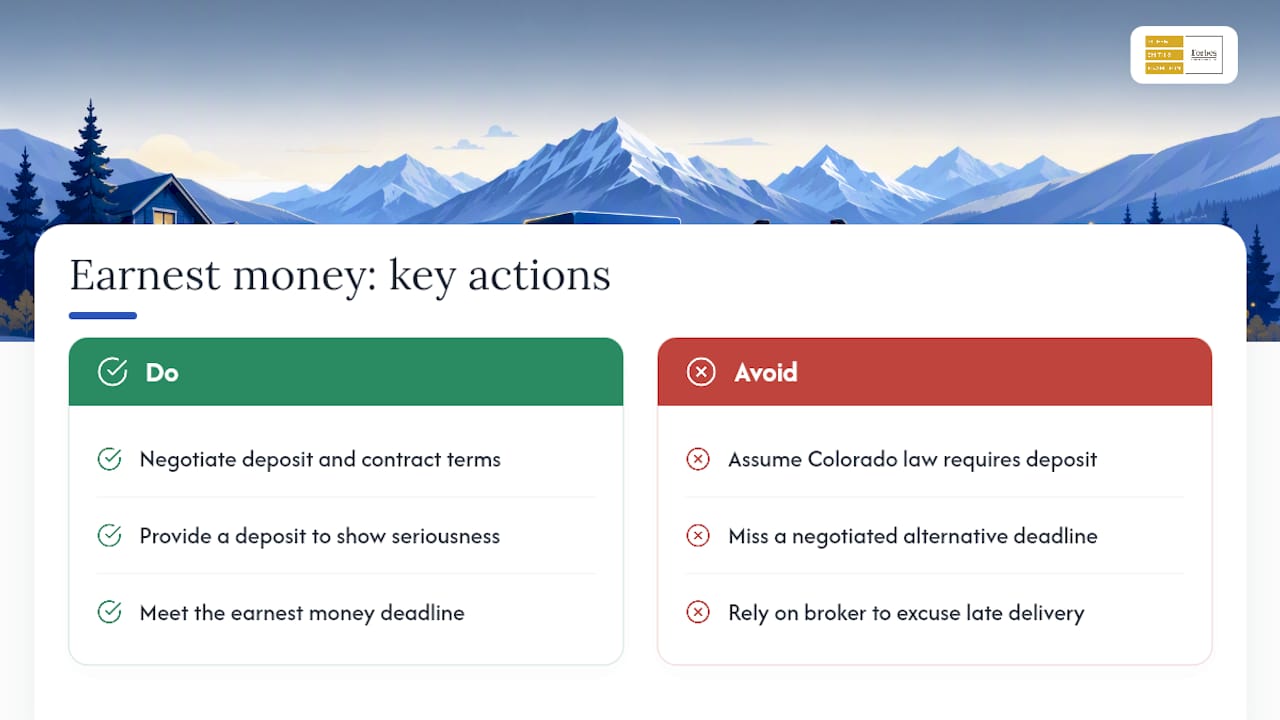
No statute forces a Colorado buyer to put down earnest money. It's negotiated, and the contract terms control everything. A seller could technically accept an offer with no deposit, though in practice almost no accepted offer in Summit County skips it, since it signals to the seller that you're serious.
Where buyers get tripped up is the Alternative Earnest Money Deadline, a contract provision letting the deposit due date slide past the effective date of the contract. If you negotiate that later date and then miss it, you're in default territory. The Colorado Real Estate Commission has been clear that brokerage firms holding funds have specific duties, and late or missing delivery isn't something they can simply overlook on your behalf.
How Much Earnest Money Should You Offer in Summit County?
There's no fixed percentage written into Colorado law, but two structures dominate the market: a flat dollar amount or a percentage of the purchase price, typically in the 1% to 3% range.
These numbers are illustrative only. Your agent will help you land on a figure that fits the specific listing and negotiation.
Pro Tip: In competitive Summit County markets, agents commonly advise a larger deposit to signal seriousness to the seller. But a bigger deposit also means more money at risk if you miss a contingency deadline, so match the size of your earnest money to how confident you are in closing.
A few factors shift where you land in that range:
- Market heat: multiple-offer situations in Keystone or Breckenridge often push buyers toward the higher end
- Property type: new construction and luxury listings sometimes carry different deposit expectations than resale homes
- Price band: higher-priced homes sometimes use a smaller percentage since the flat dollar figure is already substantial
Whatever number you land on, get it confirmed in writing before you assume it's settled, and talk it through with a local agent who knows how sellers in your target neighborhood typically respond.
When Is Earnest Money Due and How Do You Deliver It Safely?
The contract gives you a few timing options. Earnest money can be due with the offer, at mutual execution (when both parties have signed), or on a separately negotiated Alternative Earnest Money Deadline written into the contract itself, per the DRE's official contract form.
Once you know the date, follow these steps:
- Confirm with your agent or the title company exactly who the earnest money holder is and how they want to receive funds.
- Send a wire transfer, the most common method, or a cashier's check if the closing company allows it.
- Get written confirmation that the funds arrived, not just a verbal assurance.
- Verify the wiring instructions by calling a phone number you look up independently, never one pulled from an email you received.
Pro Tip: Wire fraud targeting real estate closings is a real threat nationwide. If you get an email with wiring instructions, call the title company using a number from their website or a prior paper document, not a number listed in that same email, before sending a cent.
When Is Earnest Money Refundable? Contingencies and Common Mistakes
Your earnest money stays protected as long as you're operating inside the contingencies you negotiated and you hit every deadline attached to them. The Colorado contract typically includes contingency windows for:
- Inspection: the right to review the property's condition and object or terminate within a set number of days
- Title and HOA document review: the chance to examine title commitments and, for condos, HOA governing documents
- Appraisal: protection if the lender's appraised value comes in below the purchase price
- Loan approval: the right to terminate if financing falls through within the negotiated timeframe
Each of these has its own deadline written into the contract, and the mechanism that protects your deposit is timely written notice. Verbally telling your agent "I want out" doesn't count. You or your agent need to deliver a formal notice to object or terminate before the deadline passes, following the exact procedure spelled out in the contract.
Where buyers lose earnest money most often:
- Missing an inspection objection deadline by even a day, even when they genuinely had concerns
- Waiving a contingency early to look more competitive, then discovering a problem afterward
- Failing to deliver the funds on time in the first place, which itself can trigger default
Waiving contingencies to strengthen an offer is common in a hot Summit County market, but every waiver removes a door you could have walked through. Weigh that trade-off with your agent before you sign, not after.
How Are Earnest Money Disputes Resolved in Colorado?
When a deal falls apart and both sides disagree about who keeps the deposit, Colorado has a defined path rather than a free-for-all.
- Direct negotiation first. Most disputes resolve when buyer and seller (through their agents) agree on a split or full release.
- Earnest Money Release form. If both parties agree, they sign a mutual release directing the holder to disburse funds accordingly.
- Mediation. Many Colorado contracts require mediation before either party can sue, giving both sides a lower-cost path to resolution.
- Interpleader or litigation. If no agreement is reached, the escrow holder can deposit the funds with a court and let a judge decide, rather than choosing a side themselves.
Under CREC's position on earnest money release, a brokerage firm is not required to disburse disputed funds without proper authorization, and a signed release isn't legally mandatory when there's no dispute at all. If your deposit is meaningful and the disagreement drags past a few weeks, that's the point to bring in a real estate attorney rather than waiting it out.
Special Situations: New Construction, HOAs, and Promissory Notes
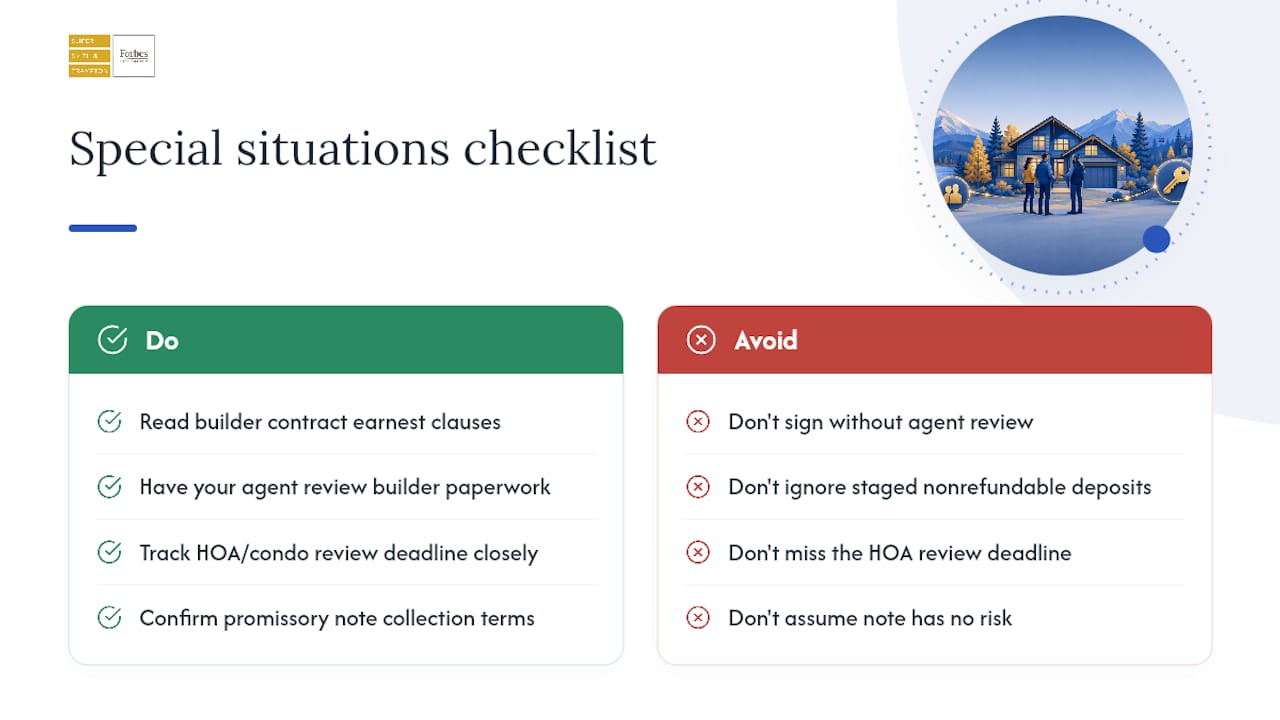
Builder contracts often run on their own paperwork instead of the standard DRE form, and many include staged deposits due at construction milestones, sometimes with nonrefundable language buried in the fine print. Read every builder contract clause on earnest money before you sign anything, ideally with your own agent reviewing it, not just the builder's representative.
Condo and HOA purchases add a document review window where you examine governing documents, financials, and rules. That review period interacts directly with your earnest money protection, so track its deadline as closely as your inspection deadline.
Less commonly, buyers sign a promissory note instead of wiring cash upfront. The DRE's contract forms include a standardized note option, but it carries real collection risk if you later default and the seller has to pursue you for the amount owed.
A Summit County Earnest Money Checklist
Protecting your deposit comes down to sequencing. Here's the order that keeps buyers from getting caught off guard, whether you're closing on a condo in Keystone or a single-family home in Silverthorne:
- Confirm the earnest money holder and their wiring or check instructions in writing, verified by phone.
- Calendar every deadline from the contract: earnest money due date, inspection objection date, loan and appraisal deadlines, and HOA document review window.
- Request written confirmation the moment your funds are received, not just an assumption they arrived.
- For condos, review HOA documents inside the negotiated window and flag anything concerning to your agent immediately.
- If you're waiving a contingency to compete for a listing, understand exactly what protection you're giving up before you sign.
A local agent who works Keystone, Breckenridge, and Frisco regularly can flag which of these deadlines tend to get compressed in a multiple-offer situation and which title companies in the area are fastest to confirm receipt. That local pattern recognition is often the difference between a smooth closing and a scramble in the final week.
Work With a Local Agent Who Protects Your Deposit
Reading the contract language is one thing. Having someone who has walked a hundred Summit County closings through their earnest money deadlines is another. A local real estate agent who regularly works in Keystone, Breckenridge, Frisco, Dillon, and Silverthorne can coordinate directly with title companies and escrow holders to help ensure deposit deadlines are met.
That local footprint matters more than it sounds. HOA document timelines in a Breckenridge condo building move differently than a custom build in Blue River, and knowing which title companies in Summit County confirm receipt quickly versus slowly can save you a stressful phone call two days before your inspection deadline. Whether you're comparing Keystone condos and townhomes or looking at Breckenridge condos for sale, you get a set of eyes on every deadline in your contract, not just the big ones.
If you're getting ready to make an offer anywhere in Summit County, start with a home valuation and buyer consultation or reach out directly to talk through your specific timeline before you write an offer.
Official Colorado Resources on Earnest Money
- Contract to Buy and Sell Real Estate (Residential) — the governing contract language
- Colorado home buying process guide — DRE consumer overview
- CFPB owning a home resources — general closing cost context
Sources
- Contract to Buy and Sell Real Estate (Residential) — Colorado Division of Real Estate
- The home buying process in Colorado — Colorado Division of Real Estate
- Owning a home — Consumer Financial Protection Bureau (CFPB)
FAQ
How Much Is Earnest Money on a $400,000 House in Colorado?
The actual figure depends on how competitive the listing is and what your agent recommends for that specific offer.
Who Keeps Earnest Money if the Buyer Backs Out?
It depends on whether the buyer terminated within a valid contingency window or backed out without contractual grounds. If a buyer walks away outside their protected contingencies, the Colorado contract's disposition provisions generally allow the seller to claim the deposit, though the earnest money holder won't release funds without proper authorization or a signed mutual release.
Who Pays Closing Costs on a House in Colorado?
Closing costs in Colorado are negotiated between buyer and seller and vary by transaction, with no single statewide standard. Your earnest money deposit gets credited toward your share of those costs at settlement, per DRE closing guidance, so it reduces the additional cash you need to bring to the table.
Is $1,000 Enough for Earnest Money in Colorado?
A flat earnest money deposit can work on lower-priced properties or slower markets, but in competitive Summit County price bands, it often reads as a weak signal to sellers fielding multiple offers. Talk with your agent about whether a percentage-based deposit better matches the property and the level of competition you're facing.
Does Jayden Vermeer Realtor Help Buyers Manage Earnest Money Deadlines?
Yes. Experienced local real estate agents provide buyer representation across Summit County, including Keystone, Breckenridge, and Frisco, coordinating with title companies and escrow holders to track contract deadlines. Reach out through the contact page to discuss your specific purchase timeline.