

A fixed-rate mortgage locks your rate for the entire loan term, making it the right call for anyone planning to stay put long-term or who simply wants predictable payments. An adjustable-rate mortgage (ARM) starts with a lower rate that resets later, and it fits buyers who will sell or refinance before that adjustment hits, or who can comfortably absorb a higher payment if it doesn't happen on schedule.
TL;DR:
- Adjustable-rate mortgages typically offer an initial rate 0.3 to 1.0 percentage points lower than fixed-rate loans for the first fixed period.
- Borrowers should stress-test the fully adjusted, capped payment to determine if they can afford the worst-case scenario over their actual holding period.
- A 5/1 ARM offers a fixed rate for five years with annual adjustments afterward, making it suitable for buyers planning to stay five years or less.
- Local factors such as loan limits, HOA dues, and short-term rental rules significantly influence mortgage choice in Summit County.
- Market rate fluctuations and a borrower’s credit profile impact the long-term cost and risk profile of fixed versus adjustable mortgages.
Table of Contents
- Fixed vs Adjustable Mortgage at a Glance
- How Do ARMs Actually Calculate Your New Rate?
- Which Mortgage Fits Your Situation Best?
- How Do You Decide Between Fixed and Adjustable?
- What Do 3/1, 5/1, 7/1, and 10/1 Actually Mean?
- Why Refinancing Isn't a Guaranteed Escape Hatch
- Where Have Rates Been Headed, and Why Does It Matter?
- Does Your Credit Score Change Which Loan Makes Sense?
- How Do Total Costs Compare Over 15 and 30 Years?
- Do Fixed and Adjustable Mortgages Get Taxed Differently?
- Local Considerations for Summit County Buyers
- Sources
Fixed vs Adjustable Mortgage at a Glance
The two products behave almost like opposites once you look past the closing table. A fixed-rate loan gives you the same principal and interest payment every month for 15, 20, or 30 years. An ARM gives you a discounted rate for an initial period, then recalculates based on market conditions, sometimes every year after that.
Here's how they typically stack up:
- Starting rate: ARMs usually open lower than a comparable fixed loan, often by roughly 0.3 to 1.0 percentage points, with shorter initial periods carrying bigger discounts.
- Payment behavior: Fixed payments never change from principal and interest; ARM payments can rise (or occasionally fall) once the adjustment period begins.
- Common terms: Fixed loans run 15 or 30 years; ARMs are named for their fixed period followed by adjustment frequency, like 5/1 or 7/1.
- Typical borrower: Fixed loans suit long-term owners and risk-averse buyers; ARMs suit buyers with a clear exit timeline or strong income growth expectations.
How Do ARMs Actually Calculate Your New Rate?
Once the introductory period ends, your ARM rate is set by adding an index (a benchmark that moves with the broader market) to a margin (a fixed percentage your lender sets at closing and never changes). If the index sits at 5% and your margin is 2.5%, your new rate becomes 7.5%, subject to whatever caps apply.
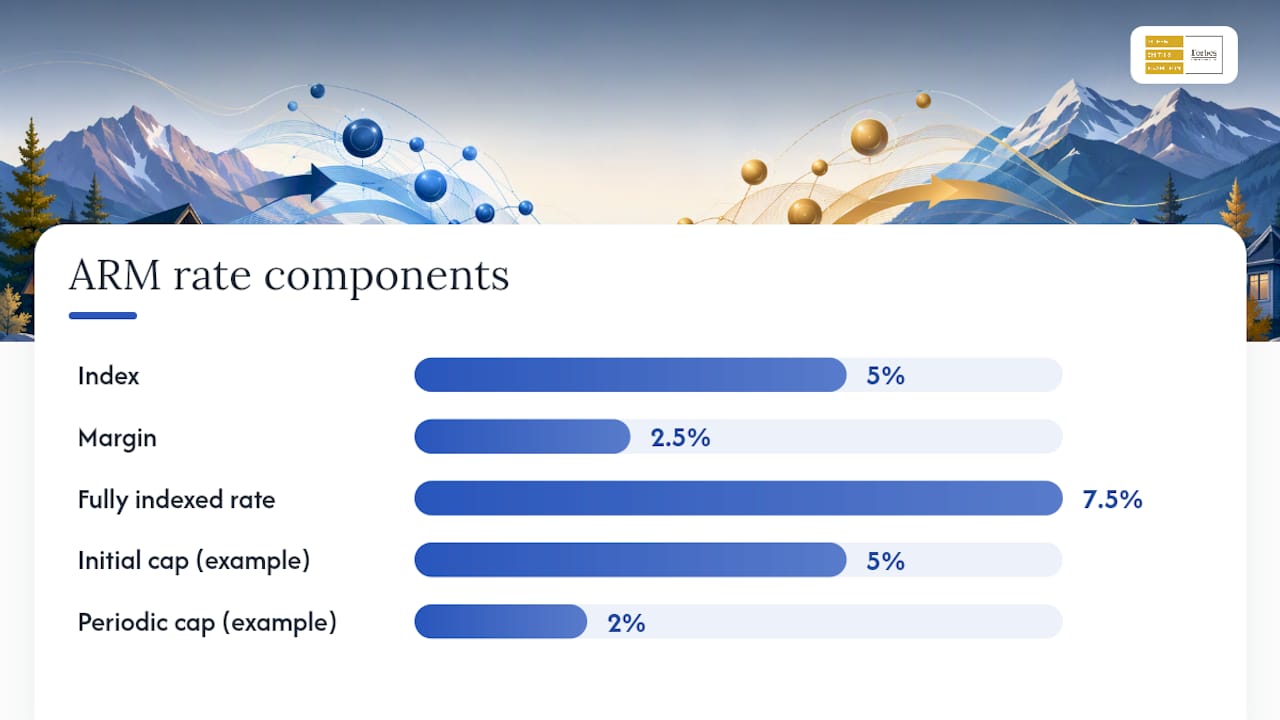
The "5/1" in a 5/1 ARM means the rate stays fixed for five years, then adjusts once every year after that. A 7/1 or 10/1 ARM works the same way, just with a longer initial runway.
Caps control how far that adjustment can swing, and they usually come in three layers:
- Initial cap: the maximum increase allowed at the first adjustment.
- Periodic cap: the maximum increase allowed at each adjustment after that.
- Lifetime cap: the ceiling your rate can never exceed for the life of the loan.
A common cap structure is written as 5/2/5, meaning the rate can rise up to 5% at the first adjustment, no more than 2% at each adjustment after that, and never more than 5% above your starting rate over the loan's lifetime, according to Chase's ARM guidance. Worth noting: some ARMs also limit how far your rate can drop, so a falling index won't always translate into instant savings, per the Consumer Financial Protection Bureau.
Which Mortgage Fits Your Situation Best?
Fixed-rate mortgages reward patience. Your payment stays flat regardless of what the Federal Reserve does next, which makes budgeting simple and protects you if rates climb after closing. That predictability acts as a built-in inflation hedge on your single biggest monthly expense.
ARMs reward a shorter timeline. If you know you're moving in four years, or you're an investor planning to sell before the adjustment period, the lower introductory rate can mean real savings without ever facing the reset.
Fixed-rate mortgage strengths:
- Predictable budgeting for the full loan term
- No exposure to rate spikes after closing
- Simpler comparison shopping across lenders
ARM strengths:
- Lower initial payment frees up cash flow early on
- Useful for short holding periods or planned refinances
- Can work well for buyers expecting rising income
The risk on the ARM side is payment shock, a sudden jump in your monthly payment once the fixed period ends and the market hasn't cooperated. Qualification standards also differ slightly. Lenders generally evaluate ARM borrowers against a higher stress-tested payment to confirm they can handle the loan even if rates move against them, which is one reason Freddie Mac frames the ARM decision around how confident you are in your timeline.
How Do You Decide Between Fixed and Adjustable?
The single most useful exercise before signing anything is stress-testing the loan at its fully adjusted, capped payment, not the teaser rate advertised in your quote. Freddie Mac's core guidance boils down to one question: can you afford this loan if you never sell and never refinance?
Run through this checklist with your actual numbers:
- Estimate your holding period. Are you likely to stay five years, ten years, or indefinitely?
- Check your emergency reserves. Could you absorb several months of a higher payment if the market shifted?
- Calculate the lifetime-cap payment. Add your margin to a stressed index value, apply the lifetime cap, and run a full amortization at that rate.
- Compare that number to your budget and debt-to-income ratio, not just your current payment.
- Pressure-test your refinance plan. Would you still qualify to refinance if home values dropped or your income changed?
When you talk to lenders, ask them directly: What index does this loan use? What's the margin? What are the initial, periodic, and lifetime caps? Can you show me the payment at the lifetime cap, in writing?
Pro Tip: Ask your lender to print the fully indexed, worst-case payment on your loan estimate. If you can't comfortably afford that number today, the ARM's low starting rate is a temporary discount, not a long-term plan.
What Do 3/1, 5/1, 7/1, and 10/1 Actually Mean?
The number before the slash tells you how many years your rate stays fixed. The number after tells you how often it adjusts afterward, almost always annually.
- 3/1 ARM: Fixed for three years, then adjusts yearly. Deepest initial discount, shortest runway.
- 5/1 ARM: Fixed for five years, a common middle-ground choice for buyers planning a mid-length stay.
- 7/1 ARM: Fixed for seven years, giving more breathing room before the first reset, as Chase outlines.
- 10/1 ARM: Fixed for a full decade, often a pragmatic compromise for buyers who don't want a 30-year fixed rate but also don't want to gamble on a short window.
Shorter initial periods generally carry bigger rate discounts against the 30-year fixed, since the lender is taking on less long-term rate risk. A snapshot from Bankrate showed 5/1 ARMs averaging 6.13% against 6.60% for 30-year fixed loans, a gap of roughly half a percentage point that illustrates the trade-off in action, per Bankrate's ARM breakdown. For buyers eyeing a five to ten year plan, a 10/1 often threads the needle between savings and safety.
Why Refinancing Isn't a Guaranteed Escape Hatch
Plenty of ARM borrowers plan to refinance before their rate ever adjusts. That plan only works if three things line up: you have enough home equity, your credit still qualifies you for a new loan, and market rates haven't climbed past where they were at your original closing.
Any one of those can fail. A dip in home values can erase the equity you were counting on. A job loss or income drop can tank your qualifying ratios right when you need to refinance most. And if market rates rise broadly, a "refinance" might just swap one adjustable headache for a worse fixed rate.
Mortgage analysts generally caution against treating a future refinance as a certainty; model your finances as if the refinance never happens. If that math doesn't work, three protective moves help: build bigger cash reserves, choose an ARM with a longer initial fixed period like a 7/1 or 10/1, or simply choose the fixed-rate loan and remove the variable entirely.
Where Have Rates Been Headed, and Why Does It Matter?
Mortgage rates move with broader economic forces, including Federal Reserve policy, inflation expectations, and investor demand for mortgage-backed securities. That relationship matters directly to the fixed versus adjustable decision, because it shapes both your starting rate and what your ARM might look like at its first reset.
The FRED 30-year fixed rate series tracks the national average going back decades, and it shows how dramatically conditions can shift within a single ARM's initial period. A borrower who took a 5/1 ARM expecting rates to stay low could face a very different market by year five, depending on how inflation and Fed policy evolve in the meantime.
This is exactly why the "just refinance later" plan carries real risk. Rate cycles don't move on a predictable schedule, and a 5/1 or 7/1 ARM taken during a low-rate window can mature right as rates have climbed. Fixed-rate borrowers sidestep that uncertainty entirely, trading a potentially higher starting rate for total insulation from future rate cycles.
Buyers who track current averages before shopping put themselves in a stronger negotiating position. Comparing today's spread between ARM and fixed offers against historical norms helps you judge whether an ARM's discount is unusually wide (a stronger case for taking it) or unusually thin (a weaker one). Checking the FRED series before you lock a rate takes a few minutes and can reshape your entire strategy.
Does Your Credit Score Change Which Loan Makes Sense?
Credit score affects pricing on both fixed and adjustable loans, but it interacts with ARMs a bit differently because lenders also need confidence you can handle the loan at its stress-tested, fully adjusted payment.
Borrowers with higher credit scores typically get access to the best pricing on either product, plus more lender options overall. Where it gets more interesting is at the margin: because your ARM's margin is set at closing and never changes, a stronger credit profile at application can lock in a lower margin for the entire life of the loan, even decades after your score might change.
Debt-to-income ratio plays an outsized role in ARM qualification specifically. Lenders often underwrite ARMs against a higher, stress-tested payment rather than the discounted introductory rate, so a borrower who qualifies easily for a fixed loan might find their ARM approval amount is more conservative. This is a protective measure. It exists because payment shock is a real risk if the loan resets during a period of higher rates.
Self-employed buyers, those with variable income, or anyone with a thinner credit file should pay particular attention here. A fixed-rate loan gives lenders one number to underwrite against for the full term. An ARM asks them to underwrite against a moving target, which can mean more documentation requests or a more conservative approved amount, even at an identical credit score.
How Do Total Costs Compare Over 15 and 30 Years?
The math changes considerably depending on how long you actually hold the loan, which is the entire reason "time horizon" dominates the fixed versus adjustable decision.
On a 30-year term, a fixed-rate loan means paying the same rate on a shrinking balance for three full decades. Total interest paid is fully predictable at closing, and you can calculate it to the dollar. An ARM on the same 30-year term introduces a wildcard: interest costs for the first several years might run lower than the fixed alternative, but everything after the adjustment date depends on where the index lands. In a scenario where rates rise steadily, an ARM borrower who keeps the loan the full term can end up paying meaningfully more total interest than if they'd chosen fixed at closing, especially once the lifetime cap gets tested.
On a 15-year term, the calculus shifts again. Faster amortization means less total interest overall on either product, and the shorter timeline itself reduces ARM exposure, since there's simply less time for multiple adjustment cycles to compound against you.
Here's the practical takeaway: the shorter you plan to hold the loan relative to the ARM's initial fixed period, the more the ARM's discount works purely in your favor. The longer you hold it past that point, the more the comparison depends on interest rate cycles you can't predict at closing. Buyers who genuinely don't know how long they'll stay should weight that uncertainty heavily toward the fixed-rate option, or toward an ARM with a longer initial period like a 10/1.
Do Fixed and Adjustable Mortgages Get Taxed Differently?
Mortgage interest deductibility works the same way regardless of whether your loan is fixed or adjustable. The IRS allows homeowners who itemize to deduct interest paid on acquisition debt up to the current limits, and that rule applies to the interest actually paid each year, not the loan structure that produced it.
Where it gets practically different is the amount of interest you can deduct in a given year, since that number moves with your rate. A fixed-rate loan produces a smooth, predictable interest deduction that declines gradually as your balance amortizes. An ARM's deductible interest amount can shift more sharply once the loan adjusts, since a rate increase raises your interest paid (and therefore your potential deduction) while a rate decrease lowers it.
This cuts both ways for tax planning. A borrower whose ARM adjusts upward gets a larger interest deduction in that tax year, which partially offsets the higher payment, though it rarely offsets it completely. Because tax rules and itemization thresholds change and vary by individual circumstances, confirm your specific situation with a tax professional or the IRS's own guidance rather than assuming either loan type carries an automatic tax advantage. Neither fixed nor adjustable mortgages come with a special deduction the other doesn't get; the deduction simply tracks whatever interest you actually paid that year.
Local Considerations for Summit County Buyers
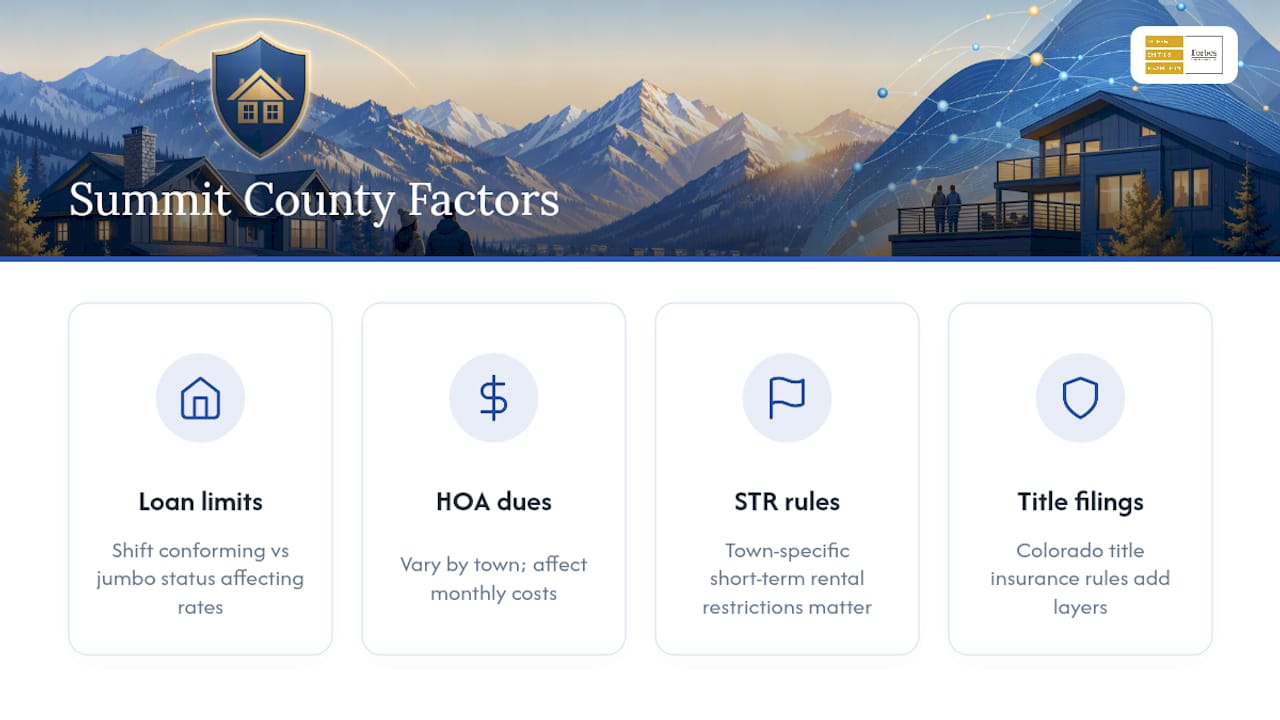
Mortgage choice gets more layered once you're shopping in Keystone, Breckenridge, Frisco, Dillon, Silverthorne, Copper Mountain, or Blue River. County loan limits affect what qualifies as a conforming loan versus a jumbo loan in Summit County, and that distinction can shift your rate options on either a fixed or adjustable product. HOA dues, town-specific short-term rental rules, and Colorado's own title insurance filings add layers that a generic national mortgage guide simply won't cover, and they're worth separating out from your rate decision rather than lumping them together.
If you're weighing a 5/1 ARM against a 30-year fixed on a Summit County property, those local factors, loan limits, HOA obligations, and STR restrictions in your target town, deserve their own conversation before you lock anything with a lender.
Local real estate professionals work with buyers across Keystone, Breckenridge, Frisco, Dillon, and Silverthorne who are trying to line up the right mortgage structure with the right property, not just the right rate. Local knowledge matters here: a condo in Keystone carries different HOA and rental considerations than a home in Frisco or a listing in Dillon, and those factors shape whether a fixed or adjustable loan makes more sense for your specific purchase. If you're ready to talk through your timeline, budget, and target neighborhood in Summit County, reach out through the contact page to start the conversation with Jayden directly.
Sources
For the full mechanics of ARM caps and terminology, the Consumer Financial Protection Bureau's ARM explainer is a reliable starting point. Freddie Mac offers additional guidance on choosing between fixed and adjustable loans based on your timeline. For current rate context, check Bankrate's ARM comparisons and the FRED 30-year fixed rate series. To verify any lender's licensing, search NMLS Consumer Access.
This article is general information, not a substitute for advice from a qualified financial advisor. Consult a qualified financial professional about your own circumstances before acting on anything here.