

A rental cap is usually enforceable if it's recorded in the community's CC&Rs and adopted through the right process, but whether it applies to you depends on when you bought your unit and what your state statute allows. Your first move is simple: pull the recorded CC&Rs and any amendments, then check the effective date against your closing date.
TL;DR:
- Rental caps vary by state law, with California requiring restrictions stricter than 25% to be amended and enforced properly.
- Valid amendments to rental caps typically require a supermajority vote and recording with the county to be legally enforceable against owners.
- Enforcement involves notices, fines, liens, and court actions, but owners often challenge enforcement based on grandfathering or improper rule adoption.
- Buyers should verify recorded CC&Rs, current rental counts, and waitlist status before assuming rental rights or financing eligibility.
- In resort communities, seasonal demand causes waitlists to extend beyond one season, so understanding local building-specific rules is vital before purchasing.
Table of Contents
- What Is an HOA Rental Cap?
- How Do HOAs Legally Adopt Rental Caps?
- Do State Laws Limit How Strict a Rental Cap Can Be?
- What Are the Trade-Offs of Rental Caps?
- How Do Associations Enforce Rental Restrictions?
- What Should You Do Next, Depending on Your Role?
- A Local Perspective: Rental Caps in Resort Communities
- Editorial Perspective: What the Conventional Advice Misses
- How Vacationhomesforsalecolorado Helps You Navigate Rental Rules
- Sources
What Is an HOA Rental Cap?
A rental cap limits how many units in a community can be leased at any given time. Associations typically use one of two structures: a percentage cap (say, no more than 20% of units rented) or a numeric cap (a flat number, like "no more than 40 of the 200 units"). When a community hits that ceiling, owners who still want to rent usually land on a waitlist until a slot opens.
Rental caps rarely travel alone. Boards often pair them with related restrictions that shape how leasing works in practice:
- Minimum lease terms requiring 30 to 180 days, which effectively blocks short-term or vacation rentals
- Owner-occupancy requirements demanding the owner live in the unit for a set period before leasing it out
- Short-term rental (STR) bans that treat Airbnb-style stays differently from standard leases
These forms of restriction commonly range from 10% to 30% of total units, depending on the community's size, financing needs, and lender relationships. In a 300-unit building, a 20% cap allows 60 rentals; in a 40-unit building, that same percentage allows only eight.
How Do HOAs Legally Adopt Rental Caps?
Whether a rental cap needs a full membership vote or just a board decision depends on where the rule lives. If the restriction is written into the Declaration (the CC&Rs), amending it almost always requires a formal vote, often a supermajority of owners, sometimes as high as 67% depending on the governing documents and state law. If the association is only adopting an operating rule under its existing rulemaking authority, the board may be able to act without a full membership vote, though this is riskier and more open to legal challenge.
The typical path to a valid amendment looks like this:
- The board drafts proposed language addressing the cap, grandfathering, and enforcement mechanics.
- An association attorney reviews the draft against state statute and the existing governing documents.
- Owners vote, usually requiring the supermajority threshold specified in the CC&Rs.
- The amendment is recorded with the county to become enforceable against current and future owners.
Courts generally uphold rental restrictions that were properly adopted and are uniformly enforced, which is exactly why skipping the recordation step or applying a rule selectively creates the openings owners use to challenge caps later.
Pro Tip: Ask your management company for the recorded amendment, not just the CC&R booklet you got at closing. Booklets go stale; recorded documents are the legal record.
Do State Laws Limit How Strict a Rental Cap Can Be?
State law is where a lot of homeowners get surprised, because a cap that looks airtight on paper can be partially unenforceable depending on where the property sits. Rules vary widely from state to state, and a few examples show the range:
- California set a statutory floor: since January 1, 2021, caps stricter than 25% are unenforceable, and associations had to amend their documents to comply.
- Florida has developed grandfathering nuances through case law that often protect owners who purchased before a rental restriction was recorded.
- Texas allows associations more latitude but frequently requires tenant approval processes tied to background and credit checks.
- Colorado communities commonly pair supermajority voting requirements with explicit grandfathering language protecting existing owner-investors.
A cap also has to coexist with local short-term rental ordinances and with fair housing or source-of-income protections, which can complicate enforcement if a restriction disproportionately affects a protected group. Because this area shifts often, check your state's official HOA statute page or consult a local real estate attorney before assuming a cap applies to you exactly as written.
What Are the Trade-Offs of Rental Caps?
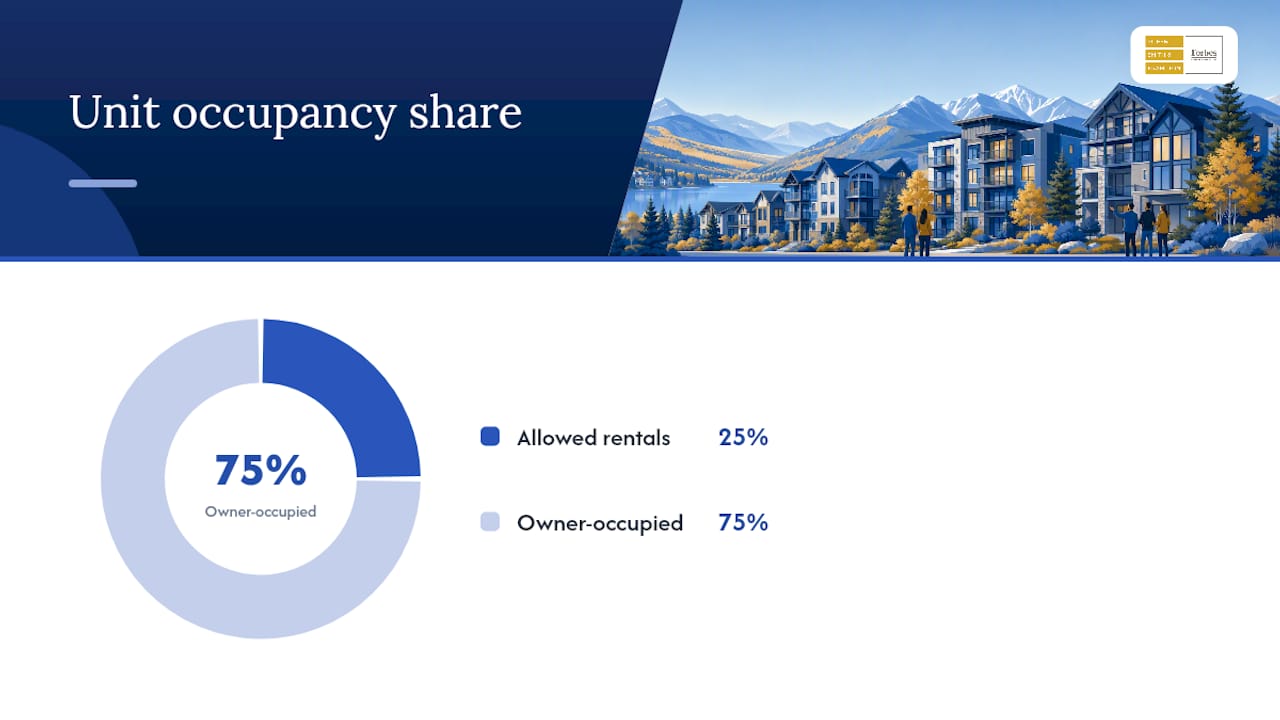
Boards adopt caps for real reasons, but those reasons come with costs that fall on individual owners.
Why boards like caps:
- They protect financing eligibility, since many lenders decline loans in projects where rental concentration crosses a threshold.
- They encourage owner-occupancy, which tends to reduce turnover and complaint volume.
- They can lower a lender's perceived risk profile for the whole project.
Why owners and investors push back:
- Caps remove income flexibility for owners who bought specifically to rent.
- Waitlists can stretch for months in popular buildings, shrinking realistic investor demand.
- Administration, legal review, and ongoing enforcement carry a real cost that boards frequently underestimate.
A 25% cap sounds generous until you look at a 200 unit building with heavy seasonal turnover, where a waitlist can stretch across an entire ski season and meaningfully shrink your resale buyer pool.
How Do Associations Enforce Rental Restrictions?
Enforcement almost always follows a predictable sequence rather than jumping straight to litigation:
- Notice of violation — the association flags the unauthorized lease and gives the owner a chance to respond.
- Fines, often assessed daily until the violation is cured.
- Lien placement if fines and legal fees go unpaid, which can block a future sale or refinance.
- Injunctive relief as a last resort, where the association goes to court to force compliance.
Owners facing enforcement often raise two defenses: that they're grandfathered under an earlier version of the rule, or that the amendment itself was improperly adopted without proper recordation or the required vote. Selective enforcement, where a board fines one owner but ignores identical violations elsewhere, is one of the more common grounds for a successful challenge.
What Should You Do Next, Depending on Your Role?
The right move depends on whether you're buying in, already own, or sitting on the board.
If you're a prospective buyer:
- Request the recorded CC&Rs and current rental count directly from the management company, not the listing agent.
- Ask how a cap could affect your financing, since some loan programs restrict lending in projects near a rental concentration limit.
- Ask for the current waitlist length before assuming you can rent immediately.
If you already own and want to rent:
- Confirm whether you're grandfathered by checking your closing date against the amendment's recorded effective date.
- Document every rental inquiry and waitlist request with dates, since disputes often hinge on timing.
- Consider lease-term strategy carefully. A 6-month lease may satisfy a minimum-term rule that a 3-month stay would violate.
If you sit on the board:
- Commission a legal review before drafting any amendment language.
- Model the financing impact using your lender relationships before setting a specific percentage.
- Write explicit grandfathering language and test it against your state statute before the membership vote.
Pro Tip: A management platform like HomeRent can help track waitlist order and lease dates, but it doesn't replace an attorney's read of your specific CC&R language.
A Local Perspective: Rental Caps in Resort Communities
In vacation-rental-heavy markets like Summit County, rental caps carry extra weight because seasonal demand concentrates around ski season and summer weekends. A 25% cap in a resort condo building can produce a waitlist that outlasts an entire season, which changes how you should evaluate a purchase. Before writing an offer on a property you plan to rent, bring the recorded CC&Rs, the current rental count, and your lender's occupancy threshold to a local agent or attorney who knows the specific building's history.
Editorial Perspective: What the Conventional Advice Misses
Most guides on rental caps treat the legal question as the whole story: is the cap enforceable, yes or no. That framing misses what actually determines your outcome, which is timing and documentation, not just statute language. I've seen the research on this consistently point to grandfathering disputes and improper adoption, not the cap percentage itself, as the real battleground.
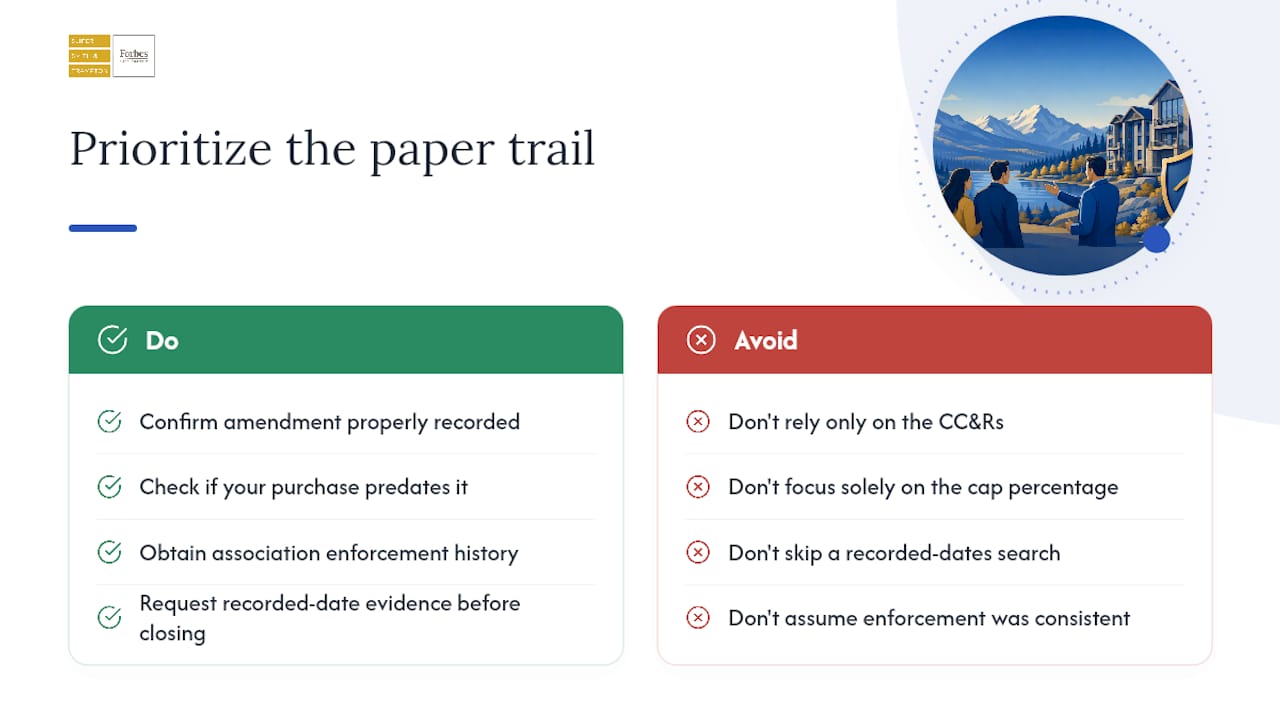
The overrated piece of advice is "just read your CC&Rs." Reading them tells you the current rule. It tells you nothing about whether the amendment was properly recorded, whether your purchase predates it, or whether the association has enforced it consistently. Those three facts matter more than the number in the document.
If you take one thing from this, prioritize the paper trail before the percentage. A 30% cap you're grandfathered against is worth more than a 15% cap you're not. Buyers in particular skip this step because they're focused on price and square footage, not recorded amendment dates, and that's exactly the gap that creates costly surprises after closing.
— Jayden
How Vacationhomesforsalecolorado Helps You Navigate Rental Rules
Vacationhomesforsalecolorado gives Summit County buyers and owners something a generic search of CC&R language can't: a local read on how a specific building's rental cap actually plays out season to season, before you're locked into a contract. Jayden pulls recorded CC&Rs, checks current rental counts and waitlist position, and flags how a cap could affect your financing or resale pool in Breckenridge, Keystone, Frisco, Silverthorne, and Dillon.

If you're evaluating a ski condo or investment property anywhere in Summit County, browse current listings or reach out to schedule a consultation before you write an offer. Remote buyers get the same document review; in-person walkthroughs are available for anyone visiting the area to tour properties directly.