

In Colorado, an HOA is a private association funded by dues, while a metro district is a Title 32 special district that finances infrastructure through property taxes. Either one can attach to a Summit County property, and many communities in Keystone, Breckenridge, Frisco, Dillon, and Silverthorne have both at once. The two answer to different laws, different boards, and different collection tools, so a buyer who checks only one is checking half the picture.
TL;DR:
- Most properties in Summit County can be subject to both HOA fees and metro district taxes, requiring buyers to check both systems thoroughly.
- HOA fees are private charges based on CC&Rs, while metro district taxes are public property taxes that can have lien priority over mortgages.
- Metro districts often finance large infrastructure projects through bonds, with debt remaining for years, which can influence property taxes and district stability.
- Transparency laws differ, with metro districts mandated to hold open meetings and disclose financial data publicly, unlike HOAs.
- Buyers should request and review detailed district and HOA documents, including service plans, budgets, and debt schedules, before making a purchase decision.
Table of Contents
- HOA vs Metro District: The Comparison Colorado Buyers Need
- What Is an HOA in Colorado?
- What Is a Metro District, and How Does It Work?
- Governance and Transparency: Who Actually Runs Things?
- Money, Liens, and Foreclosure Risk
- Weighing the Trade-Offs Before You Buy
- Your Buyer Checklist Before Signing Anything
- What Happens When a District or HOA Changes Over Time?
- What the State Task Force Found About Metro District Homeowner Protections
- How Jayden Vermeer Realtor Helps You Sort Out HOA and District Exposure
- Sources
- FAQ
HOA vs Metro District: The Comparison Colorado Buyers Need
Before you tour another listing in Summit County, it helps to see the two side by side.
- Who governs: HOAs run on a board elected by unit owners under CC&Rs; metro districts run on a public board that starts developer appointed and later transitions to resident elections.
- How they raise money: HOAs bill dues and special assessments directly to owners; metro districts levy property taxes (mill levies) and often repay construction bonds through those taxes.
- Where the charge shows up: HOA dues arrive as a separate invoice from the association; district costs are folded into your annual county property tax bill.
- Legal foundation: HOAs follow the Colorado Common Interest Ownership Act; metro districts are formed under the Special District Act, Title 32 of the Colorado Revised Statutes.
- Lien priority: Metro district tax liens can outrank a first mortgage; HOA liens carry more limited priority in most cases.
- Typical services: HOAs maintain shared amenities and enforce community standards; metro districts often build and operate roads, water systems, parks, and recreation centers.
Coexistence is common, not rare. A neighborhood can have a metro district paying off the roads and utilities while an HOA next door enforces landscaping rules and runs the clubhouse.
What Is an HOA in Colorado?
A homeowners association is a private, nonprofit corporation created when a developer files a declaration of covenants, conditions, and restrictions, known as CC&Rs, with the county recorder. That filing establishes the association's authority the moment lots or units start selling. In Colorado, HOAs operate under the Common Interest Ownership Act, which sets baseline member rights, disclosure duties, and voting rules.
Funding comes from mandatory dues, usually billed monthly, quarterly, or annually, plus occasional special assessments when reserves fall short of a major repair. A reserve study, which projects future capital costs like roof replacement or repaving, should back up those numbers. CCIOA gives members the right to inspect financial records and meeting minutes, and it governs how votes on budget increases or rule changes get counted.
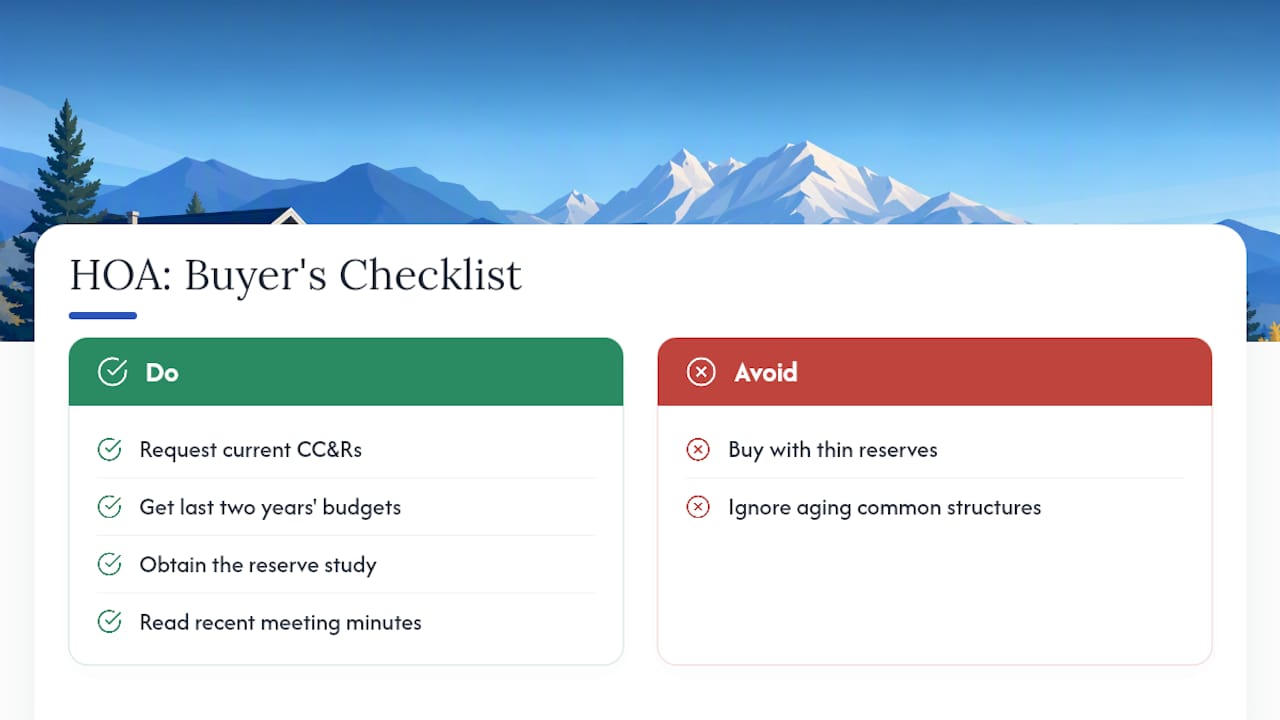
Before you buy into an HOA community, request the current CC&Rs, the last two years of budgets, the reserve study, and recent meeting minutes. Thin reserves paired with an aging clubhouse or parking structure is the kind of combination that produces a surprise special assessment right after closing.
What Is a Metro District, and How Does It Work?
A metropolitan district is a quasi-municipal government formed under Title 32 to build and operate public infrastructure that a town or county isn't funding directly. Formation requires a service plan, a detailed proposal covering what the district will build, how much it can borrow, and what limits apply, which the local government reviews and approves before the district can issue bonds or levy taxes.
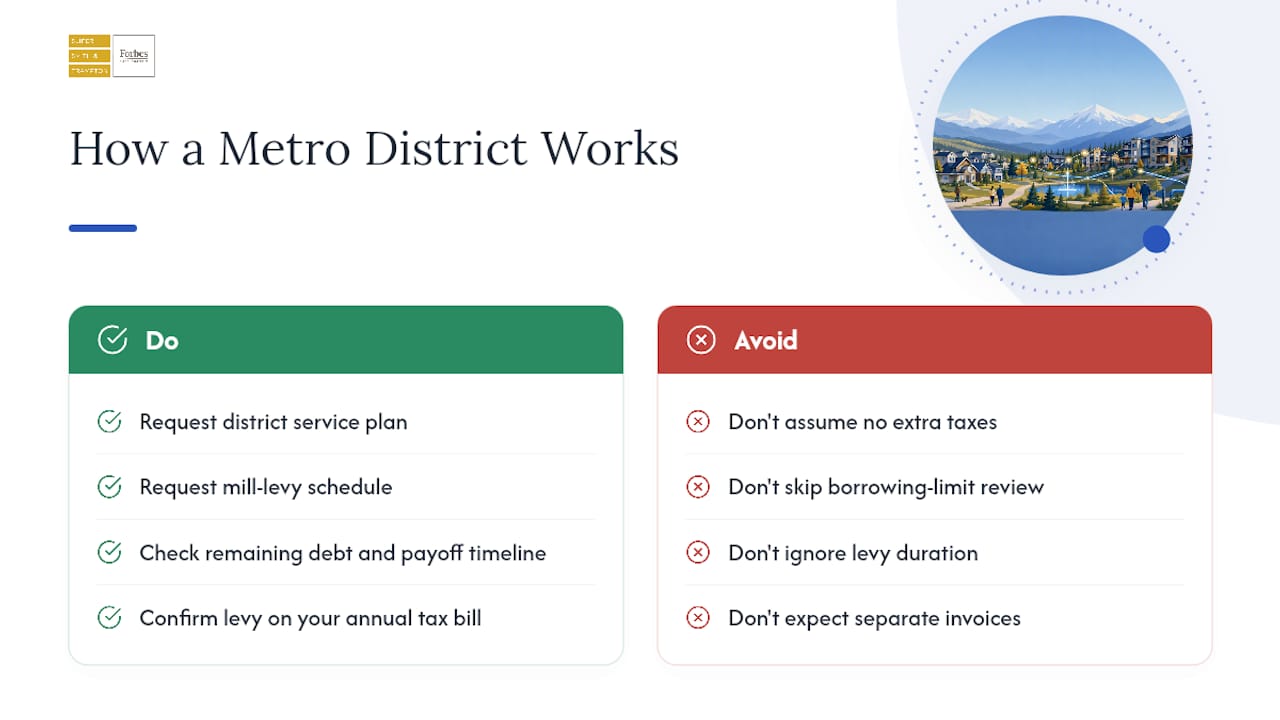
Metro districts commonly finance roads, water and sewer lines, parks, and recreation centers, the kind of large infrastructure a builder would otherwise have to fund upfront. They pay for it by issuing bonds, then repaying that debt through a mill levy applied to every property inside the district boundary. That levy shows up alongside your county and school taxes on the same annual tax bill; it doesn't arrive as a separate invoice.
Before buying, ask for the district's service plan and its current mill-levy schedule. Both documents tell you how much debt remains and how long you can expect to keep paying it down.
Governance and Transparency: Who Actually Runs Things?
Newly formed metro districts almost always start with a developer-appointed board, since builders need control while infrastructure gets built and financed. State law eventually requires a shift toward resident-elected boards, though the transition timeline varies by district and depends on when enough homes are occupied to hold a meaningful election.
The oversight rules differ sharply once you look past the board itself. Metro districts, as public entities, must follow Colorado's open meetings requirements and public budget law, meaning their meetings, budgets, and financial reports are open records anyone can request. HOAs answer to CCIOA's disclosure rules instead, which give members inspection rights but don't carry the same public-meeting obligations. If you want to know who's actually calling the shots in a given neighborhood, pull the district's recent meeting minutes and check when the next board election is scheduled.
Money, Liens, and Foreclosure Risk
HOA dues are private contractual assessments; metro district charges are property taxes, which affects how unpaid amounts are collected and enforced.
Pro Tip: A metro district's tax lien can jump ahead of your mortgage in a foreclosure, which is exactly why lenders and title companies pay close attention to district debt before closing.
Metro district liens are enforced like tax liens, and the Colorado Division of Real Estate confirms they can be superior to a first deed of trust in many cases. HOA liens are more limited in priority under Colorado law, which generally caps how much of a super-lien can jump ahead of a mortgage. In practice, that superior status means district debt rarely gets written off, which is good for collection reliability but means unpaid or growing district debt is a genuine risk factor for a buyer, not just an inconvenience.
Ask your lender directly how outstanding district bonds affect your loan approval, and request the district's debt-service schedule so you know whether the mill levy is likely to rise, hold steady, or start declining as bonds get retired.
Weighing the Trade-Offs Before You Buy
An HOA keeps common areas maintained and enforces the community standards that protect resale value, but that comes with recurring dues and the possibility of a special assessment if reserves run short. A metro district delivers real infrastructure, roads, water systems, recreation centers, and answers to public transparency laws an HOA never has to follow, but its property-tax addition can run for years while bonds remain outstanding.
Where both exist, expect either duplication (an HOA fee and a district mill levy covering separate things) or a complementary split, with the district handling infrastructure and the HOA handling amenities and covenant enforcement. In newer developments around Keystone, Breckenridge, Frisco, Dillon, and Silverthorne, this dual structure is increasingly the norm rather than the exception.
Your Buyer Checklist Before Signing Anything
Work through these steps before you go under contract on a property tied to either structure:
- Request the HOA's CC&Rs, current budget, and reserve study.
- Request the metro district's service plan, debt-service schedule, and most recent audited financial statements.
- Pull recent board and district meeting minutes to see how governance actually operates.
- Ask directly: is this property inside a metro district, and are its infrastructure projects finished or still under construction?
- Confirm the current mill levy and how many years of bond debt remain outstanding.
Watch for red flags: a recent large special assessment, a developer-controlled board with no stated transition timetable, or a service plan with vague limits on future levies. Confirm recorded documents with the county clerk and recorder, and direct any statutory questions to the Colorado Division of Local Affairs or the Colorado Division of Real Estate.
What Happens When a District or HOA Changes Over Time?
Metro districts don't necessarily last forever. Once bonds are paid off, a district can dissolve, transfer its assets to an HOA, or simply continue operating the infrastructure it built. Which path happens depends heavily on the service plan's own terms and the tax-exempt status tied to outstanding bonds, which can make an early transfer legally complicated.
Ask specifically whether the service plan caps mill levies or sets a bond repayment timeline, and ask your agent or the district's manager what happens to services once that debt is retired. A district that's ten years from paying off its bonds is a very different ownership picture than one entering its final year.
What the State Task Force Found About Metro District Homeowner Protections
The Metropolitan District Homeowners' Rights Task Force, created under HB23-1105, spent 2024 examining exactly the friction points covered above: tax-levying practices, foreclosure procedures, homeowner communications, governance transitions, and the path toward converting districts into common-interest communities. Its final report recommends stronger disclosure requirements and better public communication so residents aren't blindsided by mill-levy increases or bond decisions made before they moved in.
For Summit County buyers, that report is worth reading directly rather than taking secondhand, since pending legislative changes could affect disclosure timing and foreclosure practice in districts you're considering. Pair it with current guidance from the Colorado Division of Real Estate and Division of Local Affairs before you finalize any purchase involving district debt.
How Jayden Vermeer Realtor Helps You Sort Out HOA and District Exposure
Reviewing CC&Rs, service plans, and mill-levy schedules on your own is doable, but cross-referencing them against a specific listing takes local knowledge most buyers don't have time to build from scratch. Some real estate professionals work these documents daily across Summit County and can flag what a debt-service schedule or a thin reserve study actually means for your monthly costs before you write an offer.
Whether you're weighing a condo tied to a metro district in Keystone, a Breckenridge HOA with an aging amenity package, or a newer build in Frisco, Dillon, or Silverthorne still carrying bond debt, getting the disclosures pulled and explained in plain terms before you make an offer changes how you negotiate. A skilled real estate agent can request the right paperwork on your behalf, walk you through what it means for your budget, and pull comparable listings so you know whether the price already reflects the district's outstanding debt. Browse current inventory in Keystone condos and townhomes or Breckenridge condos for sale, or start with a free home value estimate if you're weighing a sale on the other side of these same rules. None of this replaces legal or tax advice. For binding interpretations of a CC&R clause or a district's bond covenant, talk to an attorney or CPA. For everything else, from finding the right listing to knowing which questions to ask, reach out to Jayden Vermeer directly.
This article is general information, not a substitute for advice from a qualified financial advisor. Consult a qualified financial professional about your own circumstances before acting on anything here.
Sources
- Colorado Division of Real Estate — CCIOA and other state, local and federal laws
- Southeast Public Improvement Metropolitan District — What is a metropolitan district?
- Metropolitan District Homeowners' Rights Task Force final report (HB23-1105) — 2024
- Colorado Division of Local Government — Open meetings requirements
FAQ
What Is the Difference Between an HOA and a Metro District?
An HOA is a private nonprofit that collects dues under CC&Rs filed with the county, while a metro district is a public entity formed under Title 32 that finances infrastructure through property taxes. A single Colorado property can fall under one, both, or neither, so checking both is essential before you buy.
What Are the Pros and Cons of Living in a Metro District in Colorado?
Metro districts fund real infrastructure, roads, water systems, and recreation centers, and operate under public transparency laws that require open meetings and public budgets. The trade-off is an added property-tax mill levy that can last for years while bonds remain outstanding, sometimes continuing even after debt is paid if the district keeps operating the infrastructure.
Why Are HOA Fees So High in Colorado in Some Communities?
HOA fees rise when reserve studies show major repairs coming, insurance costs climb, or the association covers extensive amenities like pools, trails, or clubhouses. A thin reserve fund combined with an aging building is the most common driver behind a sudden special assessment on top of regular dues.
What Are the Newer Rules Affecting Homeowners Associations and Metro Districts in Colorado?
The HB23-1105 Task Force recommended stronger disclosure and communication requirements for metro districts, focused on tax-levying practices, foreclosure procedures, and governance transitions. Buyers should check current guidance from the Colorado Division of Real Estate and Division of Local Affairs, since related legislative changes are still being considered.