
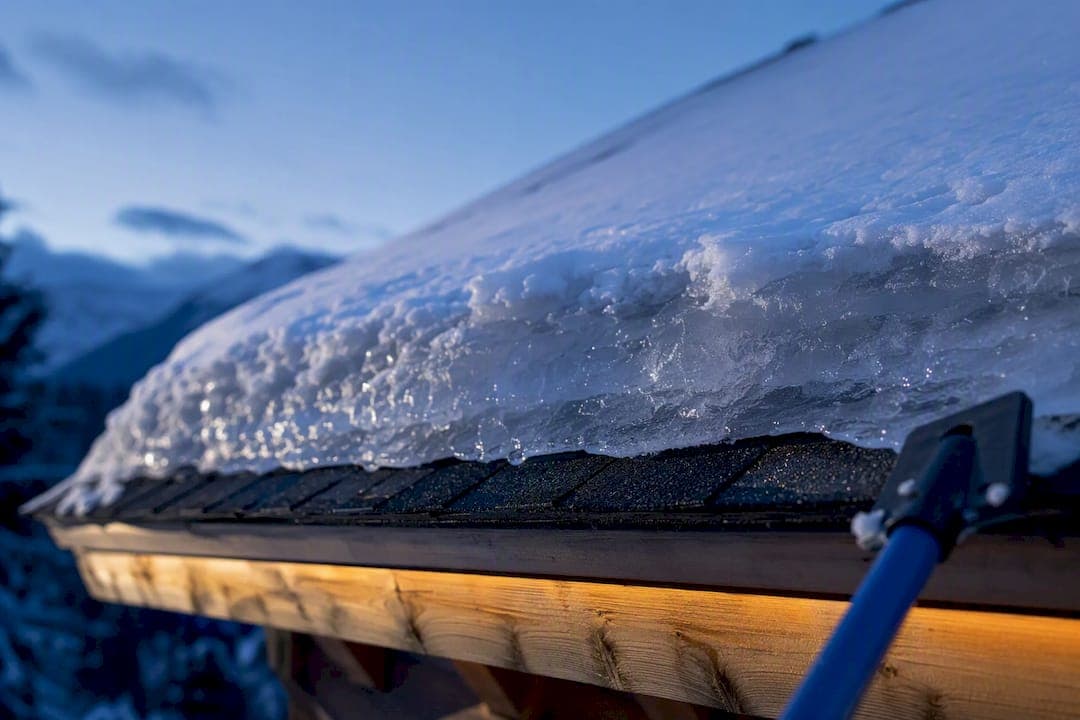
The most reliable way to handle ice dam prevention is to stop warm air from entering the attic in the first place. Air seal first, then bring insulation up to R-49 or R-60 and balance the soffit-to-ridge ventilation. This winter, rake snow off the eaves, keep gutters clear, and treat temporary drainage tricks as stopgaps only. If ice dams keep coming back, a blower-door test and infrared scan will find the real problem before you spend money on a permanent fix.
TL;DR:
- Raking snow from the ground on the eaves and keeping gutters clear can temporarily reduce ice dam formation but do not address underlying attic heat leaks.
- Attic air sealing and increasing insulation to R-49 or R-60 are essential steps to prevent heat escape that causes ice dams.
- Infrared scans and blower-door tests are key diagnostic tools to identify hidden attic leaks before making permanent repairs.
- Heated roof cables and ice-and-water shield manage dam symptoms but do not stop their formation, which is driven by heat escaping the attic.
- Combining proper attic sealing, insulation, and balanced ventilation is the most effective long-term strategy for ice dam prevention.
Table of Contents
- How Ice Dams Form on Colorado Roofs
- What Can You Do About Ice Dams Right Now?
- Do Membranes and Heat Cables Actually Stop Ice Dams?
- How Do You Fix Ice Dams for Good?
- What Do Blower-Door Tests and Infrared Scans Actually Find?
- What Should You Do if an Ice Dam Is Already Leaking?
- Local Next Steps for Summit County Homeowners
- Sources
- FAQ
How Ice Dams Form on Colorado Roofs
Ice dams form when heat escaping from the attic warms the upper roof deck enough to melt accumulated snow. That meltwater runs down the roof and refreezes the moment it hits the colder eaves, where there's no warm attic below to keep the surface above freezing. Layer after layer of refreeze builds a ridge of ice that traps water behind it, and that water finds its way under shingles.
Three things drive these in Summit County homes: air leaks funneling warm household air into the attic, insulation that's too thin to block heat transfer, and roof geometry that creates warm and cold zones side by side (a dormer next to a shaded valley, for instance). Fixing the freeze-thaw cycle means fixing the temperature difference across the roof, which is exactly why attic air sealing and insulation come before anything else on the priority list.
What Can You Do About Ice Dams Right Now?
You don't need a contractor to buy yourself some breathing room this week. A few low-cost, low-risk moves reduce the snow load and water volume that feed an ice dam while you plan the bigger retrofit.
- Roof rake from the ground. Pull snow off the lower three to four feet of roof along the eaves, working from the ground with an extendable rake. Never climb onto an icy roof to do this. Stand clear of the fall zone, since sliding snow and ice chunks can drop without warning.
- Clear gutters and downspouts before the first hard freeze so meltwater has somewhere to go instead of backing up under shingles.
- Check for interior signs weekly, including ceiling stains, musty smells, or damp drywall near exterior walls, which often show up before you notice a visible dam outside.
- Try warm-water hosing or ice-melt socks to cut temporary channels through a dam, understanding these buy hours, not seasons.
Pro Tip: Ice-melt socks (calcium chloride in a mesh stocking laid perpendicular across the dam) work faster and more predictably than rock salt, and they won't pit your shingles the way loose salt can.
Call a professional if you see active leaking indoors, heavy attic condensation on the underside of the roof deck, or ice dams forming at multiple eaves at once. Those are signs the problem has outgrown a rake and a garden hose.
Do Membranes and Heat Cables Actually Stop Ice Dams?
Not exactly. Ice-and-water shield and heated cables manage the symptoms of ice dams rather than the cause, and understanding that distinction saves you from over-relying on either one.
- Ice-and-water shield is a self-adhering membrane installed at eaves, valleys, and other vulnerable spots during roofing work. It doesn't stop a dam from forming, but it keeps meltwater trapped behind one from soaking into the roof deck. The BASC eave protection guide treats it as a standard cold-climate detail, not an optional upgrade.
- Heated roof cables run along eaves and through gutters to melt channels for water to escape. Self-regulating cables, which adjust output to ambient temperature, are generally preferred over older manual designs because they draw less power and run less risk of overheating shingles. They're worth using in valleys or over bay windows where attic retrofits are impractical, but self-regulating de-icing cable systems add ongoing electricity costs and need annual inspection.
- Gutter heating elements keep gutters and downspouts flowing, but only matter if gutters are already clear of leaves and debris.
Think of these as supplements for problem spots, not a substitute for fixing attic heat loss.
How Do You Fix Ice Dams for Good?
Once you've triaged the immediate risk, the real fix is a sequenced retrofit. Skipping the order matters. Adding insulation over an unsealed attic floor traps warm, moist air against the roof deck instead of blocking it, which can make things worse.
- Diagnose first. A blower-door test depressurizes the house to reveal exactly where conditioned air is escaping into the attic, and an infrared scan shows the resulting warm spots on the roof deck from outside or in. Skipping this step means guessing at leak locations.
- Air seal every penetration. Recessed lighting, attic hatches, plumbing stacks, duct chases, and the top plates of interior walls are the usual culprits. Contractors typically use spray foam or caulk for small gaps and rigid foam board with foil tape for hatches and larger openings.
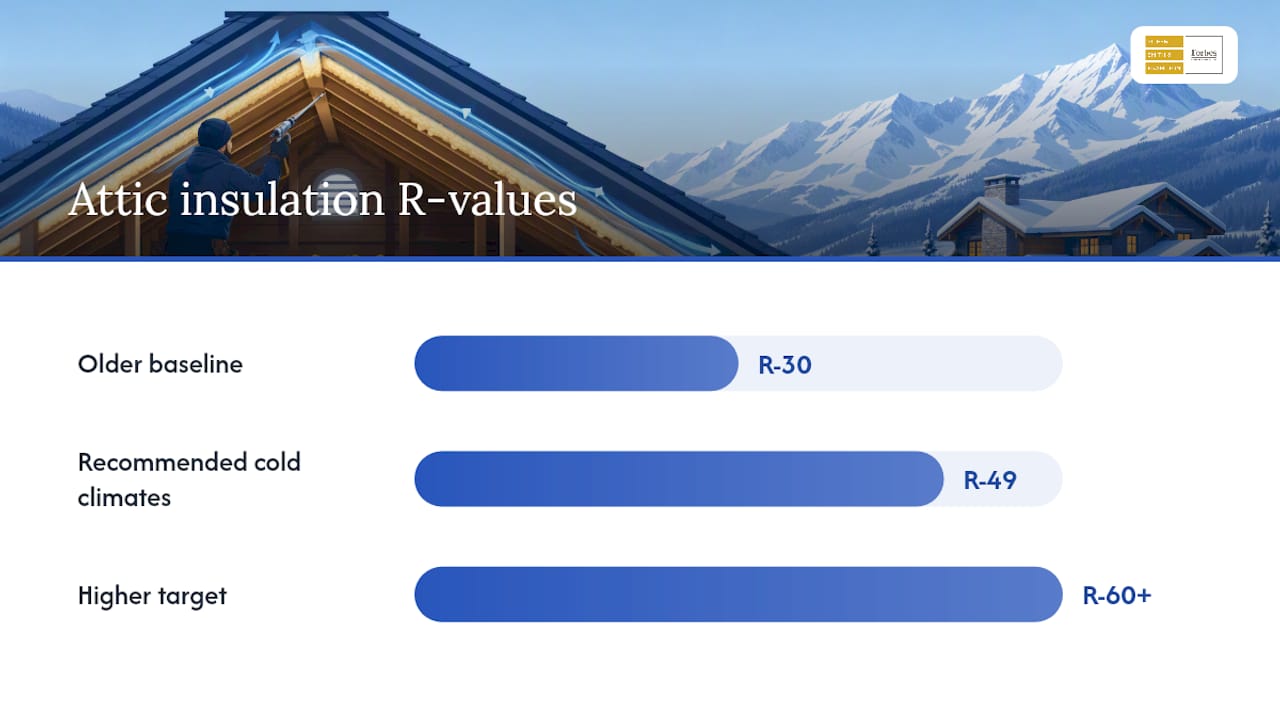
- Bring insulation up to target R-value. Federal insulation guidance and cold-climate building science both point toward R-49 to R-60 in attics for most mountain and northern climates, well above the R-30 minimum some builders still install. Blown-in cellulose or fiberglass are the most common methods for topping off an existing attic.
- Balance soffit-to-ridge ventilation. Continuous soffit intake paired with ridge exhaust keeps the whole roof deck at a uniform, cold temperature, which is the entire point once air sealing and insulation are done. Baffles at the eaves keep insulation from blocking the soffit vents. As a rough rule of thumb, aim for roughly equal net free area at intake and exhaust; lopsided ventilation pulls conditioned air through the attic instead of outside air.
Statistic Callout: Recommended attic insulation for cold climates runs R-49 or higher, roughly double the R-30 baseline many older Summit County homes were built with.
Most retrofit crews complete air sealing and an insulation top-off in two to four days for an average attic, assuming access isn't complicated by a finished attic or cathedral ceiling. Ventilation corrections, like adding baffles or opening a blocked ridge vent, usually happen in the same visit. Building science research consistently treats airtightness as the primary control, with insulation and ventilation as the second and third layers, not the other way around.
What Do Blower-Door Tests and Infrared Scans Actually Find?
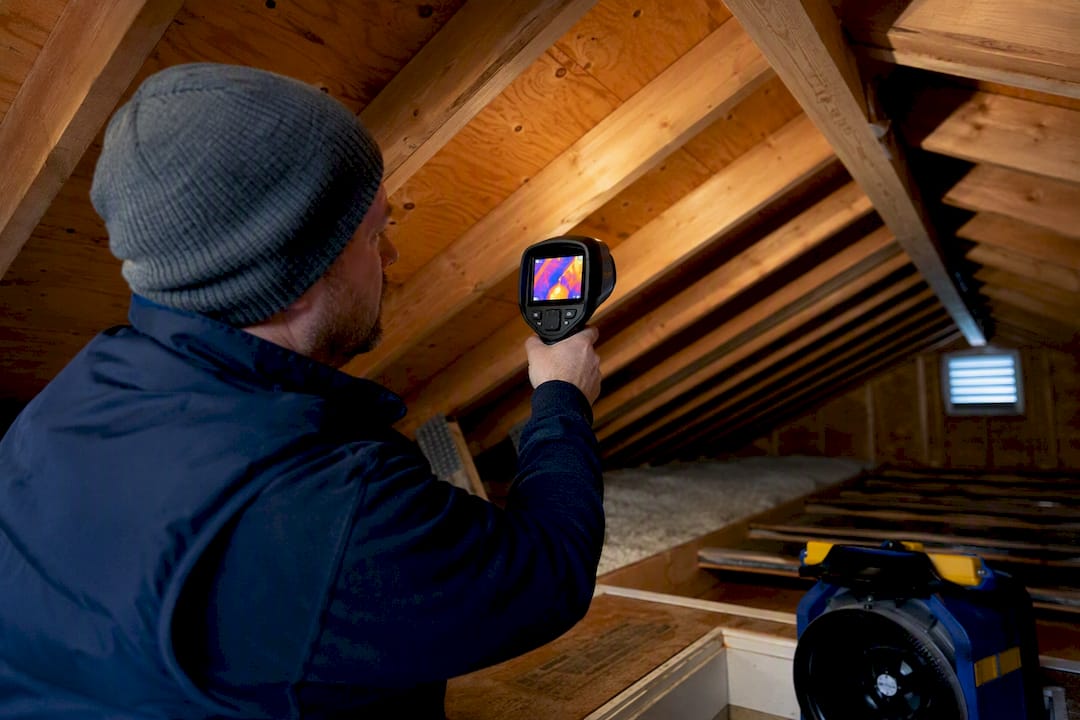
A blower-door test tells you how much air your house is losing and roughly where, by using a calibrated fan to depressurize the building while a technician traces leaks with a smoke pencil or pressure gauge. Building science guidance treats blower-door and infrared diagnostics as the standard method for locating hidden attic air leaks before any sealing or insulation work starts.
Infrared cameras scan the underside of the roof deck for warm patches that reveal exactly where heat is escaping, often spots you'd never find by eye. If you're already planning a roof replacement, that's the easiest time to add ice-and-water shield at the eaves and correct ventilation details, since the deck is already exposed.
- Ask any contractor for proof of insurance and recent local references.
- Ask to see photos or examples of past ice dam or ventilation retrofits, not just general roofing work.
- Be wary of anyone who proposes heat cables or gutter heating as the only fix without discussing attic air sealing.
Pro Tip: Schedule your attic inspection in early fall, before the first heavy snow, so any degraded seals around hatches, garage ceilings, or shared walls get caught while repairs are still easy to access.
What Should You Do if an Ice Dam Is Already Leaking?
- Rake snow off the eaves from the ground to reduce the meltwater source; don't climb onto an icy roof under any circumstances.
- On a milder day, hose warm water in channels running perpendicular to the gutter line, or lay ice-melt socks across the dam to cut drainage paths.
- Indoors, place buckets or towels to catch dripping water and start drying wet drywall or insulation right away to limit mold risk.
- Call a water-restoration professional if water has soaked into walls, ceilings, or insulation, or if the leak is ongoing.
Never chisel at ice or use a power tool to break up a dam. Both can puncture shingles and turn a temporary leak into a permanent one.
Local Next Steps for Summit County Homeowners
Ice dams hit mountain roofs harder than most, and if you're buying or selling in Keystone, Breckenridge, Frisco, Dillon, or Silverthorne, roof condition is usually part of the conversation before it's part of the closing. Local real estate professionals can point you toward contractors familiar with high-altitude snow loads and steep-slope roofing, whether you need a pre-listing inspection or a second opinion on a home you're about to buy.

If you're evaluating a property's roof condition as part of a purchase, or you're prepping a listing and want it to show well before winter buyers walk through, browsing current inventory in Keystone, Breckenridge, or Frisco is a good place to start understanding what condition comparable homes are in. For property-specific advice, or to request a referral to a vetted local contractor for an attic inspection, reach out through the Jayden Vermeer Realtor contact page.
Sources
This article draws on cold-climate building science and federal guidance, including the BASC attic air sealing and ventilation guide, UMN Extension's ice dam prevention resource, Building Science Corporation's BSD-135 digest, and Department of Energy insulation guidance. Check the Jayden Vermeer Realtor site map for more Summit County resources.
- Attic air sealing, insulating, and ventilating for ice dam prevention - BASC (PNNL)
- TRM self-regulating de-icing roof heating cable - GTD Supply
FAQ
Will Raking Snow off the Roof Prevent Ice Dams?
Roof raking reduces the snow available to melt and refreeze at the eaves, which lowers ice dam risk, but it doesn't fix the attic heat loss that causes dams in the first place.
How Do You Get Rid of Ice Dams Fast?
Cut drainage channels with warm water or ice-melt socks laid perpendicular to the gutter line, and clear snow from the eaves with a roof rake from the ground; both are temporary measures until you can address attic air sealing and insulation.
Do Roof Vents Prevent Ice Dams?
Soffit-to-ridge ventilation helps keep the roof deck uniformly cold, but on its own it can't compensate for poor air sealing or thin insulation, and some extension programs caution against mechanical attic ventilation as a fix.
Is an Ice Dam Covered by Homeowners Insurance?
Coverage for ice dam damage depends on your specific policy and insurer, since some plans cover the resulting water damage while others exclude it or cap it. Check your policy directly or ask your insurance agent before assuming coverage.