

An investment property mortgage will cost more and demand more paperwork than the loan on your primary home: expect rates roughly 0.5 to 1.2 percentage points higher, a down payment of 15% to 25% or more, and reserves in the bank. Your main paths are conventional agency financing, DSCR or non-QM loans, portfolio lending, and specialty products for jumbo or non-warrantable condo purchases. Check your credit, line up cash for down payment and reserves, and get quotes from at least three lenders before you write an offer.
TL;DR:
- Investment property mortgage rates are typically 0.5 to 1.2 percentage points higher than primary residence loans, driven by perceived risk.
- Lenders require larger down payments, often 15% to 25% or more, and substantial reserves, especially for multi-property portfolios.
- Conventional loans are usually cheaper if you meet credit and income requirements, but DSCR loans are ideal when property income exceeds personal income or for LLC ownership.
- Borrowers should compare APRs carefully, as lower headline rates may come with higher upfront points and LLPAs that increase total costs.
- Local market knowledge and documentation, such as rent surveys and HOA rules, are crucial for optimizing loan terms in resort areas like Summit County.
Table of Contents
- What Types of Investment Property Mortgages Are Available?
- Why Are Investment Property Mortgage Rates Higher?
- What Do Lenders Require to Approve an Investment Loan?
- How Much Down Payment and Reserves Do You Need?
- DSCR vs Conventional Loan: Which Should You Choose?
- How Do You Shop Lenders for the Best Terms?
- Weighing the Financial Trade-Offs of Financing a Rental
- How Resort-Market Financing Differs in Summit County
- What This Guide Gets Right That Others Miss
- Get Local Help Financing Your Next Investment Property
- Sources
What Types of Investment Property Mortgages Are Available?
Conventional agency loans, backed by Fannie Mae or Freddie Mac guidelines, are often the cheapest option if you qualify. They require full income documentation (tax returns, W-2s, pay stubs) and limit the number of financed properties you can have, which often constrains investors scaling beyond several properties.
DSCR loans (debt service coverage ratio) flip the underwriting logic. Instead of your personal income, the lender looks at whether the property's rent covers the mortgage payment, typically requiring a ratio around 1.0 to 1.25. That makes DSCR loans a natural fit for self-employed borrowers, investors closing in an LLC, or anyone whose tax returns understate real cash flow after depreciation write-offs.
Portfolio loans, held by the originating bank instead of sold to an agency, trade rate for flexibility. A local bank or credit union can waive property-count limits or work around an unusual income structure, but you'll typically pay more for that latitude.
A few situations need specialty handling:
- Jumbo investment loans for properties above conforming loan limits, which come with tighter credit and reserve standards.
- Non-warrantable condo financing, common in resort towns where a building has too many rentals or too much commercial space to meet agency rules.
- FHA and VA loans, which generally don't apply to pure rental purchases since both require owner occupancy.
Why Are Investment Property Mortgage Rates Higher?
Rate quotes on a rental property routinely run 0.5 to 1.2 percentage points above what you'd pay on a primary residence, and the gap moves with your credit profile and loan type. Lenders view investment properties as the first thing a borrower walks away from in a financial squeeze, so they price in that added risk from the start.
Three forces set the pricing you'll see:
- Loan-level price adjustments (LLPAs): Fannie Mae and Freddie Mac add pricing surcharges specifically for investment occupancy, on top of any credit-score adjustment.
- The 10-year Treasury yield: mortgage rates track it loosely, so a jump in Treasury yields pushes investor rates up even if your credit hasn't changed.
- DSCR-specific spreads: the premium DSCR loans carry over conventional pricing has narrowed significantly in recent years (https://www.crowdfundedwealth.com/articles/dscr-loan-vs-conventional-mortgage), down from the 200 to 400 basis point gap older guides still quote.
Always compare APR, not the headline rate. A lender advertising a slightly lower rate but charging two extra points at closing can cost you more over a five-year hold than a higher-rate loan with no points.
What Do Lenders Require to Approve an Investment Loan?
Underwriters for rental property loans check the same categories every time, but the bar sits higher than it does for a primary residence.
- Credit score: the best conventional pricing generally starts around 740, with meaningful rate increases below 700. DSCR lenders often accept scores in the mid-600s, at a cost.
- Debt-to-income ratio: conventional lenders count a percentage of your rental income toward offsetting the new mortgage, but each additional financed property adds its own debt load to the calculation. This is where investors with five or more mortgages often hit a wall.
- Cash reserves: plan on 2 to 6 months of PITI (principal, interest, taxes, insurance) per financed property, with the requirement climbing as your portfolio grows.
- Documentation: conventional loans want full tax returns and pay stubs; DSCR loans want a lease or market rent schedule and an appraisal with a rent survey; portfolio lenders sometimes accept bank statements in place of tax returns.
Pro Tip: Pull your own tri-merge credit report before you apply. A 20-point score bump from paying down a card balance can shift you into a better pricing tier and save more than a broker's rate-shop ever would.
How Much Down Payment and Reserves Do You Need?
Down payment requirements scale with unit count. Many conventional programs allow as little as 15% down on a single-unit purchase, but 2 to 4-unit properties frequently require 25% down under the same agency guidelines. DSCR and portfolio lenders often sit at 20% to 25% regardless of unit count.
The trade-off is straightforward but easy to miscalculate:
- A larger down payment lowers your monthly payment and improves your DSCR, making qualification easier.
- It also ties up more capital, which lowers your cash-on-cash return if the property performs as expected.
- Reserve requirements stack on top of the down payment: many lenders want 2 to 6 months of PITI sitting untouched in the bank for each financed property you own, not just the one you're closing on.
That reserve math is where a lot of buyers get caught off guard. A $2,400 monthly PITI payment with a six-month reserve requirement means $14,400 in reserves for a single door, on top of the down payment and closing costs, and that number multiplies with every additional property already on your credit report.
DSCR vs Conventional Loan: Which Should You Choose?
The decision usually comes down to which constraint you're trying to solve, not which loan sounds better on paper. If conventional financing is available to you, it's typically the cheaper path. DSCR buys you something conventional can't: no personal income documentation, no DTI ceiling, and the ability to close in an LLC from day one.
Watch for these triggers that should push you toward a DSCR loan:
- You're approaching or past the point where Fannie Mae's financed-property limits stop you from qualifying conventionally.
- Your tax returns show low taxable income because of depreciation, even though your actual cash flow is strong.
- You need to vest title in an LLC at closing for liability or estate reasons.
- You need to close fast, and DSCR underwriting timelines often beat the paperwork-heavy conventional process.
Run both scenarios side by side before you commit. A DSCR loan at a 70 to 120 basis point premium is a fair price for solving a real constraint; it's an expensive habit if conventional financing was available and you just didn't ask.
How Do You Shop Lenders for the Best Terms?
Getting quotes from a narrow slice of the market is the most common way investors overpay.
- Request quotes from a community bank, a credit union, a mortgage broker, and at least one lender that specializes in DSCR products.
- Compare APR, not just the rate, along with points, LLPAs, reserve requirements, and each lender's LLC vesting policy in writing.
- Bring two years of tax returns, current leases or a market rent schedule, and proof of reserves to your application, since complete documentation shortens underwriting timelines and often improves your pricing.
Weighing the Financial Trade-Offs of Financing a Rental
Financing lets you control more real estate with less of your own capital, and mortgage interest on an investment property remains deductible, alongside depreciation, which offsets rental income on paper even when the property is cash-flowing.
The other side of that ledger: higher rates than an owner-occupied loan, more underwriting friction, and exposure to vacancy or repair costs that a cash buyer never has to finance around. Many investors land on a mix of loan types across a portfolio, using conventional financing while it's available and shifting to DSCR once property count or income documentation becomes the limiting factor.
How Resort-Market Financing Differs in Summit County
Underwriting a rental in Breckenridge, Keystone, or Frisco isn't the same exercise as underwriting one in a year-round rental market. Lenders often rely on trailing twelve-month occupancy data for short-term rentals, and Summit County's HOA and municipal transient-rental rules can directly change what rent a lender will credit toward your DSCR. Appraisal comparables in resort towns also skew wider than in typical suburban markets, which affects your loan-to-value calculation at closing.

Pro Tip: Before you apply, get a local rent study and a copy of your target HOA's short-term rental policy. A lender unfamiliar with Summit County's rules will often default to conservative rent assumptions that can shrink your approved loan amount unnecessarily.
What This Guide Gets Right That Others Miss
Most financing guides treat DSCR loans as a fallback for investors who can't qualify conventionally. That framing undersells the tool. The real question isn't whether you can qualify for conventional financing. It's whether conventional financing solves the actual problem you have.
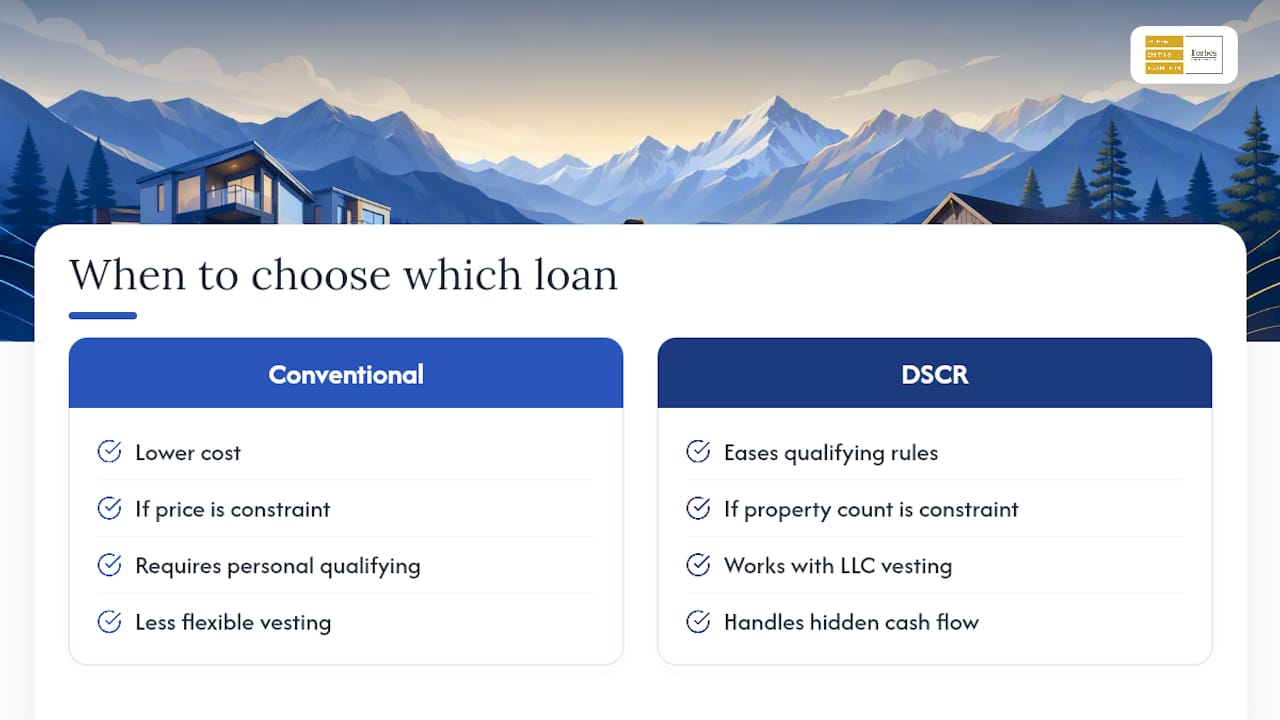
If your constraint is cost, conventional wins almost every time it's available. If your constraint is property count, LLC vesting, or a tax return that hides real cash flow behind depreciation, DSCR isn't a compromise. It's the correct instrument for the job, and the shrinking rate premium makes that trade-off easier to justify than it was even a couple of years ago.
Where conventional advice consistently falls short is reserves. Buyers budget the down payment and closing costs, then get blindsided when a lender wants six months of PITI sitting untouched for every financed property already on their credit report. In a resort market where seasonal cash flow is lumpier than a standard rental, that gap catches even experienced investors. Prioritize your reserve math before you fall in love with a property, not after your lender flags it.
— Jayden
Get Local Help Financing Your Next Investment Property
A national loan officer can quote you a rate. What they usually can't do is tell you what a lender will actually credit toward rental income on a Frisco condo with a variable short-term rental schedule, or which HOA in Keystone still allows nightly rentals. That's the gap Vacationhomesforsalecolorado closes for investors buying in Summit County: local comps, realistic rent estimates, and HOA compliance checks before you ever submit a loan application.

Working with Jayden means you walk into lender conversations with a market brief, a sample rent schedule, and a list of local lenders who already understand resort-market underwriting, instead of guessing at numbers a national bank will second-guess anyway. If you're evaluating a rental purchase in Breckenridge, Keystone, Frisco, Silverthorne, or Dillon, reach out through the contact page for a pre-offer checklist built around your specific property and financing plan.
Sources
For current pricing and program rules, check Bankrate's investment property rate survey and Freddie Mac's investment property guidelines before you apply.
This article is general information, not a substitute for advice from a qualified financial advisor. Consult a qualified financial professional about your own circumstances before acting on anything here.