

A jumbo loan is any conventional mortgage that exceeds the FHFA conforming loan limit for your area, and crossing that numeric threshold is the fastest way to know which loan applies to you. Once you're over the line, expect stricter underwriting, more documentation, and higher reserve requirements than a standard conforming loan asks for.
TL;DR:
- Higher credit scores, larger down payments, and more reserves are typically necessary for jumbo loans, which often require 10-20% down versus as little as 3-5% for conforming loans.
- Jumbo rates may be close to or slightly above conforming rates, but qualification hinges more on borrower profile and individual lender policies.
- Refinancing from jumbo to conforming is possible once the loan balance drops below the FHFA limit, unlocking lower rates and PMI removal.
- Verifying county-specific limits and preparing comprehensive documentation before applying can streamline the process and improve approval chances.
Table of Contents
- Jumbo vs. Conventional Loan: What the Terms Actually Mean
- FHFA Conforming Loan Limits for 2026 and What They Trigger
- How Jumbo and Conventional Underwriting Really Differ
- Rates, Closing Costs, and Mortgage Insurance: What Changes With Loan Size
- Weighing Jumbo vs. Conventional: Which One Fits Your Situation?
- Your Pre-Application Checklist: What to Calculate and Ask
- A Local Take: Jumbo Loans in High-Value Resort Markets
- Where to Verify These Numbers Yourself
- Sources
Jumbo vs. Conventional Loan: What the Terms Actually Mean
The terminology trips up more buyers than the math does, so let's clear it up first. "Conventional" just means the loan is privately originated, not insured by the government the way FHA, VA, and USDA loans are. Within that conventional category, loans split into two lanes based on size.
- Conforming loans meet the size and underwriting standards set by Fannie Mae and Freddie Mac, the government sponsored enterprises (GSEs) that buy mortgages from lenders.
- Jumbo loans exceed those FHFA limits, which means Fannie Mae and Freddie Mac won't purchase them.
That's why industry guides often call a jumbo loan a "non-conforming conventional loan" rather than treating it as a separate product category. It's still conventional; it's just too large for the GSEs to buy. Because Fannie Mae and Freddie Mac can't purchase these mortgages, lenders either hold jumbo loans on their own books as portfolio products or sell them into a smaller, pricier private secondary market. That single structural difference explains almost every gap in rates, documentation, and approval difficulty you'll read about below.
FHFA Conforming Loan Limits for 2026 and What They Trigger
For 2026, the FHFA conforming loan limit for a single-unit property sits at $832,750 in most counties, rising to $1,249,125 in designated high-cost areas.
The Threshold That Decides Your Loan Type: Finance more than $832,750 in a standard-cost county, or more than $1,249,125 in a high-cost county, and you're in jumbo territory, regardless of your credit score or income.
These figures aren't fixed forever. FHFA adjusts them annually based on national home price trends, and high-cost counties (think mountain resort towns and coastal metros) get their own elevated ceiling because local prices run well above the national median. Before you assume you need a jumbo loan, check your county's specific limit rather than the baseline number.
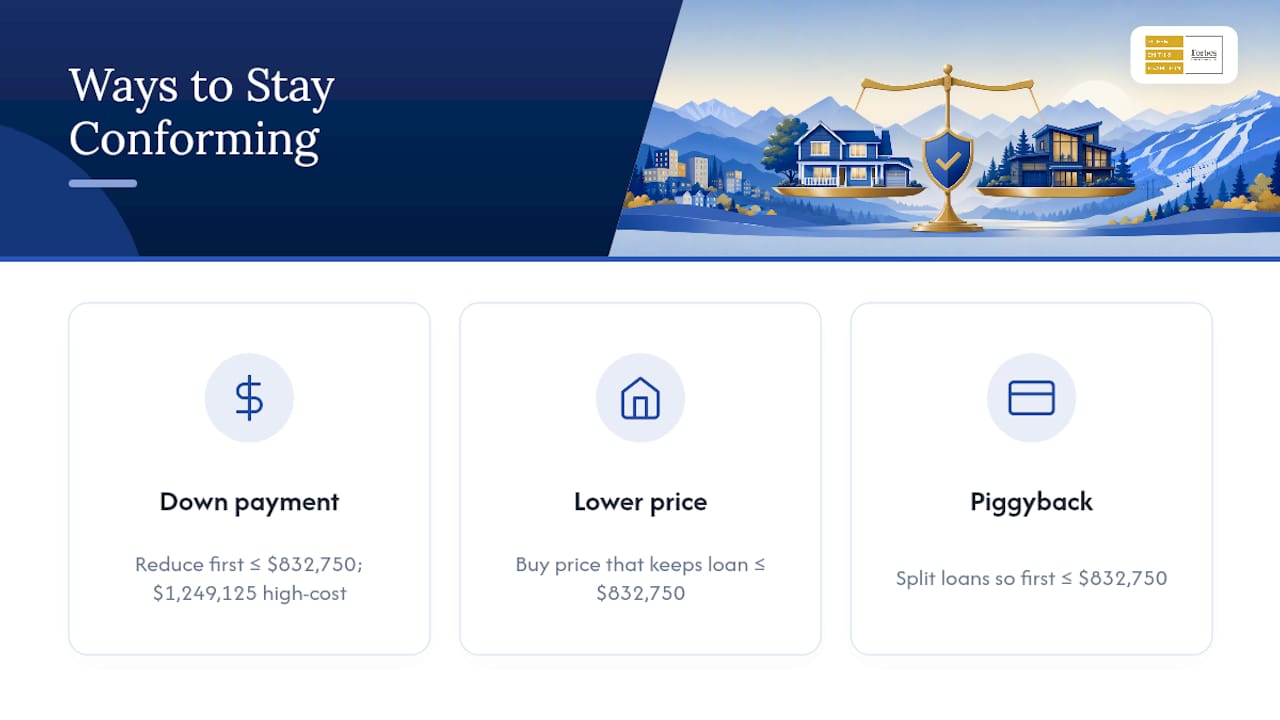
You also have more control over classification than most buyers realize. A larger down payment reduces your loan amount, which can pull you back under the conforming ceiling even on an expensive home. Some buyers use a piggyback second lien to split financing across two loans and keep the first mortgage conforming. Others simply shop for properties priced closer to the limit rather than stretching into jumbo territory unnecessarily.
How Jumbo and Conventional Underwriting Really Differ
Underwriting is where jumbo loans vs conforming conventional loans separate the most, because lenders can't offload jumbo risk to the GSEs the way they can with conforming products. That missing safety net means every part of your file gets a closer look.
- Credit score: Conforming loans can work with scores in the mid-600s, though best pricing usually starts around 740. Jumbo lenders commonly want 700 or higher just to open the conversation, and the strongest rates often require scores well above that.
- Debt-to-income ratio: Conforming guidelines frequently allow DTI up to 45-50% with compensating factors. Jumbo lenders tend to cap DTI tighter, since a large loan payment carries more absolute risk even at the same percentage.
- Down payment and LTV: Conforming loans can go as low as 3-5% down for qualified buyers. Jumbo loans generally ask for 10-20% or more, which caps loan-to-value well below what conforming borrowers can access.
- Cash reserves: Conforming loans may require little to no reserves beyond closing funds. Jumbo lenders routinely want six to twelve months of mortgage payments sitting in liquid, verifiable accounts.
- Documentation: Expect deeper income verification, more months of bank and asset statements, and closer scrutiny of any non-salary income on a jumbo application.
One more wrinkle worth knowing: not all jumbo lenders play by the same rulebook. Some hold these loans as portfolio products with their own internal guidelines, while others broker them out to investors with standardized jumbo criteria. That variability means two lenders can quote meaningfully different requirements for the identical loan amount, so it pays to compare more than one before you commit.
Rates, Closing Costs, and Mortgage Insurance: What Changes With Loan Size
Jumbo rates don't automatically run higher than conforming rates. They move with market liquidity and your individual profile more than with the label on the loan.
- Rate behavior: In some rate environments, jumbo pricing tracks close to conforming rates; in others, it carries a premium because the private market backing it demands more compensation for risk than the GSEs do.
- Borrower profile matters more than the category. A borrower with excellent credit and deep reserves can sometimes land jumbo pricing that rivals a conforming rate, which is a detail a lot of buyers never hear until they're already shopping.
- Closing costs scale with loan size. Origination fees calculated as a percentage of the loan amount rise automatically on larger balances, and some lenders require a second appraisal on high-value properties to confirm the valuation independently.
- PMI works differently at the top end. Conforming loans typically require private mortgage insurance below 20% down. Jumbo borrowers who put down 20% or more often skip PMI entirely, though some jumbo programs apply their own risk-based pricing instead.
Where the Money Actually Moves: According to SoFi's comparison of jumbo and conventional financing, jumbo loans can carry competitive rates but consistently ask for larger down payments, tighter DTI limits, and more reserves than conforming products.
If home values in your area climb or you pay down principal, refinancing from jumbo into conforming becomes possible once your remaining balance drops under the FHFA limit. That single move can unlock PMI relief and better rate access without you having to sell the property.
Weighing Jumbo vs. Conventional: Which One Fits Your Situation?
Conforming conventional loans win on accessibility: lower down payment options, standardized underwriting that most lenders follow closely, and the pricing stability that comes from deep GSE liquidity in the secondary market. Jumbo loans win on reach: they open the door to higher-priced homes and, for borrowers with strong credit and reserves, occasionally deliver pricing that's just as competitive.
- The luxury primary buyer. If you're financing a $1.4 million home in a standard-cost county, you're well past the $832,750 limit and jumbo financing is your only conventional path forward.
- The buyer just over the line. If your loan amount lands at $850,000, increasing your down payment by even $20,000 to $30,000 could push you back under the conforming ceiling and unlock easier qualifying.
- The investor or second-home buyer. Reserve requirements and DTI scrutiny run even tighter on non-primary residences, making it worth confirming loan-type math before you make an offer.
Your Pre-Application Checklist: What to Calculate and Ask
Before you contact a lender, run your own numbers first. Take your target purchase price, subtract your planned down payment, and compare the result against your county's FHFA limit. That single calculation tells you which loan type you're actually shopping for.
Gather these documents ahead of time, since jumbo applications move faster when the file is complete on day one:
- Two years of tax returns and W-2s or 1099s
- Two to three months of bank statements across all accounts
- A ledger of investment and retirement account balances
- Gift letters for any down payment funds from family
- Documentation for non-traditional or self-employment income
When you talk to lenders, ask direct questions: What pricing tier do I fall into at my credit score? How many months of reserves do you require? Do you require a second appraisal above a certain loan amount? Do you hold jumbo loans in portfolio or sell them? A lender that dodges questions about reserves or documentation requirements is a signal to keep shopping.
Pro Tip: Get lenders to quote you an all-in effective rate that includes fees, not just a headline APR. Two "competitive" jumbo quotes can differ by thousands of dollars in closing costs even when the rate itself looks identical.
A Local Take: Jumbo Loans in High-Value Resort Markets
Working residential sales across Summit County, Colorado, including Breckenridge, Keystone, and Frisco, I see jumbo financing come up constantly. Most properties in this price range sit well above the standard FHFA limit, even before you factor in the high-cost adjustment.
The underwriting wrinkle buyers don't expect is appraisal comps. Resort markets have fewer comparable sales than suburban subdivisions, and thin comp pools can slow underwriting or push appraisers toward more conservative valuations. I coach buyers to pull additional comparables themselves, coordinate appraisal timing around the local selling season rather than the off season, and document any non-traditional income sources, like rental income from a short-term rental property, well before the lender asks. Buyers eyeing a similar price point in other resort or luxury markets, including places like the Las Vegas condo market, run into the same comp and financing challenges.
If you're weighing a jumbo purchase in Summit County, reach out through Vacationhomesforsalecolorado before you write an offer. Getting the financing math right before you're under contract saves you from renegotiating price or terms mid-transaction.
— Jayden
Where to Verify These Numbers Yourself
For the official 2026 limits, go straight to the FHFA's announcement. For qualification norms and worked examples, Bankrate, SoFi, and Investopedia each publish detailed consumer guides. Individual lenders' education pages are useful for underwriting practice notes, though requirements vary by institution.