
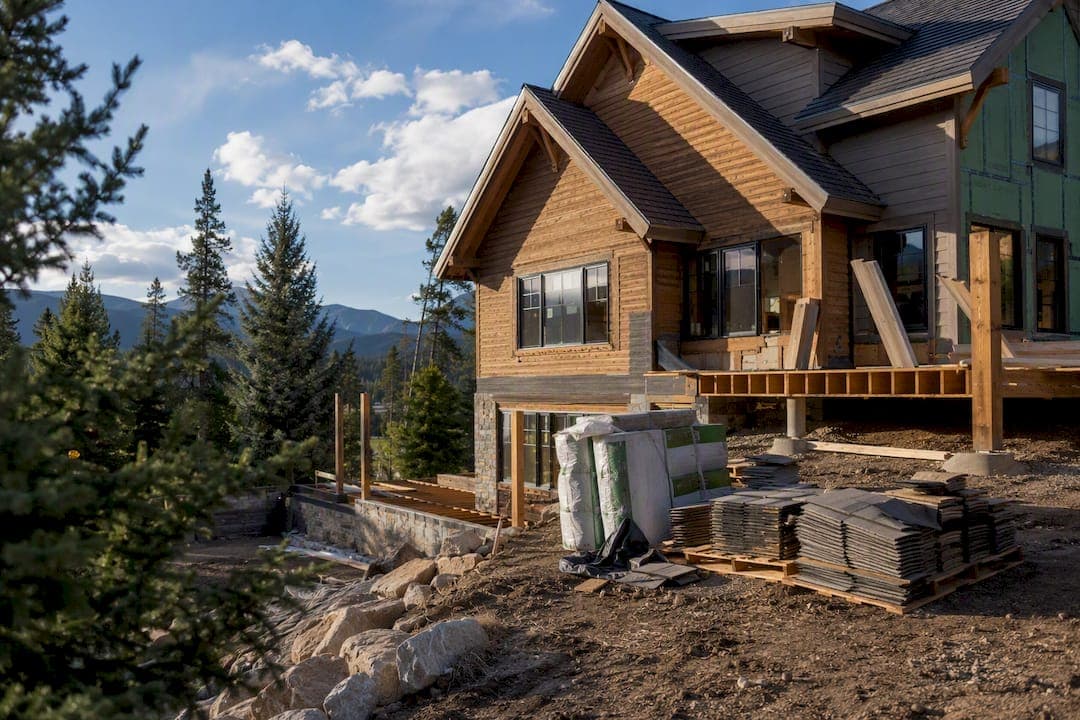
If you want a home built around your choices and low near-term maintenance, new construction usually fits. If you need a specific neighborhood, a faster move-in, or more room to negotiate, resale often wins. Builder incentives and local inventory can shift that answer, so weigh true cost, timeline, and your tolerance for construction risk before deciding.
TL;DR:
- New construction offers significant energy savings through modern insulation and efficient HVAC systems, which can reduce monthly utility bills in many markets.
- Resale homes in established neighborhoods provide immediate occupancy, larger lots, and opportunities for negotiation on price and repairs, often at a lower overall cost.
- Upgrades and design features in new builds can add tens of thousands of dollars beyond the base price, and builder incentives may offset some costs for buyers planning to stay long-term.
- Closing timelines vary: spec homes close in 30 to 90 days, while to-be-built homes typically take 6 to 12 months, requiring planning for potential delays.
- Builder warranties generally cover structural and mechanical issues but exclude routine maintenance, landscaping, and cosmetic issues, making inspections and reserves essential.
Table of Contents
- New Construction vs Resale: What New Builds Deliver
- Resale Home Advantages: Location, Speed, and Leverage
- What Does New Construction Really Cost vs Resale?
- How Long Does Each Option Take to Close?
- Inspections, Warranties, and What They Actually Cover
- Customizing a New Build vs Renovating a Resale Home
- How to Choose: A Decision Framework for Your Situation
- New Construction and Resale Upgrade Costs, Explained
- Which Appreciates Faster: New Construction or Resale?
- What Can Go Wrong With a New Build?
- Environmental Trade-Offs Between New and Existing Homes
- Jayden Vermeer: Applying the Framework in Summit County
- How Jayden Can Help You Decide
- Where This Article's Numbers Come From
- Sources
New Construction vs Resale: What New Builds Deliver
Walk into a new build and you notice the systems before you notice the finishes. Modern insulation, high-SEER HVAC, and sealed envelopes cut utility bills in ways older housing stock rarely matches, and ENERGY STAR's smart-home guidance shows how much of that savings comes from appliance and system choices made at construction, not retrofits added later. In parts of Colorado, a properly sealed new build with efficient HVAC can save a significant amount monthly on energy compared to an older resale home, a factor worth folding into any five-year ownership math.
Builders also sell flexibility, though the amount varies by product type:
- Spec homes are already built or nearly finished, with fixed finishes and no design input.
- Semi-custom homes let you pick from a builder's option packages for flooring, cabinets, and fixtures.
- Fully custom homes put you in the driver's seat on floor plan and materials, usually at a premium in both cost and time.
Most builders back their work with a 1-2-10 warranty: one year on materials and workmanship, two years on major mechanical systems, and ten years on structural defects. Buyer frustration usually traces back to what is not covered. Cosmetic settling, landscaping, and routine maintenance items typically fall outside warranty protection.
Pro Tip: Ask your builder for the exact warranty exclusions list before you sign, not after you move in. Verbal assurances rarely match the fine print.
Rate buydowns and closing-cost credits are common builder incentives right now, and Eye on Housing found that preference for new homes has climbed to its highest point since 2007, a signal that these perks are landing with buyers. These benefits tend to offset the higher sticker price when you plan to stay put for at least five to seven years and can use the energy savings and warranty coverage to reduce total ownership cost.
Resale Home Advantages: Location, Speed, and Leverage
Resale homes win on the things a builder cannot manufacture overnight. Established neighborhoods come with mature trees, settled soil, and often larger lots than new subdivisions carved from raw land. You also get a real sense of the block: how loud the street gets, whether the neighbors mow their lawns, what the school pickup line actually looks like.
Negotiation is where resale often pulls ahead. Sellers facing inspection findings, slow markets, or personal timelines will frequently offer repair credits or price reductions that a builder simply will not match on a fixed-price contract.
- Immediate or near-immediate occupancy in many transactions
- Room to negotiate price, repair credits, and closing costs
- Access to lots and locations that new subdivisions cannot replicate
- Ability to renovate gradually instead of paying builder markup on every upgrade
Closing on a resale home typically runs a predictable 30 to 45 days once you have an accepted offer, compared to the open-ended waiting that comes with a to-be-built home.
Pro Tip: If you love a resale home's bones but not its kitchen, get a renovation estimate before you write your offer. It gives you a real number to negotiate with, not a guess.
What Does New Construction Really Cost vs Resale?
Sticker price is the least useful number in this comparison. A reproducible way to compare options: sticker price plus upgrades plus closing costs plus maintenance reserves equals true cost. Model-home pricing almost always excludes landscaping, window coverings, and the design-center upgrades that turn a base package into a livable home.
- Start with the base price, then add realistic upgrade costs for flooring, appliances, and landscaping, categories that routinely add tens of thousands of dollars over the advertised price.
- Compare incentive structures, not just headline numbers. NAHB reported that the price gap between new and existing homes has narrowed in recent periods, and builders often lean on rate buydowns or design-center credits rather than cutting the base price outright.
- Run the monthly payment math for a rate buydown against a straight price cut. A buydown can lower your payment for a few years without reducing the loan balance, while a price cut reduces both.
- Get preapproved and shop competing loan estimates before committing to a builder's in-house lender, and verify any lender through NMLS Consumer Access.
- Consider an FHA 203(k) loan if you are eyeing a resale home that needs renovation, since it rolls purchase and repair costs into one mortgage, a route Chase outlines in its home-buying guidance.
How Long Does Each Option Take to Close?
Timelines diverge sharply depending on whether you buy inventory, commit to a to-be-built home, or go resale.
- Spec or inventory new builds: often 30 to 90 days to close, similar to resale in many cases.
- To-be-built homes: commonly 6 to 12 months from contract to move-in, longer in markets with labor or material constraints.
- Resale homes: typically 30 to 45 days from accepted offer to closing, with rent-back agreements available if the seller needs extra time.
Builder delays usually stem from permitting backlogs, weather, or supply chain snags, and most contracts frame delivery as an estimated window rather than a guaranteed date. If you have a hard deadline, like a lease ending or a school year starting, build in a buffer. A short-term rental, a rent-back clause on your resale purchase, or a sale contingency written into your offer can all bridge the gap without forcing a rushed decision.
Inspections, Warranties, and What They Actually Cover
New construction and resale homes need different inspection strategies entirely. New builds benefit from staged inspections, especially a pre-drywall inspection that catches framing, plumbing, and electrical issues before walls seal them in, a step that has caught costly errors on more than one Colorado job site.
- Pre-drywall inspection: checks structural and mechanical work before drywall installation
- Final walkthrough: confirms punch-list items are complete before closing
- Resale home inspection: covers the entire structure, often flagging roof age, HVAC lifespan, and foundation issues
The 1-2-10 warranty structure covers workmanship for one year, mechanical systems for two, and structural defects for ten, but claims typically require documentation and a formal request through the builder, not a phone call. Builder warranties are real protection, but most buyer disappointment traces back to misunderstanding what is excluded, particularly landscaping, cosmetic settling, and routine upkeep.
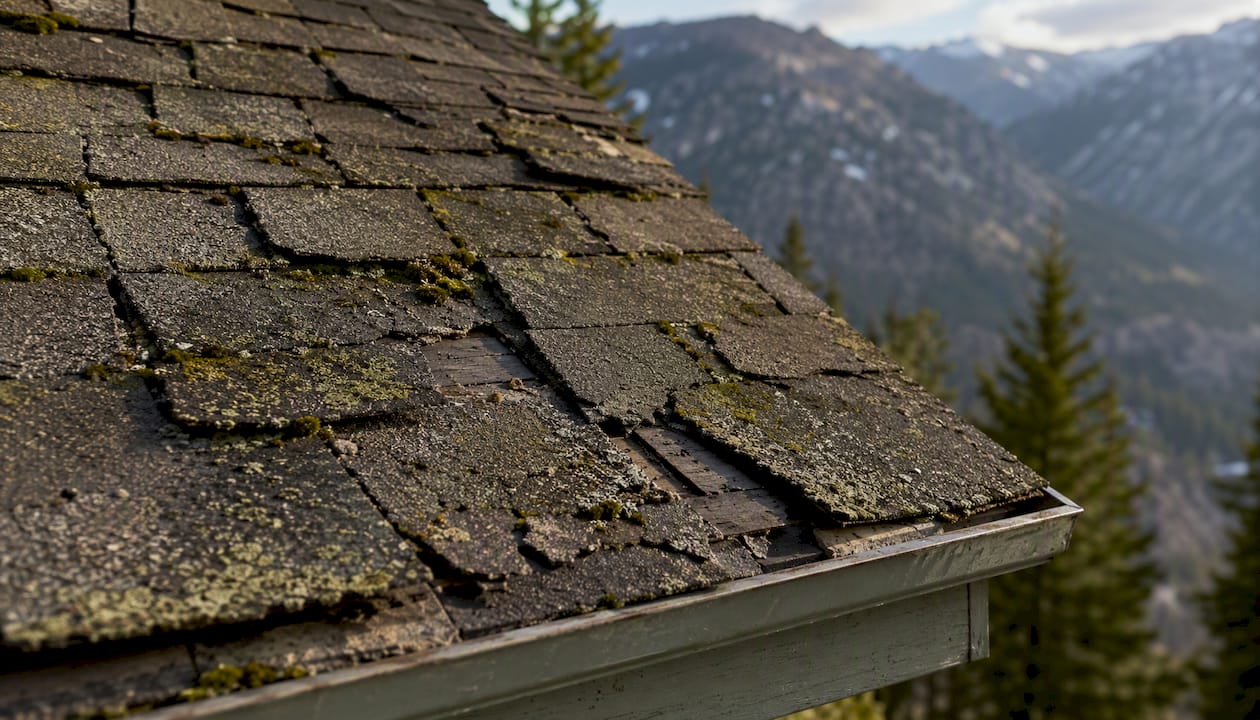
Resale inspections commonly turn up deferred maintenance: aging roofs, outdated electrical panels, or HVAC systems near the end of their service life.
Pro Tip: Budget 1% to 2% of your home's value annually for maintenance reserves on a resale home. On a new build, budget less in year one, but do not skip it entirely.
Customizing a New Build vs Renovating a Resale Home
Builders sell customization in tiers, and knowing which tier you are buying determines how much control you actually have.
- Spec homes offer zero customization; what you see is what you get.
- Quick-delivery homes allow minor selections from a limited catalog, often on homes already under construction.
- Semi-custom homes open up the design center: cabinets, counters, flooring, and fixtures chosen from builder-approved packages.
- Full custom builds give you control over the floor plan itself, at a higher cost and longer timeline.
Design-center pricing is where builders often make their margin, particularly on lighting, tile, and cabinet upgrades marked up well above retail. Renovating a resale home later gives you more control over the same categories, often at lower cost, but it takes time. A kitchen remodel commonly runs several weeks to a few months depending on scope, while builder upgrades are baked into your original closing timeline. Staged renovation makes resale attractive if you would rather spread costs over years instead of financing every upgrade into your mortgage on day one.
How to Choose: A Decision Framework for Your Situation
Five questions cut through most of the noise:
- What is your timeline? If you need to move within 60 days, resale or spec inventory usually wins.
- How much does customization matter to you? If picking finishes matters more than moving fast, a semi-custom or full custom build fits.
- What is your real budget, including reserves? Add upgrades, closing costs, and a maintenance reserve to the sticker price before comparing options.
- Is location non-negotiable? Established neighborhoods usually mean resale; new subdivisions usually mean new construction.
- How much construction risk can you tolerate? Delays, allowance overages, and design-center decisions add stress that not every buyer wants.
Score each question from one to five based on how strongly it points toward new construction or resale, then total both columns. A simple weighting method: if customization and efficiency dominate your scores, lean new construction. If location and timeline dominate, lean resale.
Three quick profiles illustrate how this plays out:
- The relocating professional with a 45-day deadline almost always does better with resale or ready inventory.
- The empty-nester who wants low maintenance and specific finishes typically finds more value in a semi-custom new build.
- The renovator who loves a fixer-upper in a mature neighborhood should look hard at resale paired with an FHA 203(k) loan.
Pro Tip: Write down your five answers before you tour a single home. It keeps a great open house from talking you out of your own priorities.
New Construction and Resale Upgrade Costs, Explained
Base price rarely reflects what you will actually spend. Builders advertise a starting price that excludes landscaping, blinds, and often basic appliances, then upsell those items through the design center at premium markup. Buyers who skip this step routinely discover $30,000 to $50,000 in "necessary" upgrades between contract signing and closing.
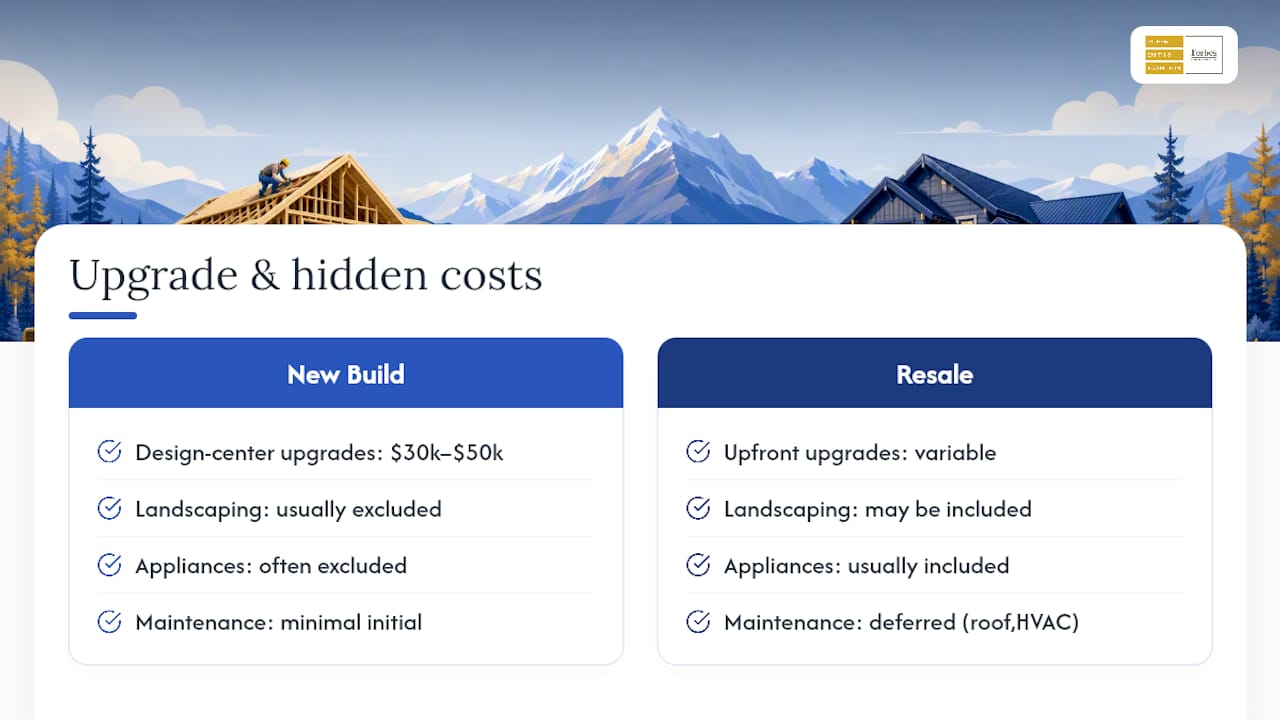
Resale carries its own version of this problem: deferred maintenance. A home priced below market often needs a new roof, updated electrical, or HVAC replacement within a few years of purchase, costs that do not show up on the closing disclosure but show up on your credit card soon after.
Incentives complicate the comparison further. A builder offering a rate buydown might advertise a lower "effective payment" without touching the purchase price, while a resale seller offering a $10,000 repair credit reduces your actual cash outlay at closing. Compare both against your specific loan terms, not the headline incentive number, since a buydown's value depends heavily on how long you plan to keep the loan at that rate. Run both scenarios through a lender before assuming either incentive beats a straightforward price reduction.
Which Appreciates Faster: New Construction or Resale?
Appreciation trends do not consistently favor one category over the other. Location, school quality, and local inventory drive value more than whether a home was built last year or thirty years ago. What has shifted recently is the price relationship between the two categories.
NAHB's tracking shows the price gap between new and existing homes narrowing, which changes the calculus for buyers who assumed new construction always carries a steep premium. In markets where that gap has closed, new construction becomes a more direct competitor to resale on pure appreciation potential, not just on features.
Resale homes in established, high-demand neighborhoods often show steady appreciation tied to school district reputation and proximity to amenities that cannot be replicated in new subdivisions built farther from town centers. New construction in developing areas can appreciate quickly if the surrounding infrastructure catches up, but that growth is less predictable and depends on factors outside any single buyer's control, like municipal investment in roads and schools.
The practical takeaway: do not buy new construction expecting an automatic appreciation edge, and do not assume a resale home in a mature neighborhood is safer simply because it is older. Pull comparable sales for the specific neighborhood and product type you are considering, not a generic new-versus-resale trend.
What Can Go Wrong With a New Build?
New construction carries risks that resale buyers rarely face. Construction delays top the list, often driven by permitting backlogs, material shortages, or weather, and most builder contracts frame delivery dates as estimates rather than guarantees.
Builder reputation matters more than most buyers realize going in. A builder with a poor track record on warranty claims or subcontractor quality can turn a dream home into a multi-year headache, even with a solid 1-2-10 warranty on paper. Research a builder's completed communities, not just their model home, before signing.
Allowance overages are another common surprise. Design-center budgets get eaten quickly by tile, lighting, and cabinet upgrades, and buyers who do not track spending against their allowance often find themselves thousands over budget by closing. Phased inspections, particularly a pre-drywall walkthrough, catch structural and mechanical issues before they become expensive to fix, but only if you request them in writing as part of your contract.
Finally, new subdivisions sometimes lack mature infrastructure. Landscaping takes years to fill in, nearby amenities may still be under construction, and HOA rules in new communities can be stricter and less predictable than in established neighborhoods with a longer track record.
Environmental Trade-Offs Between New and Existing Homes
New construction generally wins on operational efficiency. Better insulation, high-SEER HVAC systems, and tighter building envelopes reduce the energy needed to heat and cool a home year after year, which is where ENERGY STAR's efficiency guidance becomes genuinely useful for comparing appliance and system choices.
Resale carries a different kind of environmental advantage: it reuses existing materials and infrastructure instead of consuming new lumber, concrete, and land. Building a new home requires significant embodied energy, the resources spent manufacturing materials and constructing the structure, that a resale home has already accounted for decades ago. Renovating an older home to improve efficiency, adding insulation, replacing single-pane windows, upgrading HVAC, often closes much of the operational gap without the embodied-energy cost of new construction.
Neither option is a clear environmental winner across the board. New construction reduces ongoing energy use but consumes more resources upfront. Resale preserves existing materials and mature landscaping but may need efficiency retrofits to compete on utility costs. Buyers who care about this trade-off should weigh a home's expected lifespan in their hands, a starter home you will sell in five years carries different environmental math than a forever home you will own for thirty.
Jayden Vermeer: Applying the Framework in Summit County
Summit County brings its own wrinkles to this comparison. A new build in Keystone with a sealed envelope and modern HVAC can meaningfully cut winter heating costs compared to an older Frisco cabin, but that same older cabin might sit on a lot twice the size, in a location you simply cannot buy new anymore.
I model true cost for clients the same way outlined above: sticker price plus upgrades plus closing costs plus a realistic maintenance reserve, then I run the numbers against comparable resale listings in Breckenridge, Silverthorne, and Dillon. Rate buydowns look attractive on paper, but the right comparison depends on how long you plan to hold the property and what your long-term rate outlook looks like.
— Jayden
How Jayden Can Help You Decide
Whether you are drawn to a semi-custom build in Keystone or a mature resale property in Breckenridge, the numbers above only mean something once they are applied to a specific listing and your specific budget. That is where local, hands-on guidance earns its keep.

Vacationhomesforsalecolorado gives you the market-analysis and negotiation experience needed to run this comparison against real Summit County inventory instead of national averages. Jayden Vermeer helps buyers model builder incentives against resale asking prices, coordinate timelines around lease dates or school calendars, and negotiate repair credits or closing costs on resale properties throughout Breckenridge, Keystone, Frisco, Silverthorne, and Dillon. If you are weighing a new build against an existing home in Summit County, reach out through Vacationhomesforsalecolorado to get a side-by-side cost comparison built around the properties you are actually considering.
Where This Article's Numbers Come From
Market and pricing claims draw on NAHB's tracking of new-versus-existing price gaps and Eye on Housing's buyer preference data. Energy efficiency guidance comes from ENERGY STAR, and financing comparisons reference Chase's home-buying guidance. Fair housing questions should always route through HUD's Office of Fair Housing and Equal Opportunity.