

Your primary residence is the home where you actually live most of the year and use as your legal address. A second home is a property you own for personal use but don't live in full time, like a ski condo or lake cabin. That distinction drives real differences in your mortgage rate, your tax bill, and how you're allowed to rent the place out.
TL;DR:
- Second-home loans typically require a higher credit score threshold of at least 680 and larger reserves of two to six months of mortgage payments.
- Rental income from a second home is tax-free only if rented for 14 days or fewer annually; renting 15 or more days triggers Schedule E reporting and possible deductions restrictions.
- The capital gains exclusion only applies to primary residences; selling a second home usually results in taxable gains unless converted to a primary residence for at least two years.
- Insurance premiums for second homes are higher due to greater vacancy risk, and standard policies may have vacancy clauses that limit coverage after 30 to 60 days empty.
- Converting a second home into a primary residence requires genuine occupancy, updating legal records, and careful timing to qualify for capital gains exclusions and favorable mortgage terms.
Table of Contents
- What's the Real Difference Between a Primary and Second Home?
- How Do Lenders Treat Second Home Loans Differently?
- Can You Get the Capital Gains Exclusion on a Second Home?
- What Are the Rules for Renting Out a Second Home?
- Does Insurance Cost More on a Second Home?
- How Do You Convert a Second Home Into a Primary Residence?
- When Does a Second Home Actually Make Financial Sense?
- Common Buyer Mistakes I See in Summit County
- Get Local Help Buying or Evaluating a Second Home in Summit County
- Sources
What's the Real Difference Between a Primary and Second Home?
Lenders and the IRS don't take your word for which home is "primary." They test it against facts. The Rocket Mortgage guide to primary residence status lays out the same factors both institutions lean on: where you spend most nights, the address on your tax return and driver's license, your voter registration, and where your kids go to school if you have them. No single factor decides it. It's a pattern of evidence, and lenders will ask for documentation if anything looks off.
Here's how the practical differences break down once a property gets classified one way or the other:
- Occupancy test: Primary residences require you to move in within a set window, typically 60 days, and live there most of the year. Second homes just need to be available for your personal use.
- Mortgage rates: Second-home loans generally carry rates 0.25% to 0.50% higher than primary residence loans, since lenders view them as easier to walk away from in a downturn.
- Down payment: Primary residences can qualify for 3% to 5% down with certain programs. Second homes almost always require at least 10%, often more.
- Capital gains: Sell your primary residence and you may be able to exclude a significant amount of gain; sell a second home and the full gain is typically taxable.
- Mortgage interest and SALT: Interest is deductible on both, subject to the combined debt limit, but property tax deductions across all properties are capped under the SALT limit.
- Insurance: Second homes often carry higher premiums and stricter vacancy clauses than a primary residence policy.
The biggest misconception buyers walk in with? That "second home" just means "vacation house I visit sometimes" and has no bearing on financing. It has enormous bearing on financing, and lenders check.
How Do Lenders Treat Second Home Loans Differently?
Lenders price risk, and a home you don't live in full time is a higher risk in their eyes. If money gets tight, people stop paying the mortgage on the place they don't sleep in before they stop paying on the place they do. That single behavioral pattern shapes almost every rule that follows.
Rate differences are the most visible piece, but they're not the only one. Second-home borrowers typically face:
- Higher credit score thresholds. Where a primary residence loan might work with a 620 score, second-home programs often want 680 or higher.
- Larger reserve requirements. Lenders commonly want to see two to six months of mortgage payments in reserve for both the primary and second home, sitting in liquid savings, not retirement accounts.
- Stricter debt-to-income limits. Carrying two mortgages pushes your DTI up fast, and lenders will cap how far they let that ratio stretch.
- Loan program restrictions. FHA and VA loans are built for primary residences and generally can't be used for a second home. You're working with conventional financing, jumbo loans if the property is expensive, or a HELOC against your primary residence's equity.
Documentation gets more thorough, too. Expect to show pay stubs, tax returns, bank statements, and sometimes a letter explaining why you want the property and how you'll use it. Underwriters have seen every version of "I'm just going to visit occasionally" and they know how to spot inconsistencies.
Then there's occupancy fraud, which is exactly what it sounds like: telling a lender you'll occupy a home as your primary residence to get a better rate and lower down payment, then renting it out or using it as a vacation property instead. It's a federal offense, not a technicality. Lenders audit utility usage patterns, tax filings, and insurance claims, and mortgage fraud convictions carry fines and potential prison time. The rate savings almost never justify the risk.
Pro Tip: If you're not sure yet whether a property will become your full-time home or stay a second home, tell your lender that upfront. Getting reclassified after closing is far more painful than starting with accurate paperwork.
Can You Get the Capital Gains Exclusion on a Second Home?
No, not while it stays classified as a second home. The capital gains exclusion, one of the most valuable tax benefits in real estate, only applies to your primary residence. Under IRS Publication 523, you can exclude up to $250,000 of gain if single or $500,000 if married filing jointly, but only if you owned and lived in the home for at least two of the five years before the sale. Sell a second home and every dollar of gain is taxable, typically at long-term capital gains rates if you've held it more than a year.
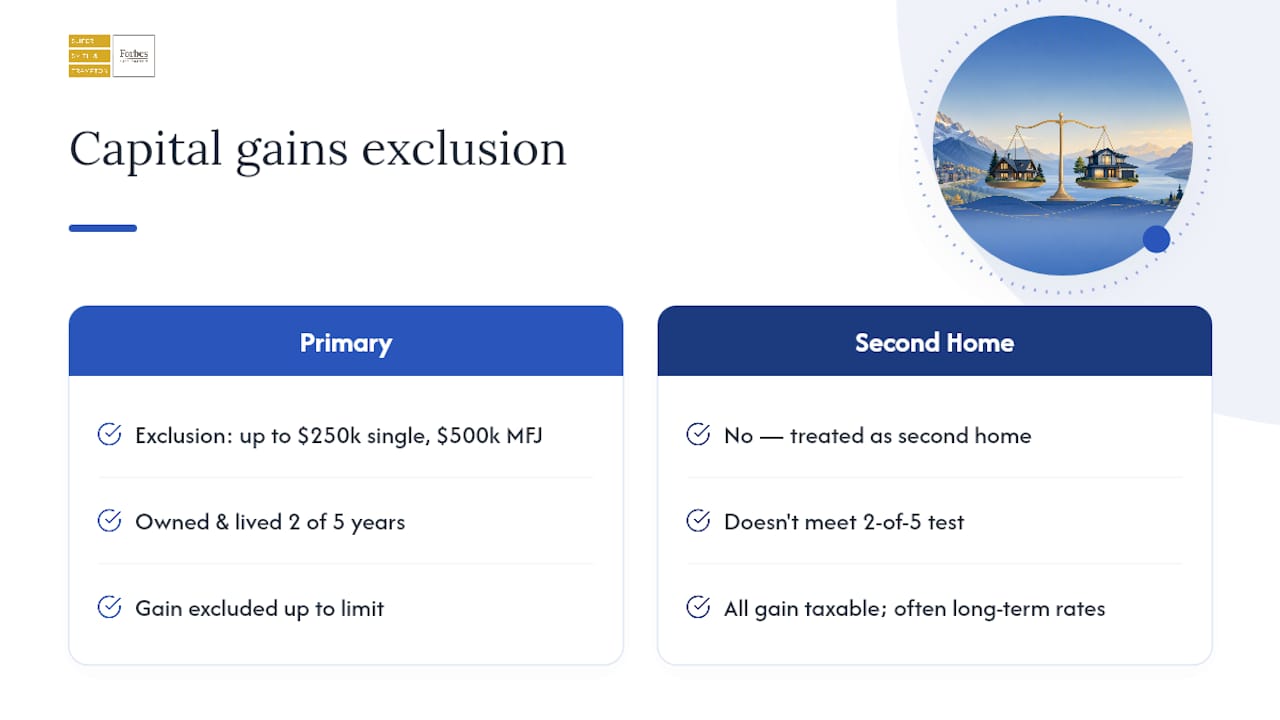
That gap is enormous in a market like Summit County, where a condo bought a decade ago could easily have appreciated by six figures. A second home sale with no exclusion available means writing a real check to the IRS on that gain. It's one reason some owners deliberately plan a conversion to primary residence before selling, timing occupancy carefully to meet the two-year test.
Mortgage interest deduction rules apply to both primary and second homes, but with a catch. You can deduct interest on a combined total of $750,000 in mortgage debt across both properties (or $1 million if the mortgage originated before December 16, 2017). Property tax deductions are where it gets tighter: the SALT deduction cap limits your combined state and local tax deduction, including property taxes on all your homes, to a set annual figure. Owning two properties in high-tax states can push you past that ceiling fast.
Second-home mortgage rates were running close to 7.45% in July 2026, roughly half a point above typical primary residence rates. On a $400,000 loan, that gap alone adds up to thousands of dollars a year in extra interest.
Renting the property changes everything again. Once you start collecting rental income, you may need to report it on Schedule E, and your ability to deduct expenses depends on how many days you personally use the home versus rent it. Publication 527 walks through the allocation rules in detail, and they're not intuitive. There's also a narrow exception: rent the home for fewer than 15 days in a year and you don't have to report the income at all, though you also lose the ability to deduct rental-related expenses for that period.
None of this is a do-it-yourself exercise once real money is involved. A tax advisor who's handled vacation property sales before can save you far more than the consultation costs, especially around exclusion timing and expense allocation.
What Are the Rules for Renting Out a Second Home?
The number of days matters more than almost anything else on this topic, and the IRS built two bright-line thresholds around it.
Rent your second home for 14 days or fewer in a year and the income is completely tax-free. You don't report it at all under the rules in Tax Topic 415. This is the rule that lets homeowners near a big event, like a marathon weekend or a festival, pocket rental income tax-free if they keep it under two weeks. The tradeoff: you can't deduct any rental expenses for that period either.
Cross into 15 or more rental days, and the property shifts into a different reporting category entirely. Now you're generally filing Schedule E, and the 10% rule kicks in to determine whether it counts as a residence for tax purposes: if your personal use exceeds 14 days or 10% of the days it's rented (whichever is greater), the IRS treats it as a personal residence with limited rental-loss deductions rather than a full rental property.
Practical steps for owners who plan to rent:
- Keep a daily use calendar. Track every day as personal use, rental use, or vacant, since this single record underpins every other calculation.
- Separate your accounts. Route rental income and expenses through their own bank account to make Schedule E reporting far cleaner.
- Save every receipt. Repairs, cleaning fees, and platform payouts all need documentation if you're claiming deductions.
- Check local rules before you list. Many Summit County towns cap short-term rental licenses or restrict them by zone, and HOAs frequently have their own rental minimums or outright bans.
Rental losses face their own ceiling too. Passive activity loss rules and at-risk limitations can restrict how much of a rental loss you're allowed to deduct against other income in a given year, details Publication 527 covers at length. Don't assume a loss on paper automatically reduces your tax bill dollar for dollar.
Does Insurance Cost More on a Second Home?
Yes, usually noticeably more, and the reason comes down to risk exposure while the home sits empty. A standard homeowners policy assumes someone's home most days, catching a leak or a break-in before it becomes catastrophic. A second home doesn't have that safety net.
- Vacancy clauses in many standard policies start limiting or denying coverage after 30 to 60 days of continuous vacancy, which is a real problem for a mountain property that sits empty most weekdays in shoulder season.
- Second-home policies or vacancy endorsements close that gap, though they typically cost more than a standard primary residence policy for comparable coverage.
- Higher premiums generally reflect slower response times to burst pipes, storm damage, and break-ins when no one's around to catch the problem early.
Maintenance costs add up in ways that surprise first-time second-home buyers. Winterizing a property at 9,000 feet elevation, running the heat to prevent frozen pipes even while unoccupied, and paying a property manager to check on things regularly are all recurring costs beyond the mortgage. Owners frequently underestimate the predictable monthly burden of property taxes, insurance, utilities, and upkeep, and it deserves its own line item before you sign anything.
Pro Tip: Ask your insurance agent specifically about the vacancy clause language, not just the premium quote. A cheap policy that stops covering you after 30 empty days is worse than a pricier one that covers you year round.
How Do You Convert a Second Home Into a Primary Residence?
Owners do this fairly often, usually for retirement or to access the capital gains exclusion before a sale. The process is straightforward on paper but easy to get wrong on timing.
- Actually move in and live there. This sounds obvious, but the IRS and lenders look at genuine occupancy, not a change of address form with no matching behavior.
- Update your official records. Change your address on your tax return, driver's license, and voter registration, and switch utilities into consistent use patterns that match full-time living.
- Track your occupancy start date carefully. To qualify for the capital gains exclusion when you eventually sell, you generally need two of the last five years as your primary residence under IRS ownership and use tests. Time spent there as a second home before conversion doesn't count toward that clock.
- Notify your lender. If your mortgage was originated as a second-home loan, converting to primary residence may trigger a review, and refinancing into a primary residence rate could actually save you money going forward.
- Plan the sale timeline early if that's the goal. Because the two-year clock starts at genuine occupancy, converting six months before a planned sale won't get you the exclusion. This needs advance planning, sometimes years ahead.
When Does a Second Home Actually Make Financial Sense?
Before you fall for a listing photo of a ski-in condo, run through a few blunt questions. Why are you actually buying this? "We'll use it four times a year and rent it the rest" is a different financial commitment than "we're buying this to retire into in ten years." Be honest about which one you're doing, because it changes the math on financing, insurance, and tax planning.
Ask yourself:
- Will you rent it, and have you checked local rules first? Some Summit County towns limit or license short-term rentals, and an HOA can override your plans entirely regardless of what the town allows.
- Do you have real cash reserves, separate from the down payment? Lenders want to see this, and so should you, since a second mortgage payment doesn't pause during a slow income month.
- Can the numbers work without rental income covering the mortgage? Counting on rental income to make the payment is the single most common mistake second-home buyers make.
Red flags worth taking seriously: using retirement account withdrawals to fund the down payment, assuming rental occupancy will match peak-season listings you saw online, and skipping the HOA rulebook because the listing agent said rentals were "generally fine."
Concrete next steps before you make an offer: get pre-qualified with a lender who explicitly quotes second-home terms, not primary residence terms. Talk to a tax advisor about how the purchase affects your SALT deduction exposure. Pull the actual HOA documents and municipal short-term rental rules for the specific property, not the general area. And stress-test your monthly cash flow assuming the property sits vacant and unrented for an entire season.
Pro Tip: Many buyers finance a second home using home equity or cash from an existing property rather than a fresh mortgage. It's worth running both scenarios before you commit to a loan structure.
Common Buyer Mistakes I See in Summit County
Most buyers I work with fall into one of three camps: retirees planning their eventual full-time move, families who want a consistent mountain base without full-time relocation, and investors chasing rental income. Each group underestimates a different risk. Retirees often forget how the two-year occupancy clock resets if they've owned the place as a second home for years already. Families frequently skip the HOA fine print on short-term rentals, assuming that because their neighbor rents theirs out, they can too. Investors, more than anyone, overestimate rental income and underestimate vacancy weeks.
The single biggest fix across all three groups is the same: run the affordability numbers assuming zero rental income for at least three months of the year, and get the HOA documents in writing before you write an offer, not after. Winterization costs at elevation catch nearly everyone by surprise the first year, too. A property that looks move-in ready in July can have a very different maintenance bill by January.
Buyers who do this well treat the second home purchase like the financial commitment it actually is, not a vacation impulse buy with a mortgage attached.
— Jayden Vermeer: Summit County Realtor
Get Local Help Buying or Evaluating a Second Home in Summit County
Classifying a property correctly on paper is one thing. Finding the right one in Breckenridge, Keystone, or Frisco and confirming it actually fits your rental plans and HOA restrictions is another. An experienced local realtor works through both sides with buyers regularly, matching properties to actual occupancy plans instead of just square footage and price.

When you reach out, expect a conversation grounded in current local market data, not generic advice. That means checking a specific property's HOA rental rules before you fall in love with it, running a realistic rental-income estimate, and helping you sort out whether a property should be financed as a primary residence or a second home before you ever talk to a lender. If you're weighing a purchase timeline against a future primary-residence conversion, that planning starts now, not after closing.
Browse current listings and start your Summit County property search to see what fits your budget and your plans for the property, whether that's a full-time move, a seasonal retreat, or a rental investment.
Sources
- Publication 523 (Selling Your Home) — IRS
- Primary, secondary and investment properties: What are the differences? — Chase
- Primary residence: Definition and importance — Rocket Mortgage
This article is general information, not a substitute for advice from a qualified financial advisor. Consult a qualified financial professional about your own circumstances before acting on anything here.