

Bills arrive in two installments, and Ohio law imposes a 10% penalty on any half paid late. Pay through the county's online portal, by mail, or in person, and lean on local resources like the Summit County Fiscal Office for official business, Ownwell for paperwork help, or American Financial Credit Services for broader planning.
TL;DR:
- Property taxes in Summit County are paid in two installments, with late payments incurring a 10% penalty on unpaid halves.
- The effective property tax rate varies significantly depending on local districts and assessed value calculations, which are adjusted by House Bill 920.
- Homeowners can qualify for automatic credits or apply for exemptions like the homestead or R.E.D. program to reduce their tax burden or improve cash flow.
- Missing a payment triggers steep penalties, including compound interest, making timely payment crucial for avoiding substantial additional costs.
- Verifying current property tax status before closing and checking for upcoming levies helps buyers prevent unexpected future tax impacts.
Table of Contents
- Property Taxes Summit County Owners Need to Know Right Now
- Shortlist: Local Places to Get Help or Pay Property Taxes
- How Summit County Property Tax Is Calculated
- When Are Summit County Tax Bills Due in 2026?
- What Exemptions and Credits Lower Your Summit County Bill?
- How Do You Appeal a Property Tax Assessment in Summit County?
- What Happens If You Miss a Property Tax Payment?
- Jayden Vermeer's Practical Tips for Summit County Property Owners
- Why Local Tax Knowledge Matters for Summit County Buyers
- Let Vacationhomesforsalecolorado Handle the Tax Details at Closing
- Sources
Property Taxes Summit County Owners Need to Know Right Now
Whether you're closing on a condo in Frisco or you've owned a place in Breckenridge for a decade, the same three questions come up every year: how much do I owe, when is it due, and who do I ask if something looks wrong? The short answer is that your bill splits into two halves, your rate depends heavily on which school district and municipality your parcel sits in, and the county's own systems are the fastest, most reliable way to check your status.
Where this gets confusing is that "property taxes Summit County" isn't a single number. A condo in one Breckenridge subdivision can carry a noticeably different effective rate than a house a few miles away in Silverthorne, purely because of overlapping school, fire, and municipal levies. That variation is exactly why the sections below walk through the math, the deadlines, and the relief programs one at a time instead of quoting one flat percentage.
Shortlist: Local Places to Get Help or Pay Property Taxes
You have three practical entry points when you need help with property taxes in Summit County, and each serves a different purpose. The Summit County Fiscal Office is where money actually changes hands and where official forms, appeals, and the R.E.D. installment program live. Ownwell focuses on tax preparation and paperwork assistance for homeowners who would rather not decode assessment notices themselves. American Financial Credit Services leans toward financial planning, useful if your question is less about the form and more about timing a payment around cash flow.
| Provider | Category | Best For | Standout | Google Reviews |
|---|---|---|---|---|
| Summit County Fiscal Office | Official county office | Payments, forms, R.E.D. enrollment, appeals | Primary authoritative source for rates, deadlines, and portals | 3.4★ (30 reviews) |
| Ownwell | Tax preparation service | Homeowners who want help preparing paperwork or filing forms | High review volume signals broad local usage | 4.7★ |
| American Financial Credit Services | Financial planning | Owners weighing tax timing against broader cash flow | Offers financial guidance alongside tax-prep adjacent services | 2.5★ (2 reviews) |
A few practical notes on each:
- The Fiscal Office's online property search updates parcel data daily, so it's the fastest way to confirm your actual balance before assuming a bill is wrong.
- Ownwell's larger review base suggests it handles routine filing questions at scale, which fits owners who mainly need someone to organize the paperwork.
- American Financial Credit Services' small review count means less public track record, so treat it as a resource for general financial strategy rather than official tax filings.
How Summit County Property Tax Is Calculated
Ohio counties, including Summit, calculate your bill through a five-step chain that starts with market value and ends with the number on your bill. First, the county assigns your property a market value based on sales data and periodic reappraisals. Second, that value is converted to an assessed value at Ohio's statutory 35% ratio for residential property. Third, House Bill 920 reduction factors adjust voted millage down so rising property values alone don't automatically inflate tax revenue for schools and local governments. Fourth, the county multiplies your assessed value by the applicable effective millage to get your gross tax. Fifth, any credits you qualify for get subtracted to reach your final bill.
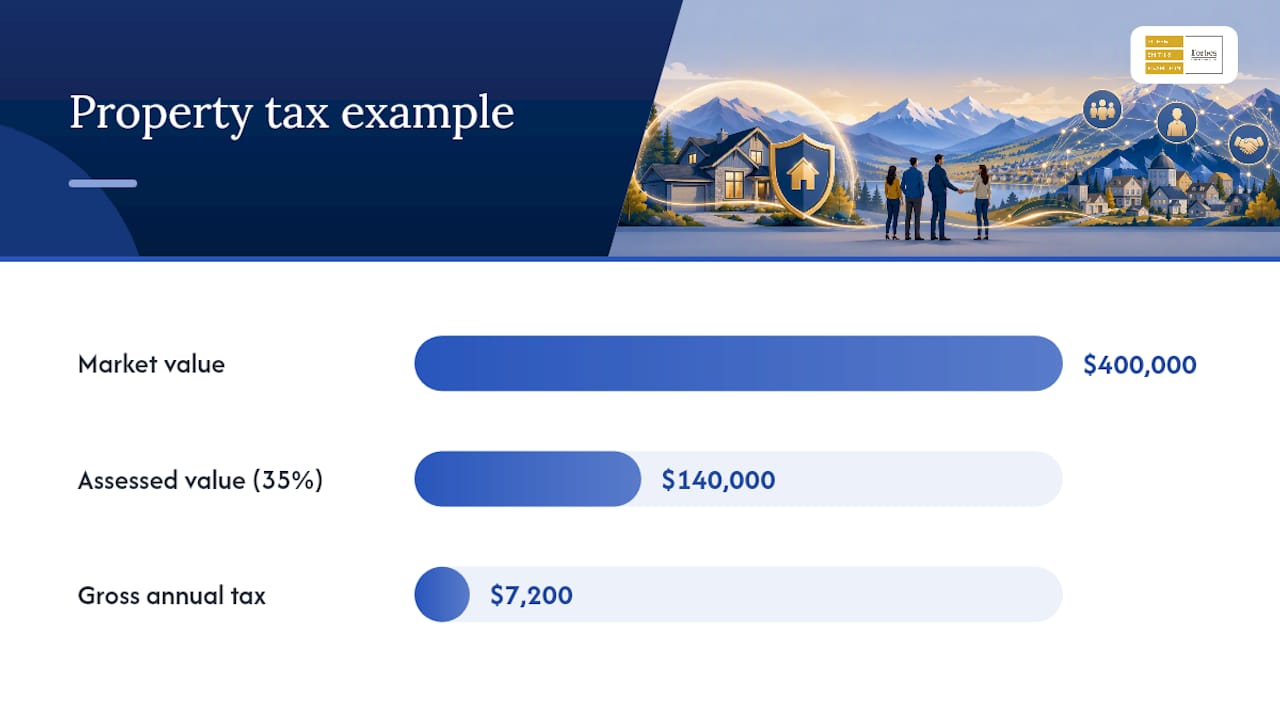
Quick math example: A home with a $400,000 market value converts to a $140,000 assessed value. At an effective rate near 1.8%, roughly the middle of the range Stewart Title's community chart shows for many Summit County communities, that produces a gross annual tax bill in the neighborhood of $7,200 before credits.
Two terms trip people up constantly:
- Stated millage is the rate voters actually approved on a levy.
- Effective millage is what HB 920 reduces it to after accounting for value growth, and it's the number that actually determines your bill.
School districts, municipalities, and special districts each set their own levies, which is why effective rates differ block to block. Always check the Full Effective Rate PDF for your specific taxing district rather than assuming a countywide average applies to your parcel.
When Are Summit County Tax Bills Due in 2026?
Summit County follows the standard Ohio two-installment schedule: a first-half payment due in late winter and a second-half payment due in the summer. Exact 2026 dates get published on the county site each year, so confirm them there rather than relying on last year's calendar. Here's how to stay ahead of it:
- Look up your parcel using your parcel number, owner name, or property address through the county's property search tool rather than waiting on the mailed bill.
- Confirm the postmark rule. Mailed payments count as on time if postmarked by the due date, but hand delivery or online payment must be completed by that date, not just initiated.
- Choose your payment channel. The county accepts payments through its online portal, by mail, in person at the Fiscal Office, or by phone (phone payments often carry a service fee).
- Check your escrow status. If your mortgage company escrows taxes, confirm they've received your bill and scheduled payment. Don't assume silence means it's handled.
Remember: the Fiscal Office states plainly that obtaining and paying your bill on time is the taxpayer's responsibility, not the county's.
What Exemptions and Credits Lower Your Summit County Bill?
Two credits apply automatically to most owner-occupied homes, and two more require an application. The 2.5% owner-occupancy rollback and the 10% non-business credit both apply automatically to Class I owner-occupied residential property, and together they typically reduce a homeowner's bill by roughly 12.5% compared to a non-owner-occupied parcel with the same value.
Beyond that, two programs require you to file:
- The Homestead Exemption for seniors and disabled veterans reduces the taxable market value of your home, subject to income limits, and requires a form filed with the county auditor's office.
- The Real Estate Discount (R.E.D.) program lets you pay in monthly installments instead of two lump sums, and the size of your discount credit depends on your initial payment amount.
Pro Tip: If your income fluctuates seasonally, enrolling in R.E.D. can smooth your cash flow enough that you never face a scramble before a due date, and it comes with a real discount incentive attached.
How Do You Appeal a Property Tax Assessment in Summit County?
If your assessed value looks too high, you have a real, structured path to challenge it, and the earlier you start gathering evidence the stronger your case tends to be. Follow these steps:
- Confirm the filing window. Board of Revision complaints typically must be filed within a set annual window after valuations are certified. Check the current deadline with the Fiscal Office before you start building your case.
- Gather your evidence. Recent comparable sales, a private appraisal if you have one, photos documenting condition issues, and repair receipts all strengthen a complaint.
- Build a focused packet. A tight three-part submission of comps, photos, and a short written narrative tends to outperform a long, unfocused one.
- Decide whether to self-file or hire help. Straightforward cases with clear comps often work fine self-filed. Complex properties or high-value disputes may justify hiring an appraiser or attorney.
- File and track your complaint through the Board of Revision process and follow up on the hearing schedule.
What Happens If You Miss a Property Tax Payment?
Ohio statute doesn't offer a grace period, and the penalty structure is unforgiving by design. A 10% penalty applies to any unpaid first-half installment, and if the second half also goes unpaid, an additional 10% penalty applies to the total unpaid balance, not just the second half. That compounding structure means a bill that slips through the cracks in the spring and again in the summer can grow substantially before you even get a delinquency notice.

Not receiving a mailed bill doesn't excuse late payment either, since the responsibility to obtain and pay your bill rests with you as the property owner. If you've missed a payment, contact the Fiscal Office immediately, and if you mailed your payment before the deadline, keep your postmarked receipt as proof.
Jayden Vermeer's Practical Tips for Summit County Property Owners
When I'm helping a buyer close on a place in Keystone or Breckenridge, tax status is one of the first things I confirm, not an afterthought. Here's my working checklist: verify the current-year tax bill status before closing, confirm how prorations are being handled at the title company, and ask whether any levies are pending on the ballot that could shift future rates.
Buyers should always ask sellers for a copy of the two most recent tax bills, then cross-check that against the county's own parcel lookup rather than taking a printout at face value. If the situation involves a homestead exemption the seller received but you won't qualify for, or a recent reappraisal that hasn't hit the bill yet, that's when I'd point a client toward Ownwell for paperwork help rather than trying to sort it out mid-closing.
Why Local Tax Knowledge Matters for Summit County Buyers
Property tax variation by school district isn't a footnote. It's a real, ongoing carrying cost that compounds over the years you own a home. Two comparable properties a few miles apart can carry meaningfully different annual bills depending on which taxing district they fall in.
Before you complete a purchase anywhere in Summit County, verify the tax history on the specific parcel and check whether any levy is on an upcoming ballot. Relying on a neighbor's bill or a general county average is how buyers get surprised a year later.
— Jayden
Let Vacationhomesforsalecolorado Handle the Tax Details at Closing
Vacationhomesforsalecolorado gives Summit County buyers something a spreadsheet or a general tax guide can't: someone checking your specific parcel's tax history and current status before you're locked into a closing date. That's the real advantage over piecing this together yourself from county PDFs and a seller's word.

When you're buying or selling in Keystone, Breckenridge, Frisco, Silverthorne, or Dillon, Jayden Vermeer reviews the property's current tax status, checks for pending levies or exemption mismatches, and coordinates with the title company on prorations so nothing surprises you at closing. If you're weighing a purchase, reach out with the parcel number and a recent tax bill, and get a clear read on what you'll actually owe going forward. Start a conversation about your Summit County property today.
Sources
For the most current numbers, always go straight to the source rather than a secondhand summary: