
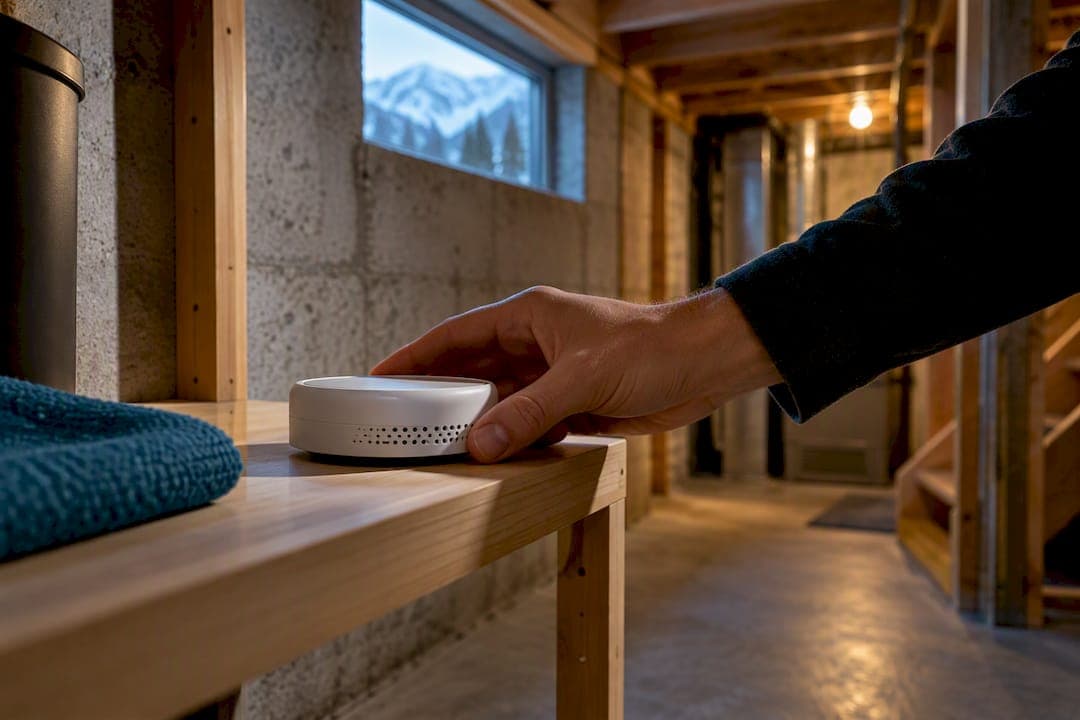
Radon is a genuine problem in Colorado, not a hypothetical one. The Colorado Department of Public Health and Environment (CDPHE) estimates the state average sits around 6.4 pCi/L, well above the EPA's 4 pCi/L action level. If you own a home in Summit County or you're closing on one soon, test the lowest level you actually live in, and if a confirmed reading hits 4 pCi/L or higher, mitigate. CDPHE and the EPA are your two go-to references for next steps.
TL;DR:
- Homes built on granite and felsic gneiss in Summit County have a high likelihood of radon levels exceeding the EPA's action threshold of 4 pCi/L, warranting testing and mitigation.
- Testing in winter under closed-house conditions provides the most accurate measurement, with professional tests typically costing around $150.
- If a radon level confirms at or above 4 pCi/L, mitigation options like sub-slab depressurization usually cost between $1,000 and $2,000, reliably lowering levels below 2 pCi/L.
- Radon in well water is less a drinking hazard than an inhalation risk during household activities, and water treatment systems such as aeration are more effective than GAC filters.
- Regular post-mitigation retesting every two years and system checks are necessary to ensure ongoing radon safety in Colorado homes.
Table of Contents
- Radon in Colorado: Prevalence, Zones, and Why Levels Run High Here
- Health Risks: What Radon Exposure Means for You and Your Family
- How to Test Your Colorado Home for Radon
- Interpreting Results: Thresholds, Confirmation, and Whether to Act
- Mitigation Options and Typical Costs in Colorado Homes
- Hiring a Mitigator: Checklist, Contract Terms, and Red Flags
- Retesting and Long-Term Maintenance of Mitigation Systems
- Radon in Water: Guidance for Private Well Owners in Summit County
- Typical Costs and Timelines for Mitigation in Colorado
- Local Help From a Summit County Real Estate Expert
- Authoritative Resources to Consult Next
- Sources
- FAQ
Radon in Colorado: Prevalence, Zones, and Why Levels Run High Here
Colorado isn't an average case. CDPHE data shows roughly half of Colorado homes test above the EPA action level, with a statewide average near 6.4 pCi/L, more than 50% higher than the 4 pCi/L threshold itself. Nearly every county in the state, including Summit County, falls into the EPA's highest radon potential category, Zone 1, meaning the predicted average indoor screening level exceeds 4 pCi/L.

The geology explains a lot of this. Summit County sits on granite and felsic gneiss derived alluvium, rock types known for higher natural uranium content that decays into radon gas. USGS mapping of the Frisco quadrangle documents these units directly beneath many mountain neighborhoods.
Why does this matter to your specific address?
- Homes built on or near these bedrock and soil types have more radon available to migrate upward.
- Permeable, rocky mountain soils let gas move more freely than dense clay does.
- Elevation and geology, not home age or construction quality, are the biggest predictors of radon potential.
Health Risks: What Radon Exposure Means for You and Your Family
Radon exposure is a serious health issue, not just a real-estate technicality. The EPA attributes roughly 21,000 lung cancer deaths per year nationwide to radon, making it the second leading cause of lung cancer in the country and the leading cause among people who have never smoked.
Radon by the numbers: The EPA estimates radon causes about 21,000 U.S. lung cancer deaths annually. Smokers exposed to elevated radon face a combined risk far higher than either factor alone.
The combination of smoking and radon exposure multiplies risk rather than simply adding to it, which is why the EPA urges smokers living in elevated-radon homes to treat testing as urgent. There's no threshold below which radon is officially "safe." The 4 pCi/L action level isn't a medical cutoff. It's a practical line the EPA drew to balance health risk against what mitigation can reasonably achieve.
How to Test Your Colorado Home for Radon
Testing is the only way to know where your home actually stands, and it's inexpensive compared to almost anything else in a home inspection.
- Choose your test type. Short-term tests run 2 to 90 days and give a quick snapshot; long-term tests run more than 90 days and capture seasonal swings.
- Run it at least 48 hours. CDPHE guidance requires a minimum 48-hour run for any valid result.
- Place the device correctly. Put it on the lowest level you regularly occupy, away from drafts, exterior walls, and windows.
- Keep the house closed. Short-term tests need closed-house conditions: windows shut, minimal door traffic, for at least 12 hours before and during the test.
- Pick DIY or professional. Hardware-store kits run cheap and work fine for a baseline check. Real-estate transactions typically call for certified professional testing, which commonly runs around $150.
Pro Tip: Test in winter when possible. Closed-house conditions happen naturally in a Colorado mountain winter, which tends to produce your worst-case, most reliable reading.
Interpreting Results: Thresholds, Confirmation, and Whether to Act
A single high number doesn't automatically mean you need a mitigation system tomorrow. Confirm it first.
- 4 pCi/L or higher: The EPA action level. Follow up with a second test, and mitigate once results are confirmed at or above this threshold.
- 2 to 4 pCi/L: No official action level applies, but the EPA still notes reduced risk from mitigating in this range, especially if you smoke or spend most of your time in a lower level of the home.
- Averaging results: When two short-term tests disagree, CDPHE recommends averaging them rather than picking the higher or lower number outright.
- Documentation: Keep every test report. Buyers, sellers, and lenders in Summit County transactions frequently request them during due diligence.
Mitigation Options and Typical Costs in Colorado Homes
Active sub-slab depressurization is the industry standard, and for good reason: it works on nearly every foundation type. A vent pipe and fan draw radon gas from beneath the slab and exhaust it above the roofline before it ever enters living space. Crawlspaces use a similar approach with a sealed membrane instead of a slab connection, and block foundation walls sometimes need sealing plus a dedicated vent system.
Radon dissolved in well water requires a different fix entirely. Aeration systems, which bubble air through water to release the gas before it reaches your tap, outperform granular activated carbon (GAC) filters. GAC is cheaper upfront, but it collects radioactive particles over time and needs special disposal handling.
| Mitigation type | Typical use case | Effectiveness |
|---|---|---|
| Sub-slab depressurization | Basements, slab-on-grade | Often reduces levels below 2 pCi/L |
| Sub-membrane (crawlspace) | Homes with crawlspaces | Similar performance to sub-slab systems |
| Water aeration | Private well with elevated radon | More effective than GAC |
| GAC filtration | Private well, lower budget | Effective but requires special disposal |
Installation costs for standard sub-slab systems commonly range from $1,000 to $2,000 in Colorado, though homes with complex foundations, multiple slabs, or unusual crawlspace layouts can run higher. Properly installed systems routinely bring levels below 2 pCi/L.
Hiring a Mitigator: Checklist, Contract Terms, and Red Flags
A mitigation system is only as good as the contractor who installs it. Treat this hire like any other major home system decision.
- Get at least three written bids. Each should include a diagnostic pressure test, not just a flat quote based on square footage.
- Require post-mitigation verification. CDPHE's guidance recommends confirming the fixed level tests below 4 pCi/L before you consider the job complete.
- Ask for a warranty. A five-year warranty on the fan and workmanship is a reasonable baseline for the Colorado market.
- Watch for shortcuts. Sealing alone, without a depressurization system, is not an adequate fix on its own.
Pro Tip: If a bid skips the diagnostic pressure test entirely, that's a red flag. That test determines fan sizing and pipe placement, and skipping it usually means a system engineered by guesswork.
Avoid any contractor who won't provide references, hedges on warranty terms, or can't produce a written diagnostic report with fan specifications and measured pressure differentials.
Retesting and Long-Term Maintenance of Mitigation Systems
Mitigation systems need occasional attention, not constant babysitting.
- Retest every two years, or sooner after any major renovation, HVAC replacement, or airtightness work.
- Check the fan monthly for unusual noise and check the pressure indicator gauge to confirm the system is still pulling a vacuum.
- Keep condensate lines and drains clear if your system includes them.
- File every test report and mitigation invoice together. Future buyers will ask for this paperwork.
Radon in Water: Guidance for Private Well Owners in Summit County
If your property relies on a private well, test the water separately from the air in your home. Radon in water mostly raises your risk through inhalation, released into the air during showers and dishwashing rather than through drinking. Aeration systems generally outperform GAC filters for water treatment, though GAC costs less upfront. Contact CDPHE's radon program or a licensed water treatment professional to arrange testing and discuss which system fits your well's output and mineral content.
Typical Costs and Timelines for Mitigation in Colorado
Plan on a full mitigation project taking anywhere from a single day to about a week, depending on your foundation type and how many entry points the contractor needs to seal. A straightforward sub-slab system in a home with a single, accessible basement slab often installs in a single day. Homes with multiple foundation types, finished basements that limit access, or crawlspaces combined with a slab typically take two to four days.
Budget the bulk of your cost toward the sub-slab or sub-membrane system itself, commonly landing in the $1,000 to $2,000 range for standard installations. Add on costs if your home needs sealing work around sump pits, floor drains, or utility penetrations, since these openings can undercut an otherwise well-designed system. Homes with unusual layouts, multiple foundation footprints, or difficult crawlspace access should expect bids on the higher end of that range or above it.
Timeline-wise, most Colorado mitigation contractors can schedule an installation within one to three weeks of your initial call, though this stretches during the fall rush when homeowners test before winter closes windows for good. Confirm your post-installation retest timing with your contractor before work starts. Most recommend waiting at least 24 hours after the fan runs continuously before taking a confirmation reading, and CDPHE recommends documenting that result for your permanent property file.

Local Help From a Summit County Real Estate Expert
Radon almost always surfaces during a real-estate transaction, whether you're buying in Keystone or listing a place in Frisco. A high test result can shift negotiation, delay closing while mitigation gets scheduled, or require specific disclosure language depending on how the contract is written. None of that has to derail your deal, but it does require someone who's navigated it before.
Real estate experts working in Keystone, Breckenridge, Frisco, Dillon, Silverthorne, Copper Mountain, and Blue River encounter radon issues regularly in mountain-market transactions due to many Summit County homes sitting on granite-derived soils. If you're evaluating a property with an existing mitigation system, or you need help interpreting a test report before you make an offer, Jayden can walk through what the numbers mean for your specific negotiation. Sellers benefit from the same guidance when deciding whether to test proactively or how to price a home that already has a mitigation system installed.
If you're browsing Keystone condos and townhomes or comparing options in Breckenridge, Jayden's local knowledge covers not just pricing and market trends but the practical details that affect closing, radon included. Start with a home valuation through What's Your Home Worth? if you're considering listing, or reach out directly through the contact page to talk through your specific property and timeline.
Authoritative Resources to Consult Next
- CDPHE Radon FAQ: testing protocols, mitigation standards, and state program contacts.
- EPA Health Risk of Radon: the science behind exposure risk and smoking interactions.
- EPA Consumer's Guide to Radon Reduction: mitigation methods, including water treatment options.
- Frisco-area geology background from USGS for readers curious about the bedrock driving local radon potential.
This article is general information, not a substitute for advice from a qualified doctor. Consult a qualified healthcare professional about your own circumstances before acting on anything here.
Sources
- Half of Colorado homes have elevated radon levels, which can cause lung cancer
- Radon FAQ — CDPHE
- Health risk of radon — EPA
FAQ
Do Air Purifiers Remove Radon From a Home?
No. The EPA does not recommend air purifiers for radon because they aren't built to filter gaseous radon out of the air. Sub-slab depressurization remains the standard, effective mitigation method.
Which Colorado Homes Are Most at Risk for Radon?
Homes built on granite or felsic gneiss derived soils face the highest risk, which describes much of Summit County's geology. Nearly every Colorado county, including Summit, falls into the EPA's Zone 1 category for radon potential, according to CDPHE.
Does Opening a Window Reduce Radon Levels?
Temporarily, yes, but it's not a real fix. Ventilation dilutes indoor radon while windows stay open, but levels climb back once the house closes up again, which is exactly why closed-house conditions are required during short-term testing.
Which States Have the Worst Radon Problems?
Colorado ranks among the states with the highest average indoor radon levels, driven largely by its bedrock geology and elevation. CDPHE's own data puts the state average near 6.4 pCi/L, well above the national action level.
How Much Does Radon Testing Cost Before Buying a Home?
Professional testing for real-estate transactions in Colorado commonly runs around $150. DIY kits cost less but aren't always accepted for closing documentation, so check with your lender or title company first.