
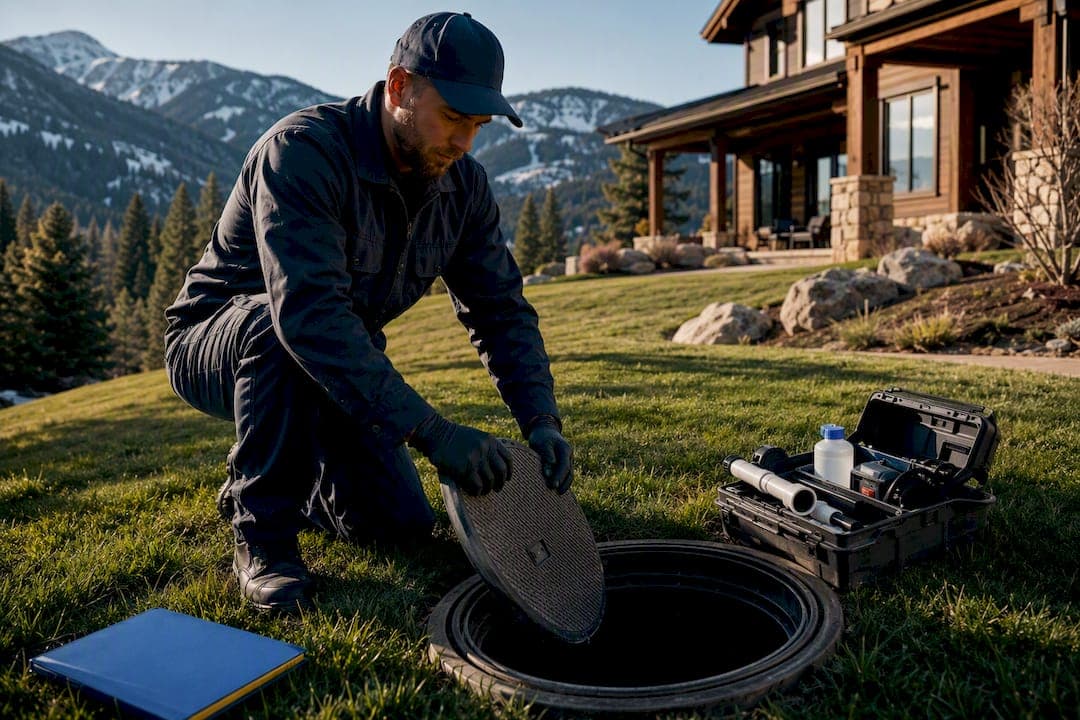
If you need septic work in Summit County, call a licensed OWTS contractor or schedule a Use Permit inspection through Summit County Environmental Health before you do anything else. For routine pumping or a point-of-sale inspection, Summit Septic - Silverthorne & Breckenridge and Summit Excavating are solid first calls, while Snowbridge Inc handles larger repairs and trenchless pipe work. If your tank hasn't been pumped in the last 12 months, schedule that first. Everything else, including permits and cost, follows from that one decision.
TL;DR:
- Routine septic pumping in Summit County typically costs a few hundred dollars, with larger or difficult-access tanks costing more.
- Soil testing ranges from $1,100 to $1,700, with P.E. stamped evaluations on the higher end, influencing permit approval speed.
- Full system replacements can vary greatly in price depending on site conditions, excavation needs, and permit review times.
- Confirming local experience and ensuring county notification procedures are followed are critical steps for hiring a trustworthy septic contractor.
- Scheduling soil evaluations and inspections promptly during listing or remodelling can prevent delays at closing and reduce costly retests.
Table of Contents
- Finding Summit County Septic Services You Can Trust
- How Does the OWTS Use Permit Process Work in Summit County?
- Septic Maintenance and Short-Term Rental Rules Owners Should Know
- How to Hire a Certified Septic Contractor in Summit County
- What Does Septic Work Cost in Summit County?
- A Local Realtor's Take on Septic Surprises at Closing
- Let a Local Realtor Coordinate Your Septic Timeline
- Where to Verify the Rules and the Providers
- Sources
Finding Summit County Septic Services You Can Trust
Summit County's septic environment is unforgiving. High elevation, granite soils, and short construction seasons mean a system installed carelessly, or serviced by someone unfamiliar with local ground conditions, fails faster and costs more to fix. Choosing an in-county provider who already knows the difference between Breckenridge clay and Silverthorne rock isn't a nicety. It's what keeps your permit application from bouncing back for a second round of testing.
The four providers below cover most of what Summit County homeowners actually need: pumping, inspections, soil testing, and full replacements.
| Provider | Google Rating | Core Services | Specialty | Service Area |
|---|---|---|---|---|
| Summit Septic - Silverthorne & Breckenridge | 5★ (14 reviews) | Pumping, OWTS Use Permit inspections, diagnostics, STR compliance | Exclusive Summit County OWTS and Use Permit focus | Silverthorne, Breckenridge, and surrounding Summit County |
| Snowbridge Inc | 4.9★ (175 reviews) | Septic installation, trenchless pipe lining, CCTV inspections, hydro excavation | Trenchless repairs and robotic pipe inspection | Summit County and broader Colorado wastewater work |
| Summit Excavating | 3.8★ (56 reviews) | Soil evaluation, septic pumping, riser installation, repairs, full installs | Combined excavation and septic installation in local soils | Summit County |
| Land Systems West Waterfalls, Ponds and Septic | 4.3★ (12 reviews) | Perc testing, soil evaluation, P.E. stamped septic design | Published pricing for soil testing and stamped design | Summit County and nearby land contracting |
- Summit Septic - Silverthorne & Breckenridge is best for routine pumping, Use Permit inspections, and short-term rental compliance pumping, since it works almost exclusively within the county's OWTS system.
- Snowbridge Inc is best for complicated underground repairs, especially when a line needs trenchless lining instead of a full dig.
- Summit Excavating is best for site work and full installs that require heavy excavation alongside soil evaluation.
- Land Systems West is best for soil testing and design work, particularly when a project needs a P.E. stamped design for permitting.
How Does the OWTS Use Permit Process Work in Summit County?
Any property with an onsite wastewater system needs a Use Permit at the point of sale or during a major remodel, and that inspection must be done by a certified Use Permit inspector approved by the county. NAWT certification or its equivalent is the standard the county checks for.
The process runs in a fairly fixed order:
- Site evaluation and percolation testing. New systems and replacements require a percolation, or "perc," test to confirm the soil can absorb wastewater at a safe rate.
- Design submission. For new or replacement systems, a licensed designer prepares plans that meet county standards. Summit County Environmental Health reviews these before construction starts.
- 48-hour pre-backfill notice. Installers must notify the Health Department at least 48 hours before backfilling so a county official can inspect the open excavation.
- Final sign-off. Once the inspection clears, the county issues final approval and the system goes into service.
Pro Tip: Get your soil evaluation scheduled the same week you list a property or start remodel planning. Perc testing windows fill up fast during Summit County's short building season, and a delayed test can push a closing by weeks.
The county's 2026 OWTS regulation update added new design revision fees, including a $63 charge for changes made before permit issuance and $126 for changes made after. Getting your initial design right the first time now carries a real financial incentive.
Septic Maintenance and Short-Term Rental Rules Owners Should Know
Most conventional systems need pumping every three to five years, but occupancy changes that math fast. A full-time family home and a short-term rental that turns over every weekend put very different loads on a tank, and STR hosts often need pumping on a tighter schedule to stay compliant at license renewal.
Watch for these warning signs between scheduled pumpings:
- Slow drains in multiple fixtures at once, not just one sink
- Standing water or unusually lush grass over the drain field
- Sewage odor near the tank lid or in the yard after rain
- Gurgling sounds from toilets or a toilet that won't fully flush, a sign the tank may be at capacity
A pumping technician will typically check tank levels, look for scum and sludge buildup, and note any structural issues with the lid or risers during a routine visit.
Pro Tip: Keep every pumping receipt and inspection form in one folder, digital or paper. When you sell or refinance, a documented service history often speeds up the Use Permit inspection because the reviewer isn't starting from zero.
How to Hire a Certified Septic Contractor in Summit County
Before signing anything, confirm four things: the contractor's Colorado OWTS license, current insurance, NAWT or equivalent certification for Use Permit inspections, and actual experience working in Summit County soils specifically, not just Colorado in general.
- Ask for license and insurance documents up front. A contractor who hesitates to produce these isn't one to hire.
- Ask how they handle the county notification process. Any legitimate contractor should describe the 48-hour pre-backfill notice without prompting.
- Ask for local references or recent Summit County job addresses. Granite and clay soils behave differently than Front Range dirt, and experience here matters.
- Request a written scope of work before any digging starts. Verbal-only agreements are a red flag on a project this expensive.
Collect pumping receipts, inspection forms, permit numbers, and, where applicable, a P.E. stamped design before the job wraps up. Refusal to notify the county, no written scope, or no prior in-county jobs are all signs to walk away.
What Does Septic Work Cost in Summit County?
Routine pumping runs a few hundred dollars for most residential tanks, though exact pricing varies by provider and tank size. Soil testing and design work have more visible numbers: Land Systems West lists basic soil testing starting at $1,100, rising to $1,700 for a P.E. stamped evaluation, with design plans starting around $975 for DIY-style plans and $1,800 for a full P.E. stamped design.
Full system replacements cost considerably more once excavation, materials, and county review are factored in, and timelines depend heavily on how quickly the initial application is accepted.
- Pumping: a few hundred dollars for most homes, more for larger tanks or difficult access
- Soil testing: $1,100 to $1,700 depending on stamping requirements
- Design plans: $975 to $1,800 depending on complexity and stamping
- Full replacement: highly variable based on site conditions and system size
A complete, accurate design application on the first submission avoids the $63 and $126 revision fees the county introduced in its 2026 update, and it keeps your project off the resubmission queue during peak season.
A Local Realtor's Take on Septic Surprises at Closing
Septic issues are one of the most predictable ways a Summit County closing gets delayed, and they're almost entirely avoidable. Sellers who wait until a buyer's inspector flags a problem are negotiating from a weaker position and racing a calendar they don't control. Schedule your pump-and-inspect the same week you list, not after an offer comes in.
Buyers should ask for the Use Permit inspection history and the last several pumping receipts before waiving any contingency. If a seller can't produce them, treat that as a negotiating point, not a formality.
I've watched closings slip by weeks over a system nobody checked until the eleventh hour. It's one of the easiest problems in a real estate transaction to prevent, and one of the most expensive to ignore.
— Jayden Vermeer: Summit County Realtor
Let a Local Realtor Coordinate Your Septic Timeline
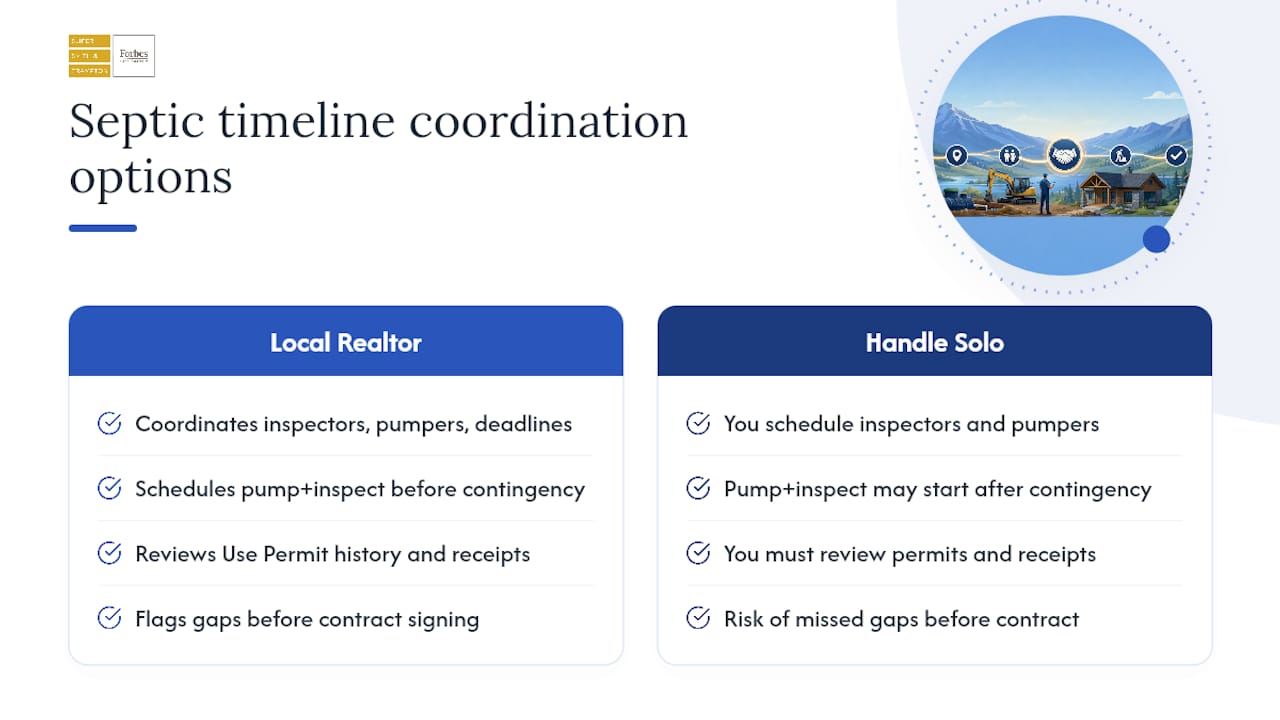
A local realtor provides sellers and buyers in Summit County support for managing a septic timeline, helping coordinate inspectors, pumpers, and closing deadlines to align with contract dates.

If you're selling, that means pump-and-inspect scheduling happens before a buyer's contingency clock starts ticking, not after. If you're buying, it means someone reviewing the seller's Use Permit history and pumping receipts on your behalf, flagging gaps before you're locked into a contract. This kind of coordination makes the most sense when you're managing a sale timeline alongside a full-time job, an out-of-state move, or a rental calendar. Handling it solo works fine if you have flexible time and patience for county paperwork; most sellers and buyers don't.
For homeowners tackling other maintenance during a septic project, coordinating interior access with a service like One Day Doors & Closets can keep unrelated repairs from stacking up on the same week.
Ready to get your Summit County sale or purchase moving without the septic guesswork? Visit Jayden Vermeer's Summit County listings to start the conversation about timing your closing around inspections, permits, and pumping schedules.
Where to Verify the Rules and the Providers
For official permitting steps, check the Summit County OWTS page and the Environmental Health permitting guide. For provider details, visit Snowbridge Inc and Land Systems West directly.
Sources
- Onsite Wastewater Treatment Systems (OWTS) — Summit County official site
- Permitting new septic system — Summit County Environmental Health
- Summit Septic — pumping & inspections (Summit County)
- Snowbridge Inc — wastewater and underground pipe solutions
- Land Systems West — septic soil testing & design