

HOA fees are recurring dues homeowners pay to fund the shared costs of a community, from landscaping and snow removal to insurance and long-term repairs. They're typically billed monthly or quarterly, and lenders count them against your income the same way they count a car payment, which means understanding HOA fees is essential before you fall in love with a Summit County condo you can't actually afford.
TL;DR:
- HOA fees in mountain resort communities like Summit County are often higher than the national average due to amenities, seasonal snow removal, and remote service costs.
- Most dues fund common-area maintenance, insurance, amenities, management, shared utilities, and reserve contributions, but do not cover interior unit repairs or personal insurance.
- HOA fees are calculated based on the community’s annual budget using methods like equal shares, proportional interests, or unit size, directly impacting ownership costs.
- Underfunded reserves increase the likelihood of special assessments, which can significantly raise costs unexpectedly, especially in regions with high seasonal expenses.
- Buyers should review the HOA’s budget, reserve study, and meeting minutes before purchasing, as these documents reveal future expense risks and help determine true affordability.
Table of Contents
- What Do HOA Fees Actually Pay For?
- How Boards Calculate Your Monthly HOA Fee
- Typical HOA Costs and What Drives Them Higher
- Special Assessments, Fee Increases, and What Happens if You Don't Pay
- Checklist: Evaluating an HOA's Financial Health Before You Buy
- Factoring HOA Fees Into Your Mortgage and Budget
- Local Reminders for Summit County, Colorado Buyers
- HOA Fees Across Condos, Townhomes, and Single-Family Homes
- Local Help: Review HOA Documents Before You Buy
- Primary Sources and Guides
- Sources
- FAQ
What Do HOA Fees Actually Pay For?
Every HOA budget breaks down into a handful of predictable categories, and knowing them helps you evaluate whether a fee is fair or a warning sign. Most dues cover:
- Common-area maintenance: landscaping, snow plowing, parking lot repairs, trash removal
- Master insurance: covers the building structure and shared liability, separate from your own policy
- Amenities: pools, hot tubs, fitness rooms, ski lockers, and clubhouse upkeep
- Management fees: paying a professional management company or a self-managed board's administrative costs
- Shared utilities: water, sewer, or electricity for common hallways, lobbies, and exterior lighting
- Reserve contributions: savings set aside for roof replacement, repaving, and other big-ticket future repairs
What dues usually don't cover matters just as much. Your unit's interior, personal appliance repairs, and your own HO-6 condo insurance policy are on you, not the association. Comparing two properties with wildly different fees often comes down to which one bundles more into the dues and which one leaves more for you to cover separately.
How Boards Calculate Your Monthly HOA Fee
Every HOA fee traces back to one number: the total annual budget. Boards add up projected operating costs, layer in reserve contributions, then divide that total across owners using a method spelled out in the community's CC&Rs (covenants, conditions, and restrictions).
Four allocation methods show up most often:
- Equal share: every unit pays the same amount, common in townhome communities with similar-sized units
- Percentage or allocated interest: larger or more valuable units pay a proportionally bigger share
- Square footage: fees scale directly with unit size
- Hybrid: a base fee for everyone plus a variable component tied to size or usage
Here's a simplified worked example. Say a 40-unit condo building adopts an annual budget of $312,000, covering operations and reserve funding combined.
| Step | Calculation | Result |
|---|---|---|
| Annual budget | Operating + reserve costs | $312,000 |
| Per-unit annual share | $312,000 ÷ 40 units | $312,000 ÷ 40 units |
| Monthly fee (equal share) | $312,000 ÷ 40 units ÷ 12 months | $650/month |
This is a hypothetical example for illustration only; your actual dues depend entirely on your community's adopted budget and allocation formula. If your building uses allocated interest instead of equal share, a larger penthouse unit will pay more than a smaller studio, even though both split the same total budget.
Typical HOA Costs and What Drives Them Higher
The national average HOA fee sat at $191 per month in 2021, according to the U.S. Census Bureau, with most properties nationwide falling somewhere between $100 and $1,000 monthly and a common range clustering around $200 to $300.
By the numbers: The Census Bureau's 2021 housing survey put average monthly HOA dues at $191, though mountain resort communities with heavy amenity packages routinely land well above that figure.
Several factors push fees above the national average. Amenity-heavy buildings with pools, gyms, and ski storage cost more to maintain than a bare-bones townhome complex. Local labor and insurance costs matter too, and in a resort market like Summit County, seasonal snow removal and heated walkways add real expense that flatter climates never face. Reserve funding policy plays a role as well: a board that fully funds its reserves will charge more today to avoid a painful special assessment tomorrow. Vendor contracts and geographic isolation, common in mountain towns where suppliers charge a premium to service remote properties, round out the list.
Special Assessments, Fee Increases, and What Happens if You Don't Pay
A special assessment is a one-time charge boards levy when the regular budget and reserves can't cover an unexpected or major expense, like a roof replacement or a failed elevator. Boards calculate the assessment by dividing the shortfall using the same allocation formula as regular dues, then often offer a lump-sum or installment payment option.

Regular fee increases typically require board approval and sometimes owner notice periods defined in the CC&Rs, but assessments can arrive with far less warning when an emergency repair can't wait.
Nonpayment carries real consequences, and they escalate quickly:
- Late fees and interest charges added to the overdue balance
- A lien placed against the property, which can complicate a future sale or refinance
- In some states, foreclosure proceedings initiated over unpaid dues, though exact remedies depend on your state's law and the community's governing documents
The single best defense against surprise assessments is a healthy reserve fund. Associations with underfunded reserves are far more likely to hit owners with emergency assessments than those that fund reserves adequately year over year.
Checklist: Evaluating an HOA's Financial Health Before You Buy
Before you write an offer on any property with an HOA, request a specific set of documents and read them closely.
- The current adopted annual budget, so you can see where dues actually go
- The most recent reserve study, which projects future capital needs and funding levels
- Board meeting minutes from the last 12 to 24 months, which often reveal upcoming capital projects or brewing disputes
- The delinquency rate among owners and the association's collection policy
Any of those signals higher fees, an assessment, or both within the next year or two.
Pro Tip: Ask the property manager directly whether a reserve study has been completed in the last three to five years. No reserve study at all is a bigger red flag than a study showing a modest funding gap, because it means the board is guessing at future costs rather than planning for them.
Factoring HOA Fees Into Your Mortgage and Budget
Lenders add your monthly HOA fee directly into your debt-to-income ratio, treating it as a recurring obligation just like a car loan or student loan payment. A $600 monthly HOA fee reduces your borrowing power the same way a $600 auto payment would, so a higher fee can shrink the mortgage amount you qualify for even if your income stays the same.
Here's how to build HOA costs into your affordability math:
- Add your estimated mortgage payment, property taxes, and homeowner's insurance together
- Add the property's current monthly HOA fee on top
- Compare that combined total against your gross monthly income using your lender's target debt-to-income threshold
As a labeled hypothetical: a buyer with a $2,200 mortgage payment, $250 in taxes and insurance, and a $400 HOA fee is budgeting $2,850 total housing costs, not $2,450, once dues are factored in.
Summit County adds a few local wrinkles worth confirming before you close. Winter maintenance lines (snowplowing, roof snow removal, ice management) run higher here than in flatter markets, and if you're eyeing a unit for short-term rental income, local short-term rental regulations can affect both your revenue projections and, in some HOAs, your dues if the association charges rental-specific fees. Bring the HOA budget, reserve study, and CC&Rs to your lender and your agent at preapproval, not just at closing.
Local Reminders for Summit County, Colorado Buyers
Mountain HOAs carry their own rhythm. Confirm the reserve study covers seasonal-specific line items like roof snow load management and heated driveway systems, since these show up far less in flatland communities. Short-term rental rules are governed separately by each town, not by the HOA alone, so verify Summit County or municipal ordinances in addition to reading the association's own rental restrictions before you count on rental income.
A few starting points as you search:
- Keystone, CO condos for sale
- Breckenridge, Colorado condos for sale
- Frisco, Colorado community page
- Dillon, Colorado community page
HOA Fees Across Condos, Townhomes, and Single-Family Homes
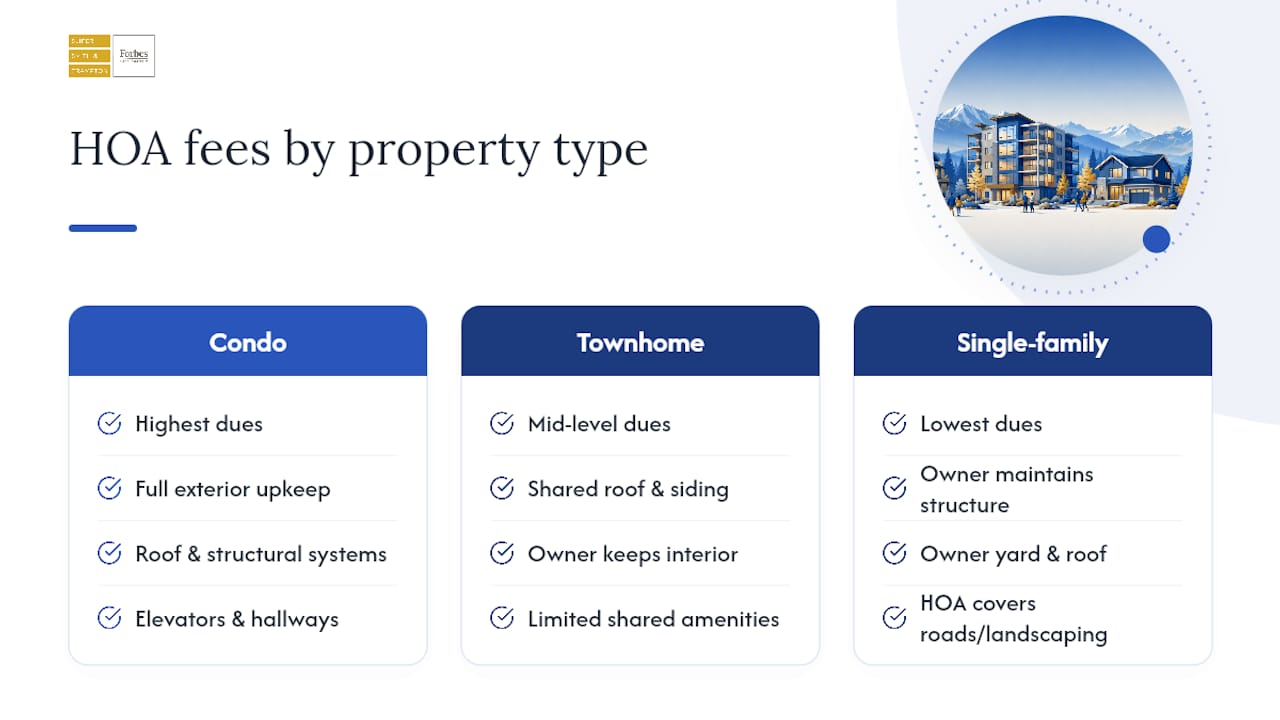
Property type has a direct, predictable effect on your HOA fee, and it's worth understanding before you compare listings across categories. Condos generally carry the highest dues because the association maintains the most: the roof, exterior walls, elevators, hallways, and often the building's structural systems. In a mountain condo building with a pool, hot tub, and ski storage, that maintenance load pushes fees higher still.
Townhomes typically sit in the middle. Owners usually own the interior and sometimes small exterior elements like a patio or garage, while the HOA handles shared roofs, siding, and common grounds. Fees run lower than condos because there's less shared square footage per unit and often fewer amenities to maintain.
Single-family homes within an HOA (common in planned communities and some mountain neighborhoods) tend to carry the lowest dues, since owners maintain their own structure, roof, and yard entirely. The HOA in these communities usually covers only shared amenities, entrance landscaping, or private roads, a much smaller scope than a condo association manages.
The practical takeaway: don't compare a condo's HOA fee against a single-family home's fee and conclude one community is more expensive to live in overall. Compare what each fee actually covers, then add back whatever costs you'd otherwise pay out of pocket, like your own roof reserve or landscaping, to get a true apples-to-apples number.
Local Help: Review HOA Documents Before You Buy
One of the most overlooked steps in a mountain condo purchase is a careful read of the HOA's budget and reserve study before you're locked into a contract deadline.

A fee that looks high on paper sometimes reflects a well-funded reserve and a building that won't hit you with a surprise assessment next winter, while a low fee can mean the opposite. A real estate professional can pull the adopted budget, reserve study, and recent board minutes for a property you're considering and walk through what the numbers actually mean for your monthly costs and your offer strategy. If you're weighing a purchase anywhere in Summit County, and want a second set of eyes on an HOA's finances before you go under contract, reach out through the contact page to get started.
Primary Sources and Guides
For readers who want to dig into the primary documentation: the U.S. Census housing characteristics report for national fee averages, KindHOA's budget calculation guide for dues math, and Nolo's overview of HOA assessments for collection law basics. Buyers handling contracts and wire transfers during closing should also review this real estate wire fraud prevention guide.
Sources
- How to calculate HOA dues from a budget — KindHOA
- How are HOA fees calculated and what factors affect them? — The HOA Handbook
- What do HOA fees cover? — The HOA Guide
- What are HOA assessments? — Nolo
FAQ
What is the average yearly HOA fee?
The U.S. Census Bureau's 2021 data put average monthly HOA dues at $191, though many communities charge more or less depending on amenities and location.
What is the downside of having an HOA?
The main downsides are recurring cost, less control over exterior changes, and exposure to special assessments if the association's reserves run low, on top of the monthly dues you already pay.
Can I refuse to join the HOA?
No. If a property is part of a mandatory HOA, membership and dues are tied to ownership itself and spelled out in the deed, so buying the home means agreeing to join and pay.
What is the average HOA fee in Michigan?
State-by-state HOA fee averages aren't reliably tracked in public Census data, so the most accurate approach is comparing recent local listings or asking a local agent for current dues in the specific community you're considering, whether that's in Michigan or here in Summit County.